



Build Your Custom Market Intelligence Report
Customize Your ReportGlobal Micro Mobility Data Analytics Market Overview
The Global Micro Mobility Data Analytics Market comprises software platforms, analytical tools, and professional services used to collect, process, interpret, and optimize data generated by shared bicycles, electric scooters, e-bikes, and other lightweight mobility services. These solutions help operators, city governments, transit agencies, and mobility service providers understand fleet utilization, rider behavior, trip patterns, vehicle availability, demand distribution, and operational performance. Data analytics is becoming increasingly important as shared micromobility systems expand across urban transportation networks and become more integrated with public transit and smart city infrastructure.
Micro mobility data analytics platforms combine information from GPS devices, Internet of Things (IoT) sensors, mobile applications, payment systems, vehicle telematics, and operational management software. The resulting datasets support descriptive analytics, predictive analytics, and prescriptive analytics. Descriptive analytics provides historical and real-time performance information, predictive analytics estimates future demand and vehicle requirements, while prescriptive analytics supports decisions related to fleet deployment, rebalancing, pricing, charging, maintenance, and route optimization.
Global Micro Mobility Data Analytics Market Key Highlights
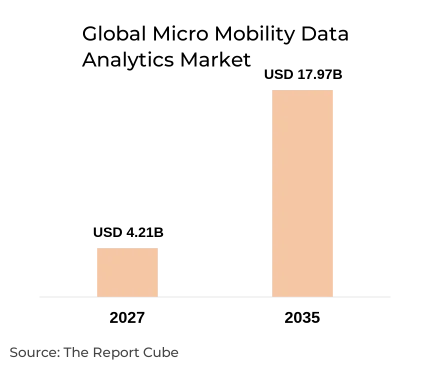
- The Global Micro Mobility Data Analytics Market is estimated at USD 4.21 billion in 2027 and is projected to reach USD 17.97 billion by 2035, based on the supplied market estimates.
- The market is expected to expand at a CAGR of approximately 19.89% during 2027–2035.
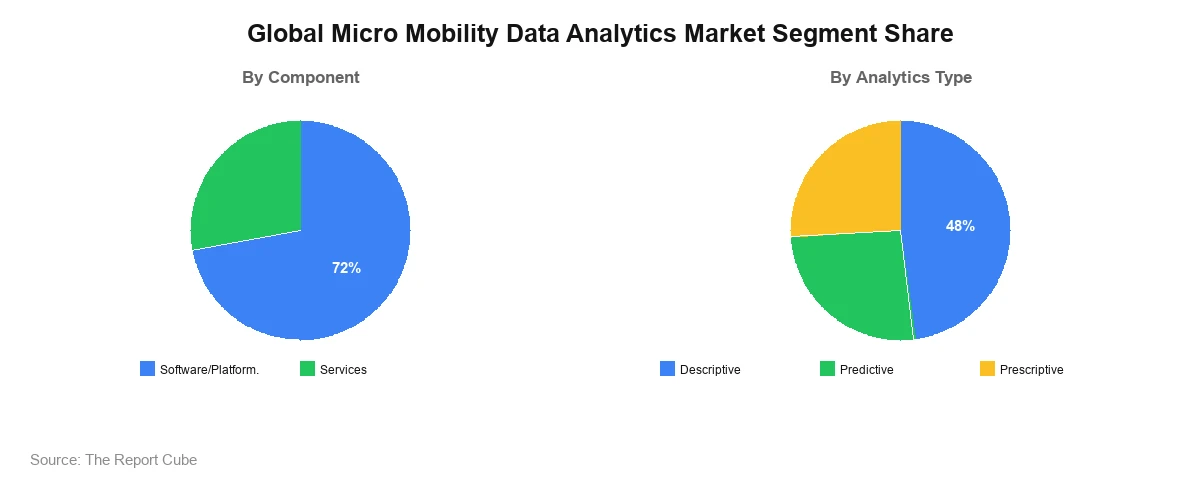
- Software/Platform is estimated to lead the component segment with an approximate 72% share in 2026, reflecting the importance of fleet management, data processing, reporting, and analytics applications.
- Descriptive Analytics is estimated to account for approximately 48% of the analytics type segment in 2026, supported by demand for operational reporting, historical performance analysis, and real-time fleet monitoring.
- Fleet management, route optimization, demand forecasting, and rider behavior analysis are important applications of micro mobility data analytics.
- Micro Mobility Operators represent a major potential user group because analytics supports fleet utilization, vehicle deployment, maintenance, pricing, and service performance.
- Cloud-based deployment is relevant to operators managing geographically distributed fleets and requiring access to centralized data, dashboards, and operational systems.
- Joyride Technologies, Movatic Inc., TIER-Dott, Lime, Bird, Bolt, Moovit, and other supplied companies participate in the mobility analytics ecosystem through software platforms, operational data, or transportation intelligence capabilities.
Global Micro Mobility Data Analytics Market Outlook
The Global Micro Mobility Data Analytics Market is expected to experience strong growth during the forecast period, supported by the expansion of shared e-scooter, e-bike, and bicycle services across urban transportation networks. Increasing fleet sizes and trip volumes generate substantial operational data that operators and city authorities can use to improve vehicle deployment, fleet availability, rider experience, and infrastructure planning. As shared mobility services become more integrated with public transit systems, the requirement for analytical tools that combine vehicle, trip, location, and transportation data is expected to increase.
Software and analytics platforms are expected to remain important components of the market because operators require centralized systems to monitor vehicle locations, track utilization, manage battery conditions, evaluate trip activity, and optimize fleet operations. Cloud-based platforms can provide centralized data access across multiple cities and operating zones, while integration with GPS, IoT devices, payment applications, and mobility data standards can improve operational visibility. Specialized providers offering analytics dashboards, fleet management systems, and predictive capabilities may benefit from increasing software adoption.
Data-sharing requirements and smart city initiatives are also influencing the market's development. The Mobility Data Specification (MDS), developed by the Open Mobility Foundation, provides standardized interfaces for data exchange between mobility providers and public agencies. Such frameworks support city-level management of shared mobility services and enable transportation authorities to assess fleet activity, parking compliance, and public-space usage. Based on the supplied market estimates, the global market is projected to increase from USD 4.21 billion in 2027 to USD 17.97 billion in 2035, registering a CAGR of 19.89%. These figures are retained as working estimates and have not been independently validated as published market statistics.
Government Regulations
Micro mobility data analytics providers and shared mobility operators must consider regulations and standards governing personal data protection, connected devices, transportation data sharing, digital services, and public-space management. In the European Union, the General Data Protection Regulation (GDPR) establishes requirements for collecting, processing, storing, and managing personal data, including information that can identify or track individuals. The EU Data Act, applicable from September 12, 2025, establishes rules concerning access to and use of data generated by connected products and related services, including relevant interoperability and data-sharing provisions.
In shared micromobility, the Open Mobility Foundation's Mobility Data Specification (MDS) provides standardized APIs for communication between mobility operators and public agencies, supporting fleet regulation, digital policy implementation, and vehicle management. The General Bikeshare Feed Specification (GBFS) provides a complementary standard for publicly disseminating real-time vehicle availability information. These standards are not substitutes for privacy laws; operators must assess the legal basis, data minimization, security, retention, and disclosure requirements applicable to each market and data use case.
Global Micro Mobility Data Analytics Market Dynamics
The Global Micro Mobility Data Analytics Market is influenced by the expansion of shared mobility fleets, increasing availability of vehicle and trip data, and the need for efficient fleet utilization across urban transportation networks. Analytics platforms help operators understand demand patterns, monitor rider behavior, improve vehicle deployment, and manage maintenance activities. At the same time, data privacy requirements, interoperability challenges, fragmented technology environments, and implementation costs influence adoption. The following factors summarize the major forces shaping market development.
| Factor | Type | Specific Impact on Market | Magnitude |
|---|---|---|---|
| Expansion of shared micromobility services | Growth Driver | Increasing deployment of shared e-scooters, e-bikes, and bicycles generates larger volumes of vehicle, location, trip, and rider data, creating demand for analytics platforms and fleet management systems. | High |
| Growing requirement for fleet utilization and operational optimization | Growth Driver | Operators use analytics to improve vehicle availability, predict maintenance requirements, optimize charging and rebalancing, and reduce operational inefficiencies across distributed fleets. | High |
| Predictive and prescriptive analytics adoption | Market Opportunity | Predictive demand forecasting, maintenance analytics, dynamic deployment, and automated operational recommendations create opportunities for advanced analytics software and integrated mobility intelligence solutions. | High |
| Smart city and public-sector mobility data integration | Market Opportunity | Standardized data exchange and integration with city transportation systems create opportunities for analytics providers serving public agencies, transit authorities, and urban mobility planners. | Medium to High |
| Data privacy, cybersecurity, and regulatory compliance | Industry Challenge | Platforms processing location, trip, payment, and rider-related data must address privacy, security, access control, data retention, and cross-border data requirements, increasing compliance complexity. | High |
| Data fragmentation and integration complexity | Industry Challenge | Different vehicle manufacturers, IoT systems, fleet platforms, payment applications, and city reporting requirements can create inconsistent datasets and integration costs for analytics providers. | Medium to High |
Growth Drivers: Expansion of Shared Micromobility Services
The expansion of shared bicycles, e-scooters, and e-bike services is increasing the amount of operational data generated across urban transportation networks. Every vehicle movement, rental transaction, parking event, battery change, and completed trip can generate information that operators use to evaluate service performance. According to NABSA's 2025 Shared Micromobility State of the Industry Report, at least 237 million shared micromobility trips were recorded across North America in 2025, with approximately 350,000 shared vehicles deployed across 403 cities and communities. Increasing trip activity and fleet deployment create demand for analytical platforms that can process large datasets, monitor vehicle utilization, identify demand patterns, and support fleet management decisions.
Need Specific Data, Let’s Customize the Report for You
Request CustomizationMarket Opportunities: Adoption of Predictive and Prescriptive Analytics
Predictive and prescriptive analytics provide opportunities for software providers to deliver more advanced mobility intelligence capabilities. Predictive models can estimate vehicle demand by location, time, weather conditions, events, and historical trip patterns. Predictive maintenance can use vehicle telemetry and battery information to identify potential failures and schedule servicing before vehicles become unavailable. Prescriptive analytics can recommend where vehicles should be deployed, when batteries should be replaced or charged, and how operators should rebalance fleets. Companies with access to high-quality trip and vehicle datasets can develop more sophisticated analytical capabilities and differentiate their platforms through automation and decision support.
Industry Challenges: Data Privacy, Cybersecurity, and Regulatory Compliance
Micro mobility analytics platforms may process location information, trip histories, payment records, user accounts, and other operational datasets. The collection and processing of such information create responsibilities related to data security, user privacy, consent, access controls, retention, and regulatory compliance. Operators serving European markets must consider GDPR requirements, while connected vehicle and device data may also fall within relevant provisions of the EU Data Act. Security incidents, unauthorized access, and inappropriate disclosure of sensitive mobility information can damage customer trust and increase regulatory exposure. Analytics providers must therefore incorporate privacy-aware data processing, secure infrastructure, appropriate governance, and controlled data-sharing mechanisms into their platforms.
Market Trends: Increasing Integration of Real-Time Fleet Analytics
Real-time fleet analytics is becoming an important capability for shared micromobility operators. Platforms increasingly combine GPS tracking, IoT connectivity, vehicle telemetry, battery information, and trip activity to provide continuous visibility into fleet performance. Operators can monitor vehicle availability, idle time, location, usage, and maintenance conditions through centralized dashboards. Joyride's platform, for example, provides real-time tracking, rider insights, reporting, and fleet analytics. The integration of real-time data with operational management systems enables faster responses to vehicle shortages, maintenance requirements, parking issues, and changing demand conditions.
Global Micro Mobility Data Analytics Market Segment Analysis
The Global Micro Mobility Data Analytics Market is segmented by component, analytics type, application, end-user, deployment mode, and region. Component segmentation distinguishes software and analytics platforms from related services, while analytics type covers descriptive, predictive, and prescriptive capabilities. Application segmentation includes fleet management, route optimization, demand forecasting, and rider behavior analysis. End-user segmentation covers micro mobility operators, city governments and smart cities, and transit agencies. Deployment mode distinguishes cloud-based and on-premises solutions, while regional analysis evaluates market conditions across North America, Europe, Asia-Pacific, and Rest of World.
By Component
- Software/Platform
- Services
Software/Platform is estimated to lead the Global Micro Mobility Data Analytics Market with an approximate 72% share in 2026. Software platforms provide the core environment for collecting, processing, visualizing, and analyzing vehicle, trip, rider, and fleet performance data. These solutions can include fleet management dashboards, real-time tracking, analytics reporting, demand forecasting, and integration with IoT and payment systems. Dedicated mobility software platforms can help operators monitor distributed fleets and manage operational activities through centralized systems. The 72% share is an analyst estimate; no publicly disclosed global component revenue split matching this segmentation was identified.
By Analytics Type
- Descriptive
- Predictive
- Prescriptive
Descriptive Analytics is estimated to lead the analytics type segment with an approximate 48% share in 2026. Descriptive analytics helps operators understand historical and current fleet performance through dashboards, trip reports, vehicle utilization metrics, rider activity, and operational indicators. These capabilities provide the foundational information required for monitoring service performance and identifying operational issues. Predictive analytics builds on historical information to estimate future demand and maintenance requirements, while prescriptive analytics recommends operational actions such as fleet rebalancing and vehicle deployment. The 48% share is an analyst estimate; no publicly disclosed global analytics-type revenue split matching this segmentation was identified.
Global Micro Mobility Data Analytics Market Regional Analysis
Regional demand for micro mobility data analytics is influenced by shared vehicle deployment, urban population density, digital transportation infrastructure, smart city initiatives, and the integration of micromobility with public transportation. North America has an established shared mobility ecosystem and extensive industry reporting through organizations such as NABSA. Europe benefits from major shared mobility operators, data-sharing initiatives, and regulatory frameworks for digital information. Asia-Pacific is supported by urban transportation demand and the expansion of shared electric mobility services, while Rest of World includes emerging markets where infrastructure development and technology adoption are shaping the growth of shared mobility services.
| Region | Key Growth Factors | Industry Trends |
|---|---|---|
| North America | Established shared bicycle and e-scooter systems, increasing trip volumes, smart city programs, digital transportation infrastructure, and demand for fleet optimization. | Growing use of fleet performance dashboards, vehicle utilization analytics, demand forecasting, standardized mobility data exchange, and public-sector mobility reporting. |
| Europe | Presence of major shared mobility operators, urban transportation digitization, multimodal mobility development, and data governance initiatives. | Increasing focus on data interoperability, privacy compliance, predictive fleet management, mobility-as-a-service integration, and public-sector data sharing. |
| Asia-Pacific | Urbanization, demand for affordable first- and last-mile transportation, expansion of shared electric two-wheelers, and growing smart city investments. | Increasing adoption of mobile-based mobility platforms, IoT-enabled fleet monitoring, digital payments, and demand analytics for high-density urban markets. |
| Rest of World | Emerging shared mobility services, urban transportation modernization, smart city investment, and expansion of digital mobility infrastructure across Latin America, the Middle East, and Africa. | Gradual adoption of cloud-based fleet management, GPS tracking, mobile applications, and analytics systems as shared mobility operations expand. |
Global Micro Mobility Data Analytics Market Competitive Landscape
The competitive landscape of the Global Micro Mobility Data Analytics Market includes dedicated mobility software vendors, shared micromobility operators, fleet management technology providers, and transportation data platforms. Joyride Technologies is directly positioned in the software and analytics segment through its fleet management dashboard, real-time tracking, reporting, and analytics features. Movatic provides shared mobility management software, while Moovit offers transportation applications and mobility data capabilities. Companies such as Lime, Bird, TIER-Dott, Bolt, and micromobility.com operate mobility services and generate substantial operational datasets that support fleet deployment, demand management, pricing, and rider experience. Their inclusion reflects participation in the broader analytics ecosystem rather than proof that each company sells standalone analytics software.
| Company | Competitive Strength | Primary Segment Served |
|---|---|---|
| Joyride Technologies | Provides a dedicated micromobility software platform with fleet management dashboards, real-time vehicle tracking, rider insights, reporting, analytics, IoT integration, and operational tools. | Software/Platform, Fleet Management, Analytics, and Services. |
| Movatic Inc. | Provides shared mobility management software and digital tools for operating bicycle, scooter, and other rental mobility programs. Its position is primarily as a mobility software and platform provider. | Software/Platform, Fleet Management, and Shared Mobility Operations. |
| TIER-Dott | Operates a large shared micromobility business formed through the merger of TIER and Dott in 2024. Its operating scale generates vehicle, trip, location, and fleet performance data for internal operational and service management. | Micro Mobility Operators, Fleet Management, and Operational Analytics Users. |
| Lime (Neutron Holdings, Inc.) | Operates shared electric scooters and bikes across international markets. Its large-scale operations generate trip, vehicle utilization, rider, and location data that support fleet deployment and service optimization. | Micro Mobility Operators, Fleet Management, and Demand Analytics Users. |
| Bird (Third Lane Mobility Inc.) | Operates shared electric mobility services and has used technology and operational data to manage vehicle deployment, utilization, and maintenance. The company's ownership and corporate structure should be described according to the relevant current legal entity and transaction disclosures. | Micro Mobility Operators, Fleet Management, and Operational Analytics Users. |
| Superpedestrian, Inc. (SURF Beyond Group) | Superpedestrian developed connected electric mobility vehicles and associated fleet technology. The supplied SURF Beyond Group association requires current legal-entity and asset-ownership verification before being presented as a confirmed current corporate relationship. | Connected Mobility Technology, Fleet Data, and Vehicle Analytics. |
| Ridepanda | Included in the supplied competitive set as a micromobility technology and service participant. Its precise current product portfolio and standalone analytics capabilities require further verification. | Micromobility Services and Technology; dedicated analytics positioning requires verification. |
- Joyride Technologies: Joyride Technologies is a dedicated software provider serving shared micromobility and lightweight electric vehicle operators. Its platform combines branded rider applications, fleet management dashboards, operational tools, GPS tracking, and analytics capabilities. Its published product information identifies real-time vehicle tracking, rider insights, fleet utilization, vehicle health, battery information, charging, maintenance, and reporting features. The platform also supports integrations with mobility-related systems and connected vehicle hardware. Joyride's dedicated software and analytics capabilities make it one of the more directly relevant participants in the micro mobility data analytics market. Its software offering is designed to support operators managing e-scooters, e-bikes, bicycles, mopeds, and other lightweight vehicles.
- Bolt Technology OÜ: Bolt is a shared mobility and transportation technology operator with micromobility services across multiple markets. Its operational activities involve data-driven decisions concerning scooter deployment, battery swapping, pricing, fleet utilization, and parking compliance. Bolt's published recruitment information for a Senior Data Scientist in Micromobility describes machine learning systems supporting vehicle deployment, battery swap planning, pricing, and computer vision for parking compliance. This demonstrates the importance of analytics within its operating model. Bolt should be classified primarily as a mobility operator and analytics user rather than a standalone third-party analytics software vendor.
Recent Developments and Updates
- August 2026 – NABSA's 2025 Shared Micromobility State of the Industry Report: The North American Bikeshare and Scootershare Association released its 2025 industry report on August 6, 2026. It reported at least 237 million shared micromobility trips across North America in 2025, representing a 5% increase over 2024. Approximately 350,000 shared vehicles operated across at least 403 cities and communities. These figures demonstrate the growing volume of mobility activity and the increasing requirement for fleet reporting, operational analytics, and demand measurement.
- 2026 – Increasing use of data science in micromobility operations: Bolt's published Senior Data Scientist, Micromobility role identifies machine learning applications in scooter deployment, battery swap planning, pricing, fleet utilization, and parking compliance. This demonstrates the growing role of predictive models and operational analytics within shared mobility businesses.
Global Micro Mobility Data Analytics Market Future Outlook
The Global Micro Mobility Data Analytics Market is expected to experience strong growth through 2035 as shared bicycles, e-scooters, and e-bikes become increasingly integrated into urban transportation systems. Expansion of shared mobility fleets is generating larger datasets related to vehicle locations, trip activity, rider preferences, battery performance, maintenance, and operational utilization. These datasets create opportunities for software providers offering fleet management, data visualization, demand forecasting, route optimization, and mobility intelligence solutions. The increasing use of shared mobility services by commuters and public transit users is expected to support demand for analytics applications that improve operational efficiency and transportation planning.
Future market development is likely to be influenced by the adoption of predictive and prescriptive analytics, integration with smart city systems, cloud-based deployment, and standardized mobility data exchange. Operators may increasingly use automated recommendations to improve fleet distribution, charging schedules, maintenance planning, pricing, and service availability. City authorities and transit agencies may also expand their use of shared mobility data for parking management, transportation planning, and first- and last-mile connectivity analysis. However, privacy compliance, cybersecurity, interoperability, data quality, and the financial sustainability of shared mobility operations will remain important considerations. Based on the supplied market estimates, the global market is projected to increase from USD 4.21 billion in 2027 to USD 17.97 billion in 2035, registering a CAGR of 19.89%.
Global Micro Mobility Data Analytics Market Report Coverage
The Global Micro Mobility Data Analytics Market Report provides an assessment of market size, growth outlook, component categories, analytics types, application areas, end-user industries, deployment models, regional trends, and competitive positioning. The report evaluates the role of software platforms, services, descriptive analytics, predictive analytics, and prescriptive analytics across fleet management, route optimization, demand forecasting, and rider behavior analysis. It also examines the influence of shared mobility expansion, smart city initiatives, standardized data exchange, privacy requirements, and technology integration on market development. The competitive assessment distinguishes dedicated mobility analytics and software providers from mobility operators and transportation data platforms.
| Parameter | Details |
|---|---|
| Market Name | Global Micro Mobility Data Analytics Market |
| Market Size (Base Year) | USD 4.21 billion |
| Market Size (Forecast Year) | USD 17.97 billion |
| CAGR | 19.89% (2027–2035) |
| Base Year | 2026 |
| Historical Period | 2022–2026 |
| Forecast Period | 2027–2035 |
| Geographic Scope | Global |
| Segmentation | By Component, By Analytics Type, By Application, By End-User, By Deployment Mode, and By Region |
| Regions Covered | North America, Europe, Asia-Pacific, and Rest of World |
| Key Companies | Joyride Technologies, Movatic Inc., TIER-Dott, Lime (Neutron Holdings, Inc.), Bird (Third Lane Mobility Inc.), Superpedestrian, Inc. (SURF Beyond Group), Ridepanda, Bolt Technology OÜ, Helbiz (micromobility.com, inc.), and Moovit Inc. (Intel Corporation) |
| Customization | Component analysis, analytics type assessment, application-level analysis, end-user evaluation, deployment mode assessment, regional analysis, competitive benchmarking, and customized research support |
Why Choose This Global Micro Mobility Data Analytics Market Report?
- Provides an overview of the global micro mobility data analytics industry, including market size estimates, growth outlook, and key demand factors.
- Examines component categories, including software/platform solutions and services.
- Evaluates descriptive, predictive, and prescriptive analytics capabilities used across shared mobility operations.
- Analyzes key applications, including fleet management, route optimization, demand forecasting, and rider behavior analysis.
- Assesses the adoption of analytics among micro mobility operators, city governments, smart cities, and transit agencies.
- Reviews cloud-based and on-premises deployment models and their relevance to different operating environments.
- Examines smart city initiatives, mobility data standards, data privacy requirements, and technology integration trends.
- Reviews the competitive landscape and distinguishes dedicated software providers from mobility operators and broader transportation data platforms.
- Identifies major growth drivers, market opportunities, industry challenges, and technology trends influencing the industry.
Table of Contents
- Introduction
- Objective of the Study
- Product Definition
- Market Segmentation
- Study Variables
- Research Methodology
- Secondary Data Points
- Companies Interviewed
- Primary Data Points
- Breakdown of Primary Interviews
- Secondary Data Points
- Executive Summary
- Market Dynamics
- Drivers
- Challenges
- Opportunity Assessment
- Recent Trends and Developments
- Policy and Regulatory Landscape
- Global Micro Mobility Data Analytics Market Overview and Forecast Analysis (2022-2035)
- Market Size, By Value, By Growth Rate (CAGR/USD Billions)
- Demand – Supply Trends
- Market Share, By Component
- Software/Platform
- Services
- Market Share, By Analytics Type
- Descriptive
- Predictive
- Prescriptive
- Market Share, By Application
- Fleet Management
- Route Optimization
- Demand Forecasting
- Rider Behavior Analysis
- Market Share, By End-User
- Micro Mobility Operators
- City Governments/Smart Cities
- Transit Agencies
- Market Share, By Deployment Mode
- Cloud-Based
- On-Premises
- Market Share, By Region
- North America
- Europe
- Asia-Pacific
- Rest of World
- Market Share, By Competitors
- Competition Characteristics
- Revenue Shares
- Software/Platform Global Micro Mobility Data Analytics Market Overview, 2022-2035F
- By Value (USD Million)
- By Analytics Type – Market Size & Forecast 2022-2035, USD Million
- Descriptive
- Predictive
- Prescriptive
- Services Global Micro Mobility Data Analytics Market Overview, 2022-2035F
- By Value (USD Million)
- By Analytics Type – Market Size & Forecast 2022-2035, USD Million
- Descriptive
- Predictive
- Prescriptive
- Competitive Outlook (Company Profile – Partial List)
- Joyride Technologies
- Company Overview
- Business Segments
- Strategic Alliances/Partnerships
- Recent Developments
- Movatic Inc.
- Company Overview
- Business Segments
- Strategic Alliances/Partnerships
- Recent Developments
- TIER-Dott
- Company Overview
- Business Segments
- Strategic Alliances/Partnerships
- Recent Developments
- Lime (Neutron Holdings
- Company Overview
- Business Segments
- Strategic Alliances/Partnerships
- Recent Developments
- Inc.)
- Company Overview
- Business Segments
- Strategic Alliances/Partnerships
- Recent Developments
- Bird (Third Lane Mobility Inc.)
- Company Overview
- Business Segments
- Strategic Alliances/Partnerships
- Recent Developments
- Superpedestrian
- Company Overview
- Business Segments
- Strategic Alliances/Partnerships
- Recent Developments
- Inc. (SURF Beyond Group)
- Company Overview
- Business Segments
- Strategic Alliances/Partnerships
- Recent Developments
- Ridepanda
- Company Overview
- Business Segments
- Strategic Alliances/Partnerships
- Recent Developments
- Bolt Technology OÜ
- Company Overview
- Business Segments
- Strategic Alliances/Partnerships
- Recent Developments
- Helbiz (micromobility.com
- Company Overview
- Business Segments
- Strategic Alliances/Partnerships
- Recent Developments
- inc.)
- Company Overview
- Business Segments
- Strategic Alliances/Partnerships
- Recent Developments
- Moovit Inc. (Intel Corporation)
- Company Overview
- Business Segments
- Strategic Alliances/Partnerships
- Recent Developments
- Joyride Technologies
- Contact Us & Disclaimer
Top Key Players & Market Share Outlook
- Joyride Technologies
- Movatic Inc
- TIER-Dott
- Lime (Neutron Holdings, Inc.)
- Bird (Third Lane Mobility Inc.)
- Superpedestrian
- Inc. (SURF Beyond Group)
- Ridepanda
- Bolt Technology OÜ
- Helbiz (micromobility.com, inc.)
- and Moovit Inc. (Intel Corporation)
Frequently Asked Questions