



Build Your Custom Market Intelligence Report
Customize Your ReportUnited States Hydrogen Energy Market Key Highlights
By Hydrogen Source:
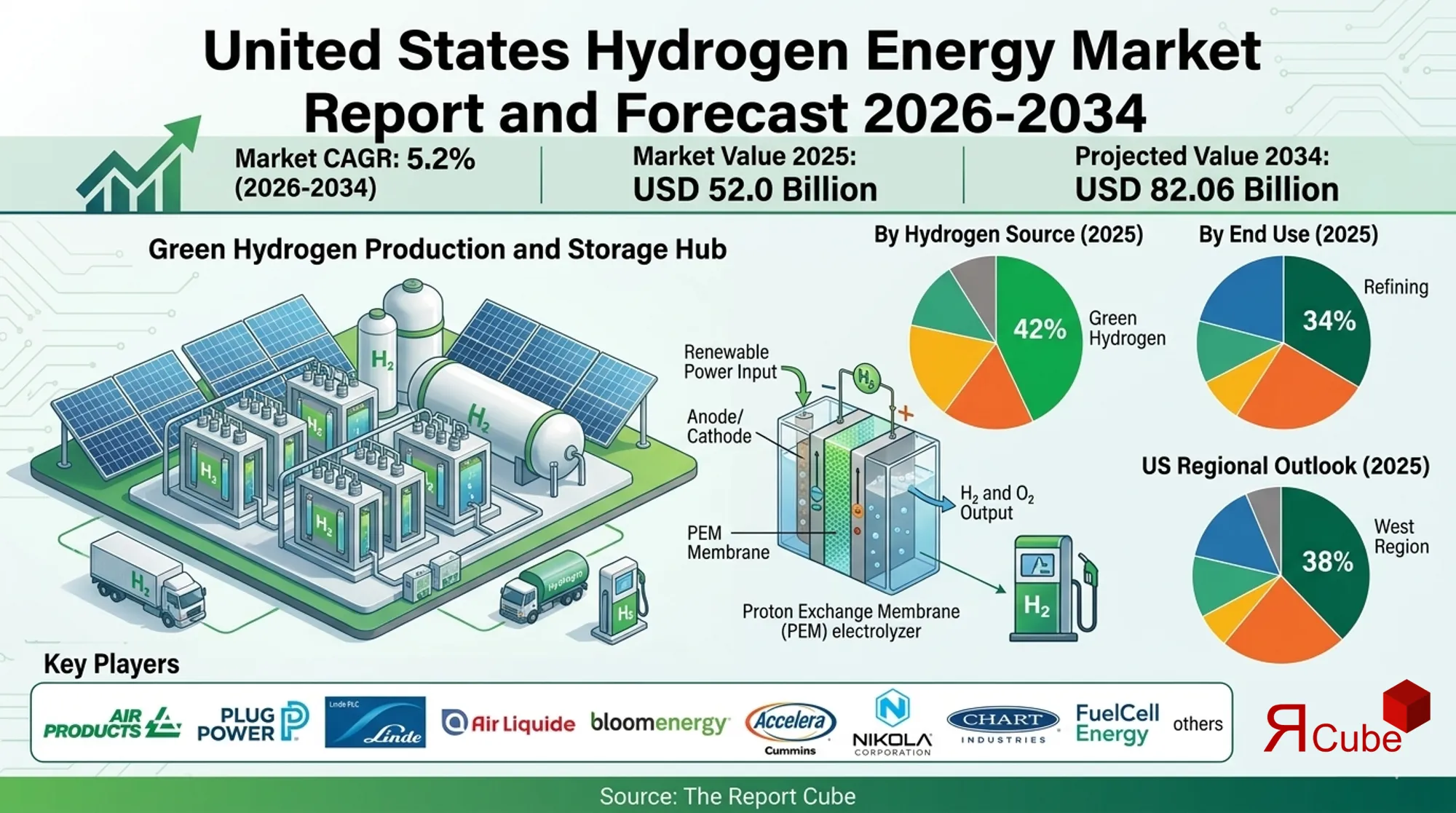
Green Hydrogen segment leads the market, with around 42% market share.
By End Use:
Refining segment dominates the market, accounting for nearly 34% of total revenue.
Regional Outlook:
West region dominates the US hydrogen energy market, with around 38% share.
United States Hydrogen Energy Market Insights & Analysis
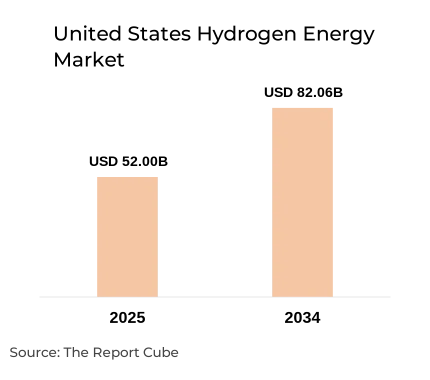
The United States Hydrogen Energy Market is anticipated to register a CAGR of 5.2% during 2026-2034. the market size was valued at USD 52.0 billion in 2025 and is projected to reach USD 82.06 billion by 2034. The market is steadily transitioning from conventional hydrogen production toward cleaner alternatives, supported by federal incentives and private sector investments. By 2025, over 10 million metric tons of hydrogen were consumed annually in the U.S., primarily in refining and ammonia production, forming a strong baseline demand for future low-carbon transition.
Investment momentum has accelerated significantly, with more than $9 billion committed to hydrogen projects under federal and private initiatives between 2023 and 2025. Large-scale hydrogen hubs across Texas, California, and the Midwest are creating integrated ecosystems that connect production, storage, and end-use applications. This shift is helping industries move toward decarbonization targets while maintaining operational efficiency.
United States Hydrogen Energy Market Dynamics
Key Driver: Strong Federal Incentives Accelerating Clean Hydrogen Adoption
The U.S. hydrogen energy market is largely driven by strong federal policy support and financial incentives aimed at reducing carbon emissions. Programs such as the 45V tax credit have significantly improved the economic viability of green hydrogen, reducing production costs by up to 40% in certain regions. In 2025, over 60% of new hydrogen projects announced in the U.S. were directly linked to federal funding programs, showing the strong alignment between policy and industry growth. Industries such as refining and chemicals are rapidly integrating hydrogen as a cleaner alternative to traditional fuels. This policy-driven momentum is further supported by state-level initiatives in California and Texas, where hydrogen infrastructure development is expanding rapidly.
Book your FREE 30-minute expert consultation today
Contact UsIndustry Trends: Rapid Expansion of Green Hydrogen and Electrolyzer Technologies
The market is witnessing a clear shift toward green hydrogen production, supported by falling renewable energy costs and technological advancements. Electrolyzer deployment capacity in the U.S. crossed 2 GW in 2025, with projections to exceed 10 GW by 2030. Companies are increasingly investing in modular and scalable hydrogen production systems to meet fluctuating demand. Integration with solar and wind power is becoming a common trend, particularly in western states.
Additionally, hydrogen is gaining traction in mobility applications, including heavy-duty trucks and public transportation, where fuel cells provide longer range and faster refueling compared to battery alternatives.
Major Challenge: High Infrastructure and Production Cost Barriers
One of the major challenges in the United States hydrogen energy market is the high capital cost associated with production, storage, and transportation infrastructure. Establishing hydrogen pipelines, liquefaction plants, and fueling stations requires significant upfront investment, often exceeding $1 million per mile for pipeline development. Additionally, green hydrogen production costs remain between $4 to $6 per kilogram in 2025, which is still higher than conventional gray hydrogen. These cost challenges limit widespread adoption, particularly in cost-sensitive industries. The lack of standardized infrastructure across regions further slows scalability and creates logistical inefficiencies.
Opportunity: Expansion of Hydrogen in Industrial Decarbonization and Mobility
The growing push toward net-zero emissions presents strong opportunities for hydrogen adoption across industrial sectors. Steel manufacturing, which contributes nearly 7% of global emissions, is exploring hydrogen-based reduction technologies to replace coal. In the U.S., pilot projects are already underway to integrate hydrogen into steel and cement production processes.
Mobility also offers strong growth potential, particularly in long-haul transportation and aviation. Hydrogen fuel cell vehicles are expected to grow at a CAGR of over 20% in the U.S. through 2030, supported by infrastructure expansion and government incentives. This expanding application scope positions hydrogen as a key enabler of clean energy transition.
United States Hydrogen Energy Market Segment-wise Analysis
By Hydrogen Source:
- Gray Hydrogen
- Blue Hydrogen
- Green Hydrogen
- Others
Green hydrogen leads the market with approximately 42% share in 2025, driven by increasing investments in renewable-powered electrolysis. The segment is gaining strong traction as industries seek carbon-neutral energy solutions. Over 70% of new hydrogen projects announced in 2025 were focused on green hydrogen production, particularly in regions with abundant renewable resources such as California and Texas. Falling solar and wind energy costs have reduced operational expenses, making green hydrogen more competitive.
Additionally, corporate sustainability commitments are pushing companies to adopt clean hydrogen solutions, further strengthening the segment's dominance.
By End Use:
- Refining
- Ammonia
- Methanol and Chemicals
- Steel and Metals
- Power Generation
- Mobility
- Buildings and Stationary Power
- Others
Refining dominates the market with nearly 34% share, as hydrogen is widely used in hydrocracking and desulfurization processes. In 2025, U.S. refineries consumed over 6 million metric tons of hydrogen annually, highlighting its critical role in fuel production. As environmental regulations tighten, refineries are transitioning toward low-carbon hydrogen sources to reduce emissions. This shift is driving investments in blue and green hydrogen integration within refinery operations. The segment continues to expand steadily due to consistent demand and regulatory compliance requirements.
Regional Projection of United States Hydrogen Energy Industry
- West
- East
- South
- Midwest
- Others
The West region leads the market with around 38% share, supported by strong renewable energy infrastructure and progressive state policies. California plays a major role, accounting for over 50% of hydrogen fueling stations in the U.S. by 2025. The region’s focus on zero-emission transportation and clean energy adoption has accelerated hydrogen deployment across mobility and power sectors. Additionally, large-scale green hydrogen projects are being developed in the West, leveraging solar and wind resources. This regional leadership is expected to continue as infrastructure investments and policy support remain strong.
Government Initiatives & Policies
- U.S. Inflation Reduction Act - Clean Hydrogen Production Tax Credit (45V): Provides up to $3/kg incentive for low-carbon hydrogen production to accelerate domestic hydrogen deployment. https://www.energy.gov
- U.S. DOE Hydrogen Hubs Program (Regional Clean Hydrogen Hubs): $7 billion initiative supporting large-scale hydrogen ecosystems across multiple U.S. regions. https://www.energy.gov/hydrogen
United States Hydrogen Energy Market Recent Developments
- 2025: Air Products advanced its Louisiana blue hydrogen and ammonia project, aligning production with long-term offtake agreements and leveraging federal tax credits to strengthen low-carbon supply chains across domestic and export markets.
- 2025: Plug Power secured up to $1.66 billion in U.S. DOE funding to expand green hydrogen plants, aiming to significantly reduce lifecycle emissions and supply large-scale industrial customers nationwide.
- 2025: Air Liquide invested $50 million to expand its Gulf Coast hydrogen pipeline network, enhancing storage and distribution capacity to support refinery and chemical sector demand growth.
- 2025: Bloom Energy accelerated hydrogen deployment through strategic partnerships and fuel-cell integration in data centers, using long-term contracts to finance electrolyzer expansion projects.
Need insights for a specific region within this market?
Request Regional DataWhy Choose This Report?
- Provides a comprehensive overview of the overall market analysis, encompassing key trends, consumer behavior analysis, and risk assessment to support strategic decision-making.
- Provides accurate, up-to-date insights into market size, segmentation, and emerging opportunities, helping to minimize risk & capitalizing on growth.
- Gives deep understanding of target audience preferences, investment habits, and communication channels for enhanced product development & marketing effectiveness.
- Delivers competitive analysis & benchmarking, uncovering the strengths & weaknesses of market competitors to guide strategies.
- Consolidate comprehensive market intelligence, reducing reasoning & streamlining research efforts.
- Facilitates customized market segmentation & risk mitigation strategies, fine-tuned to the business objectives.
- Aids in identifying both market challenges & untapped opportunities within the industry to drive long-term business growth.
- Provides valuable information based on actual customer data & search trends.
Table of Contents
- Introduction
- Objective of the Study
- Product and Category Definition
- Market Segmentation
- Study Variables
- Research Methodology
- Secondary Data Points
- Breakdown of Secondary Sources
- Primary Data Points
- Breakdown of Primary Interviews
- Secondary Data Points
- Executive Summary
- Market Dynamics
- Drivers
- Challenges
- Opportunity Assessment
- Recent Trends and Developments
- Regulatory and Policy Landscape
- United States Hydrogen Energy Market Overview (2021-2034)
- Market Size, By Value (USD Billion)
- Market Share, By Hydrogen Source
- Gray Hydrogen
- Blue Hydrogen
- Green Hydrogen
- Others
- Market Share, By Production Technology
- Steam Methane Reforming
- Auto Thermal Reforming
- Alkaline Electrolysis
- Proton Exchange Membrane Electrolysis
- Solid Oxide Electrolysis
- Others
- Market Share, By End Use
- Refining
- Ammonia
- Methanol and Chemicals
- Steel and Metals
- Power Generation
- Mobility
- Buildings and Stationary Power
- Others
- Market Share, By Delivery Mode
- Onsite Generation
- Pipeline Supply
- Bulk Liquid
- Cylinder and Packaged Gas
- Market Share, By Application
- Hydrogen Fueling Stations
- Hydrogen Storage
- Power-to-Gas
- Blending with Natural Gas
- Others
- Market Share, By Region
- West
- East
- South
- Midwest
- Others
- Market Share, By Company
- Revenue Shares & Analysis
- Competitive Landscape
- West United States Hydrogen Energy Market
- Market Size, By Value (USD Billion/Million)
- Market Share, By Hydrogen Source
- Market Share, By Production Technology
- Market Share, By End Use
- Market Share, By Delivery Mode
- Market Share, By Application
- East United States Hydrogen Energy Market
- Market Size, By Value (USD Billion/Million)
- Market Share, By Hydrogen Source
- Market Share, By Production Technology
- Market Share, By End Use
- Market Share, By Delivery Mode
- Market Share, By Application
- South United States Hydrogen Energy Market
- Market Size, By Value (USD Billion/Million)
- Market Share, By Hydrogen Source
- Market Share, By Production Technology
- Market Share, By End Use
- Market Share, By Delivery Mode
- Market Share, By Application
- Midwest United States Hydrogen Energy Market
- Market Size, By Value (USD Billion/Million)
- Market Share, By Hydrogen Source
- Market Share, By Production Technology
- Market Share, By End Use
- Market Share, By Delivery Mode
- Market Share, By Application
- Competitive Outlook and Company Profiles
- Air Products
- Company Overview
- Product Portfolio
- Strategic Alliances/Partnerships
- Recent Developments
- Plug Power
- Company Overview
- Product Portfolio
- Strategic Alliances/Partnerships
- Recent Developments
- Linde PLC
- Company Overview
- Product Portfolio
- Strategic Alliances/Partnerships
- Recent Developments
- Air Liquide
- Company Overview
- Product Portfolio
- Strategic Alliances/Partnerships
- Recent Developments
- Bloom Energy
- Company Overview
- Product Portfolio
- Strategic Alliances/Partnerships
- Recent Developments
- Accelera (Cummins)
- Company Overview
- Product Portfolio
- Strategic Alliances/Partnerships
- Recent Developments
- Nikola Corporation
- Company Overview
- Product Portfolio
- Strategic Alliances/Partnerships
- Recent Developments
- Chart Industries
- Company Overview
- Product Portfolio
- Strategic Alliances/Partnerships
- Recent Developments
- FuelCell Energy
- Company Overview
- Product Portfolio
- Strategic Alliances/Partnerships
- Recent Developments
- Ballard Power
- Company Overview
- Product Portfolio
- Strategic Alliances/Partnerships
- Recent Developments
- Messer Americas
- Company Overview
- Product Portfolio
- Strategic Alliances/Partnerships
- Recent Developments
- Syzygy Plasmonics
- Company Overview
- Product Portfolio
- Strategic Alliances/Partnerships
- Recent Developments
- Monolith
- Company Overview
- Product Portfolio
- Strategic Alliances/Partnerships
- Recent Developments
- Nel Hydrogen
- Company Overview
- Product Portfolio
- Strategic Alliances/Partnerships
- Recent Developments
- Engie North America
- Company Overview
- Product Portfolio
- Strategic Alliances/Partnerships
- Recent Developments
- NextEra Energy
- Company Overview
- Product Portfolio
- Strategic Alliances/Partnerships
- Recent Developments
- Others
- Air Products
- Contact Us and Disclaimer
Top Key Players & Market Share Outlook
- Air Products
- Plug Power
- Linde PLC
- Air Liquide
- Bloom Energy
- Accelera (Cummins)
- Nikola Corporation
- Chart Industries
- FuelCell Energy
- Ballard Power (US)
- Messer Americas
- Syzygy Plasmonics
- Monolith
- Nel Hydrogen (US)
- Engie North America
- NextEra Energy
Frequently Asked Questions






