




Build Your Custom Market Intelligence Report
Customize Your ReportEurope Indoor 5G Market Key Highlights
By Offering:
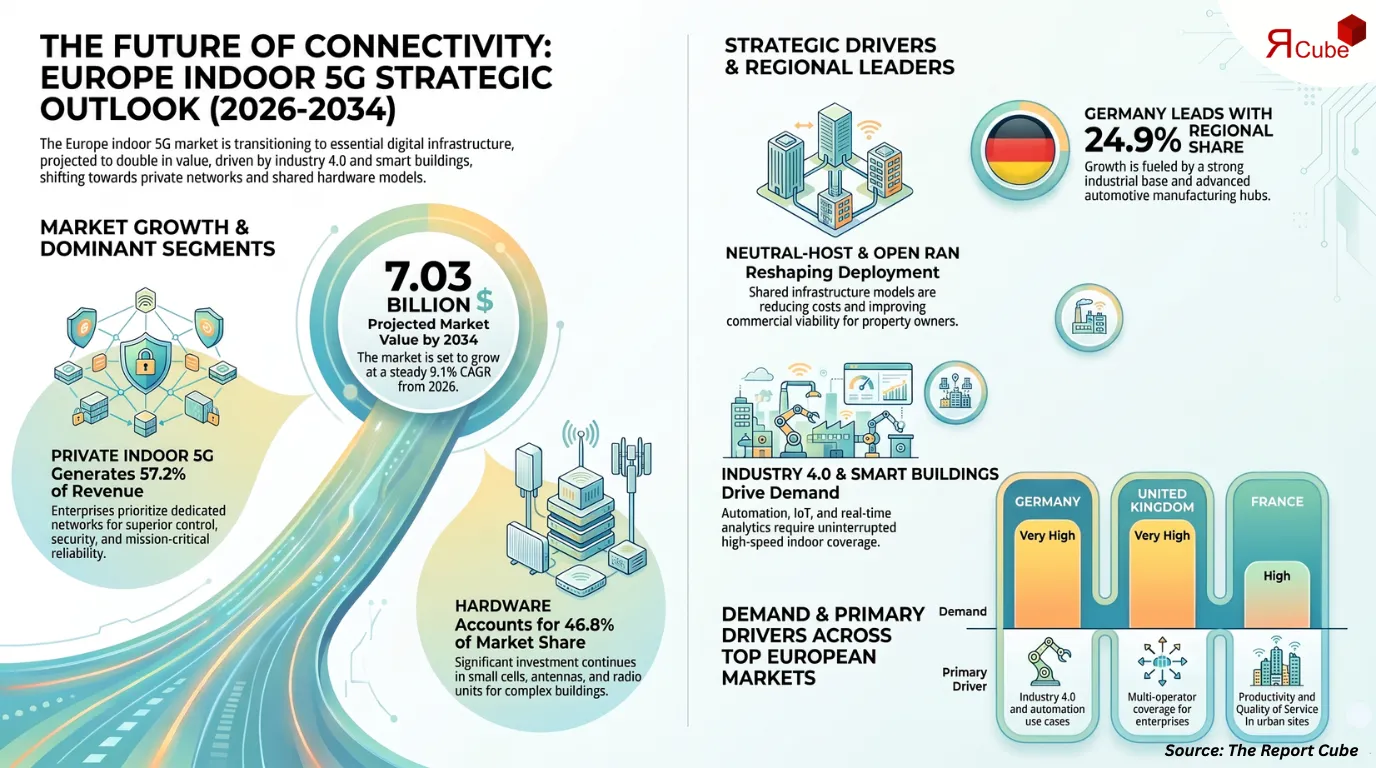
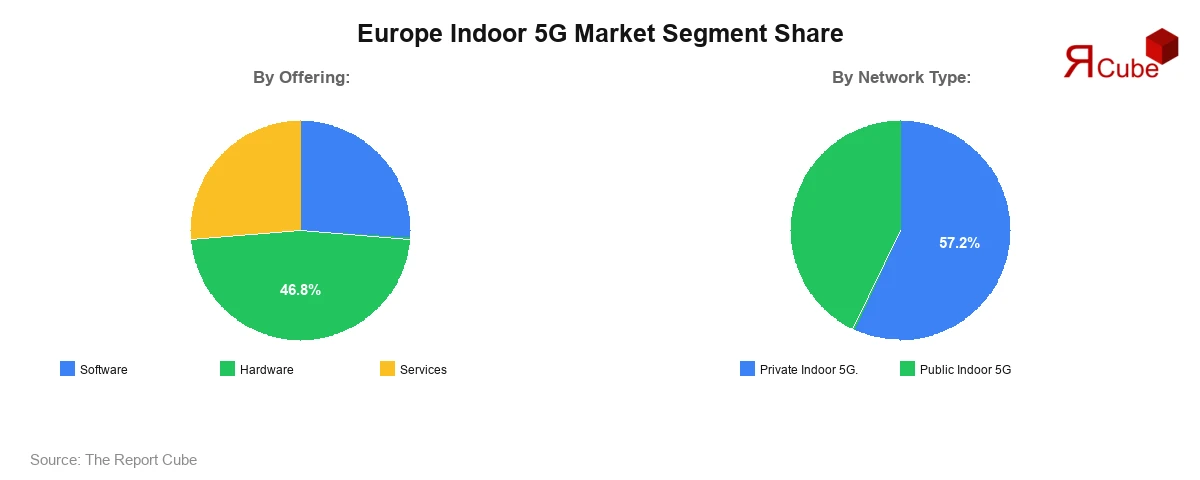
Hardware segment leads the market with approximately 46.8% share.
By Network Type:
Private Indoor 5G dominates the market with nearly 57.2% of total revenue.
Coyntries Outlook:
Germany dominates the Europe Indoor 5G market with an estimated 24.9% market share.
Europe Indoor 5G Market Insights & Analysis
The Europe Indoor 5G Market is anticipated to register a CAGR of around 9.10% during the forecast period 2026-2034. The market size is valued at USD 3.50 billion in 2026 and is projected to reach USD 7.03 billion by 2034. Demand for high-speed 5G connectivity inside buildings continues to increase as enterprises modernize communication infrastructure to support data-intensive business operations. Manufacturing plants, hospitals, airports, commercial offices, retail centers, universities, and logistics hubs require uninterrupted indoor coverage capable of supporting cloud platforms, industrial automation, connected devices, and real-time collaboration. Conventional macro cellular networks often experience signal degradation inside complex structures, encouraging organizations to deploy dedicated indoor 5G infrastructure that delivers higher capacity, lower latency, and greater network reliability. These investments are strengthening enterprise digital transformation strategies while enabling scalable connectivity for mission-critical applications across multiple industry verticals.
Investment activity across Europe continues to accelerate as telecom operators, infrastructure providers, and property developers prioritize advanced in-building wireless networks. Enterprises are incorporating indoor 5G into new commercial developments and large-scale renovation projects to improve operational efficiency, support hybrid workplaces, and enhance digital services for occupants. Technology vendors are introducing software-driven network management platforms, energy-efficient radio equipment, AI-assisted network optimization, and flexible deployment architectures that simplify implementation while reducing operating costs. The growing acceptance of neutral-host infrastructure is also improving the commercial viability of indoor deployments by allowing multiple mobile operators to share a common network. Combined with expanding adoption of private wireless networks, Open RAN technology, edge computing, and smart building platforms, these developments are creating a favorable environment for sustained growth in the Europe Indoor 5G market throughout the forecast period.
Europe Indoor 5G Market Impact Analysis
| Factor | Type | Specific Impact on Market | Magnitude | Business Implication |
|---|---|---|---|---|
| Enterprise Digitalization Programs | Market | Indoor 5G adoption rises with smart factory and campus rollout. | High | Vendors gain demand for private indoor 5G and network slicing. |
| Growth of Data-Intensive Applications | Technological | AR, VR and real time analytics need high throughput low latency indoor 5G. | High | Drives service offerings around immersive and mission critical use cases. |
| EU 5G Policy and Funding Support | Regulatory | European programs accelerate deployment of advanced indoor networks. | High | Creates favorable environment for investment and cross border solutions. |
| Spectrum Harmonization Across Region | Regulatory | Aligned spectrum use improves indoor coverage and device interoperability. | Medium | Enables scalable offerings for enterprises with multinational locations. |
| Initial Deployment and Equipment Costs | Market | High capex slows adoption for smaller venues and limited budgets. | Medium | Pushes operators to propose flexible financing and shared infrastructure. |
| Competition from Wi Fi 6 and 6E | Competitive | Advanced Wi Fi offers alternative for some indoor connectivity needs. | Medium | Requires clear positioning of indoor 5G for reliability and mobility gains. |
| Security and Privacy Considerations | Environmental | Enterprise concerns over data traffic drive demand for secure designs. | Medium | Encourages providers to bundle robust encryption and managed security. |
Europe Indoor 5G Market Dynamics
Key Driver: Enterprise Digital Infrastructure Investments Accelerating Indoor 5G Adoption
Digital transformation programs across Europe are reshaping enterprise connectivity requirements, prompting organizations to deploy high-performance indoor wireless infrastructure capable of supporting advanced business applications. Production facilities, research centers, healthcare campuses, financial institutions, transportation terminals, and corporate offices increasingly rely on uninterrupted connectivity for automation, artificial intelligence, cloud computing, augmented reality, and real-time analytics. Indoor 5G provides the performance, reliability, and scalability required to support these environments while enabling secure communication between thousands of connected devices operating simultaneously. As organizations expand intelligent operations, wireless connectivity has become an essential component of long-term infrastructure planning rather than a supplementary communication service.
Private wireless deployments are becoming a preferred investment strategy because enterprises seek greater control over network performance, cybersecurity, and operational continuity. Dedicated indoor networks allow businesses to prioritize mission-critical applications, improve production efficiency, reduce communication delays, and support highly automated workflows. Demand is particularly strong among automotive manufacturers, pharmaceutical companies, logistics providers, healthcare organizations, and technology campuses where network reliability directly influences productivity. Continuous investment in Industry 4.0 initiatives across Europe is expected to sustain strong demand for enterprise indoor 5G infrastructure over the coming years.
Industry Trends: Neutral Host Networks and Open RAN Reshaping Indoor Connectivity Strategies
Building owners and enterprise operators are increasingly adopting neutral-host deployment models that allow several mobile network operators to utilize a shared indoor infrastructure. This approach minimizes duplicate equipment, reduces installation costs, simplifies long-term maintenance, and improves commercial returns for property developers. Large office complexes, airports, hospitals, shopping centers, hotels, and mixed-use developments are among the earliest adopters because they require seamless connectivity regardless of subscribers' mobile service providers. Neutral-host architectures are becoming an important component of modern building design as demand for reliable indoor wireless services continues to grow.
Open RAN is also transforming deployment strategies by enabling greater interoperability between network hardware and software supplied by different vendors. Virtualized radio access networks provide operators with increased flexibility, simplified upgrades, and improved resource utilization while reducing long-term infrastructure dependence on single-vendor ecosystems. AI-enabled network orchestration, predictive maintenance, automated traffic optimization, and intelligent spectrum management are further improving operational efficiency. These technology advancements are encouraging broader enterprise adoption while supporting the expansion of flexible and software-defined indoor 5G networks across Europe.
Book your FREE 30-minute expert consultation today
Contact UsMajor Challenge: Infrastructure Complexity and Capital Investment Requirements
Deploying indoor 5G infrastructure requires significant investment in radio equipment, distributed antenna systems, fiber connectivity, network software, and specialized engineering services. Large commercial buildings often present structural challenges that require detailed radio frequency planning, customized network design, and extensive installation work to achieve consistent signal coverage throughout the facility. Retrofitting older buildings is particularly complex because existing communication infrastructure may not support modern wireless equipment without substantial upgrades. These factors increase deployment costs and extend project implementation timelines.
Operational integration introduces another layer of complexity as enterprises must ensure compatibility between indoor 5G networks, existing Wi-Fi systems, cybersecurity frameworks, cloud environments, and legacy operational technologies. Organizations also need experienced technical teams to manage spectrum planning, network optimization, cybersecurity monitoring, and ongoing maintenance. While the long-term operational benefits remain substantial, the combination of capital expenditure and deployment complexity continues to influence investment decisions, especially among small and medium-sized enterprises.
Opportunity: Smart Buildings and Digital Enterprise Campuses Creating New Revenue Streams
Commercial real estate developers across Europe are increasingly integrating digital infrastructure into new construction projects to meet rising expectations for intelligent workplaces and connected facilities. Indoor 5G serves as the communication backbone for smart building platforms that manage energy systems, security operations, environmental controls, occupancy monitoring, and predictive maintenance. Property owners are recognizing that advanced connectivity enhances tenant experience while increasing long-term asset competitiveness in a rapidly evolving commercial real estate market.
Demand is also expanding across healthcare facilities, transportation terminals, universities, industrial campuses, and public infrastructure where uninterrupted wireless connectivity supports operational efficiency and digital service delivery. Continued adoption of edge computing, autonomous systems, connected medical equipment, immersive collaboration technologies, and industrial IoT solutions will create additional deployment opportunities throughout the forecast period. As deployment models become more standardized and shared infrastructure continues to reduce ownership costs, indoor 5G adoption is expected to broaden across enterprises of varying sizes throughout Europe.
Europe Indoor 5G Market Segment-wise Analysis
By Offering:
- Software
- Network Orchestration & Automation
- Security Software
- Network Analytics & Monitoring
- Network Management Software
- Hardware
- Repeaters & Signal Boosters
- Radio Units (RU)
- Small Cell Systems
- Distributed Antenna Systems (DAS)
- Baseband Units (BBU)
- Services
- Managed Services
- Testing & Optimization
- Integration & Deployment
- Consulting & Network Design
- Maintenance & Support
The Hardware segment accounted for approximately 46.8% of the Europe Indoor 5G Market in 2026, making it the largest revenue-generating offering category. Indoor 5G deployments depend on a robust hardware foundation comprising small cell systems, distributed antenna systems (DAS), radio units (RU), baseband units (BBU), and signal boosters that ensure uninterrupted coverage inside complex buildings. Commercial offices, manufacturing plants, hospitals, airports, shopping centers, and transportation hubs continue investing in modern in-building wireless infrastructure to overcome signal attenuation caused by concrete structures, steel frameworks, and energy-efficient building materials. The increasing deployment of high-capacity enterprise networks is creating sustained demand for advanced radio equipment capable of supporting thousands of connected devices while maintaining low latency and high throughput.
Technology suppliers are introducing compact, energy-efficient hardware platforms that simplify installation while lowering operational costs for building owners and telecom operators. Multi-band radio units, cloud-ready baseband solutions, and scalable small cell architectures are enabling organizations to expand indoor network capacity without extensive structural modifications. Growing investments in neutral-host infrastructure and Open RAN deployments are also supporting hardware demand, as shared indoor networks require interoperable equipment capable of serving multiple mobile operators through a single infrastructure. These developments are expected to sustain the hardware segment's leadership throughout the forecast period.
By Network Type:
- Private Indoor 5G
- Public Indoor 5G
Private Indoor 5G represented nearly 57.2% of total market revenue in 2026 as enterprises increasingly prioritized secure, dedicated wireless infrastructure for business-critical operations. Unlike public cellular networks, private indoor 5G provides organizations with complete control over network performance, cybersecurity, device management, and quality of service. Industries including automotive manufacturing, pharmaceuticals, healthcare, logistics, utilities, and research institutions are deploying private networks to support industrial automation, robotics, AI-driven production systems, connected medical devices, and real-time operational analytics. The ability to guarantee reliable low-latency communication has positioned private 5G as a strategic investment for digitally connected facilities.
Enterprise adoption continues to strengthen as organizations integrate edge computing, machine vision, autonomous guided vehicles, and industrial Internet of Things (IIoT) applications into everyday operations. Dedicated spectrum resources, network slicing capabilities, and customized security policies allow businesses to optimize wireless performance according to operational requirements while reducing dependence on public mobile networks. As digital transformation initiatives accelerate across Europe's industrial and commercial sectors, private indoor 5G is expected to remain the preferred deployment model for organizations requiring secure, scalable, and high-performance wireless connectivity.
Regional Projection of Europe Indoor 5G Industry
- United Kingdom
- Germany
- France
- Italy
- Spain
- Benelux
- Rest of Europe
Germany held the largest share of the Europe Indoor 5G Market with approximately 24.9% of regional revenue in 2026. The country's leadership is supported by its strong industrial base, advanced manufacturing ecosystem, and widespread adoption of Industry 4.0 technologies. Automotive manufacturers, industrial equipment producers, logistics companies, and pharmaceutical organizations continue investing in private indoor 5G networks to improve production efficiency, automate operations, and enable real-time communication across manufacturing facilities. Continuous modernization of commercial buildings, research campuses, airports, and healthcare institutions is further accelerating demand for reliable indoor wireless infrastructure.
Supportive digitalization policies, expanding enterprise spectrum availability, and sustained investment from telecom operators are strengthening Germany's position as Europe's leading indoor 5G market. Businesses are increasingly adopting Open RAN architectures, AI-enabled network management platforms, and neutral-host deployment models to improve flexibility while reducing long-term infrastructure costs. The country's focus on smart factories, connected logistics centers, intelligent commercial buildings, and advanced digital infrastructure is expected to sustain robust market growth, reinforcing Germany's leadership throughout the forecast period.
Need insights for a specific region within this market?
Request Regional DataEurope Indoor 5G Market – Countries Analysis
Indoor 5G in Europe is growing rapidly, led by enterprise, venues and industrial campuses.
| Country / Cluster | Demand Level | Key Indoor Domains | Solution Dominance | Core Demand Logic | Growth Nature |
|---|---|---|---|---|---|
| United Kingdom | Very High | Offices, transport hubs, stadiums | Neutral‑host DAS & small cells | All‑operator indoor coverage for enterprises | Upgrade‑led, service‑rich growth |
| Germany | Very High | Factories, logistics, automotive plants | Private 5G, indoor small base stations | Industry 4.0 and automation use cases | Industrial‑driven, high‑value growth |
| France | High | Corporate offices, hospitals, airports | Indoor 5G SA, Radio Dot and small cells | Productivity and QoS in dense urban sites | Managed services and QoE‑focused growth |
| Italy | Medium | Malls, transport nodes, smart factories | Hybrid 4G/5G DAS and small cells | Retail experience and manufacturing pilots | Gradual, project‑based expansion |
| Spain | High | Tourism venues, offices, stadiums | Indoor 5G for venues and campuses | Visitor experience and enterprise connectivity | Event‑driven and tourism‑linked growth |
| Benelux | Medium‑High | Data centers, ports, smart offices | Private 5G and neutral‑host systems | High data intensity and IoT density | Steady, infrastructure‑aligned growth |
| Rest of Europe | Emerging to Medium | Universities, campuses, midsize factories | Cost‑optimized indoor 5G solutions | Targeted deployments in priority sites | Catch‑up growth with funding support |
Government Initiatives & Policies
- European Commission Digital Decade Policy Programme (2025 Implementation): The European Union continues accelerating secure 5G deployment and advanced digital infrastructure across member states to strengthen industrial competitiveness, smart public services, and high-capacity connectivity throughout the region.
- Germany Federal Digital Strategy (2025-2026): Germany continues expanding digital infrastructure investments supporting private 5G, industrial digitalization, and smart manufacturing through coordinated broadband, innovation, and enterprise connectivity initiatives.
Europe Indoor 5G Industry Recent Developments
- 2026: Telefonaktiebolaget LM Ericsson partnered with Freshwave to introduce the 5G on Omni neutral-host indoor connectivity platform in the United Kingdom. Powered by Ericsson's Radio Dot System, the solution enables all major UK mobile operators to deliver 4G and 5G indoor coverage through a single shared infrastructure. The platform debuted at Workspace's Record Hall in London and is expanding across additional commercial properties. The development strengthens multi-operator connectivity, lowers infrastructure duplication, and accelerates scalable indoor 5G deployment across enterprise buildings and mixed-use developments.
- 2025: Samsung Electronics Co., Ltd. was selected by Vodafone as a strategic partner for a large-scale Open RAN expansion across Germany and other European markets. The multi-year rollout includes virtualized RAN, O-RAN compliant radios, Massive MIMO technologies, intelligent automation, and AI-enabled network management capabilities. The initiative supports software-driven network transformation, improves interoperability, expands vendor diversity, and creates favorable conditions for cost-effective indoor 5G deployments across enterprise and commercial environments.
- 2025: Nokia Corporation expanded its private 5G strategy by promoting dedicated wireless networks for sports arenas, entertainment venues, and large indoor event locations throughout Europe. The solution delivers secure, high-capacity connectivity supporting venue operations, digital fan engagement, broadcasting, security, and real-time analytics. The expansion broadens private indoor 5G adoption beyond industrial applications and creates new opportunities across hospitality, sports, entertainment, and commercial venue ecosystems.
Why Choose This Report?
- Provides a comprehensive overview of the overall market analysis, encompassing key trends, consumer behavior analysis, and risk assessment to support strategic decision-making.
- Provides accurate, up-to-date insights into market size, segmentation, and emerging opportunities, helping to minimize risk while capitalizing on growth prospects.
- Gives deep understanding of target audience preferences, investment patterns, and evolving infrastructure requirements for enhanced product development and business planning.
- Delivers competitive analysis and benchmarking, uncovering the strengths and weaknesses of major market participants to support informed strategic decisions.
- Consolidates comprehensive market intelligence, reducing research time while improving business planning efficiency.
- Facilitates customized market segmentation and risk mitigation strategies aligned with organizational objectives.
- Assists in identifying both market challenges and untapped growth opportunities across the GCC wires and cables industry.
- Provides valuable information supported by industry trends, infrastructure investments, and evolving customer demand patterns.
Table of Contents
- Introduction
- Objective of the Study
- Product and Category Definition
- Market Segmentation
- Study Variables
- Research Methodology
- Secondary Data Points
- Breakdown of Secondary Sources
- Primary Data Points
- Breakdown of Primary Interviews
- Secondary Data Points
- Executive Summary
- Market Dynamics
- Emerging Opportunities
- Adoption Trends
- Demand Drivers
- Disruption Analysis (Challenges)
- Industry Analysis & Strategic Insights
- Supply/Value Chain Analysis
- Pricing Analysis
- Go-To-Market (GTM) Strategy
- BCG Matrix
- Recent Trends and Developments
- Import and Export Analysis
- Regulatory and Policy Landscape
- Country-wise Policies
- Government Initiatives
- Europe Indoor 5G Market Overview and Forecast Analysis (2021-2034)
- Market Size, By Value, By Growth Rate (CAGR/USD Billion)
- Market Share, By Offering
- Software
- Network Orchestration & Automation
- Security Software
- Network Analytics & Monitoring
- Network Management Software
- Hardware
- Repeaters & Signal Boosters
- Radio Units (RU)
- Small Cell Systems
- Distributed Antenna Systems (DAS)
- Baseband Units (BBU)
- Services
- Managed Services
- Testing & Optimization
- Integration & Deployment
- Consulting & Network Design
- Maintenance & Support
- Software
- Market Share, By Spectrum Band
- Millimeter Wave (mmWave)
- Low Band (<1 GHz)
- Mid Band (1-6 GHz)
- Sub-6 GHz
- Market Share, By Network Type
- Private Indoor 5G
- Public Indoor 5G
- Market Share, By Ownership Model
- Enterprise-Owned
- Neutral Host-Owned
- Mobile Network Operator (MNO)-Owned
- Market Share, By Application
- IoT Connectivity
- Industrial Automation
- Enhanced Mobile Broadband (eMBB)
- Ultra-Reliable Low-Latency Communications (URLLC)
- Smart Building & Facility Management
- Massive Machine-Type Communications (mMTC)
- Others
- Market Share, By Venue Type
- Educational Institutions
- Retail & Hospitality Venues
- Healthcare Facilities
- Transportation Hubs
- Commercial Buildings
- Industrial Facilities
- Others
- Market Share, By Country
- United Kingdom
- Germany
- France
- Italy
- Spain
- Benelux
- Rest of Europe
- Market Share, By Company
- Revenue Shares & Analysis
- Competitive Landscape
- United Kingdom Indoor 5G Market Overview and Forecast Analysis (2021-2034)
- Market Size, By Value, By Growth Rate (CAGR/USD Billion/Million)
- Market Share, By Offering
- Market Share, By Spectrum Band
- Market Share, By Network Type
- Market Share, By Ownership Model
- Market Share, By Application
- Market Share, By Venue Type
- Germany Indoor 5G Market Overview and Forecast Analysis (2021-2034)
- Market Size, By Value, By Growth Rate (CAGR/USD Billion/Million)
- Market Share, By Offering
- Market Share, By Spectrum Band
- Market Share, By Network Type
- Market Share, By Ownership Model
- Market Share, By Application
- Market Share, By Venue Type
- France Indoor 5G Market Overview and Forecast Analysis (2021-2034)
- Market Size, By Value, By Growth Rate (CAGR/USD Billion/Million)
- Market Share, By Offering
- Market Share, By Spectrum Band
- Market Share, By Network Type
- Market Share, By Ownership Model
- Market Share, By Application
- Market Share, By Venue Type
- Italy Indoor 5G Market Overview and Forecast Analysis (2021-2034)
- Market Size, By Value, By Growth Rate (CAGR/USD Billion/Million)
- Market Share, By Offering
- Market Share, By Spectrum Band
- Market Share, By Network Type
- Market Share, By Ownership Model
- Market Share, By Application
- Market Share, By Venue Type
- Spain Indoor 5G Market Overview and Forecast Analysis (2021-2034)
- Market Size, By Value, By Growth Rate (CAGR/USD Billion/Million)
- Market Share, By Offering
- Market Share, By Spectrum Band
- Market Share, By Network Type
- Market Share, By Ownership Model
- Market Share, By Application
- Market Share, By Venue Type
- Benelux Indoor 5G Market Overview and Forecast Analysis (2021-2034)
- Market Size, By Value, By Growth Rate (CAGR/USD Billion/Million)
- Market Share, By Offering
- Market Share, By Spectrum Band
- Market Share, By Network Type
- Market Share, By Ownership Model
- Market Share, By Application
- Market Share, By Venue Type
- Competitive Analysis, 2026
- Market Share of Key Players
- Competitive Mapping for Each Segment and Companies Operating Countryally
- United Kingdom Indoor 5G Companies Share & Competitive Analysis, 2026
- Germany Indoor 5G Companies Share & Competitive Analysis, 2026
- France Indoor 5G Companies Share & Competitive Analysis, 2026
- Italy Indoor 5G Companies Share & Competitive Analysis, 2026
- Spain Indoor 5G Companies Share & Competitive Analysis, 2026
- Benelux Indoor 5G Companies Share & Competitive Analysis, 2026
- Company Profile (Partial List)
- Cisco Systems, Inc.
- Company Overview
- Product Portfolio
- Strategic Alliances/Partnerships
- Recent Developments
- Mavenir Systems, Inc.
- Company Overview
- Product Portfolio
- Strategic Alliances/Partnerships
- Recent Developments
- Huawei Technologies Co., Ltd.
- Company Overview
- Product Portfolio
- Strategic Alliances/Partnerships
- Recent Developments
- CommScope Holding Company, Inc.
- Company Overview
- Product Portfolio
- Strategic Alliances/Partnerships
- Recent Developments
- NEC Corporation
- Company Overview
- Product Portfolio
- Strategic Alliances/Partnerships
- Recent Developments
- JMA Wireless
- Company Overview
- Product Portfolio
- Strategic Alliances/Partnerships
- Recent Developments
- Nokia Corporation
- Company Overview
- Product Portfolio
- Strategic Alliances/Partnerships
- Recent Developments
- Airspan Networks Holdings Inc.
- Company Overview
- Product Portfolio
- Strategic Alliances/Partnerships
- Recent Developments
- Samsung Electronics Co., Ltd.
- Company Overview
- Product Portfolio
- Strategic Alliances/Partnerships
- Recent Developments
- Comba Telecom Systems Holdings Limited
- Company Overview
- Product Portfolio
- Strategic Alliances/Partnerships
- Recent Developments
- Telefonaktiebolaget LM Ericsson
- Company Overview
- Product Portfolio
- Strategic Alliances/Partnerships
- Recent Developments
- ZTE Corporation
- Company Overview
- Product Portfolio
- Strategic Alliances/Partnerships
- Recent Developments
- Others (Partial List)
- Cisco Systems, Inc.
- Contact Us and Disclaimer
Top Key Players & Market Share Outlook
- Cisco Systems, Inc.
- Mavenir Systems, Inc.
- Huawei Technologies Co., Ltd.
- CommScope Holding Company, Inc.
- NEC Corporation
- JMA Wireless
- Nokia Corporation
- Airspan Networks Holdings Inc.
- Samsung Electronics Co., Ltd.
- Comba Telecom Systems Holdings Limited
- Telefonaktiebolaget LM Ericsson
- ZTE Corporation
- Others
Frequently Asked Questions






