



Build Your Custom Market Intelligence Report
Customize Your ReportIndia K-Beauty Products Market Key Highlights
By Product Category:
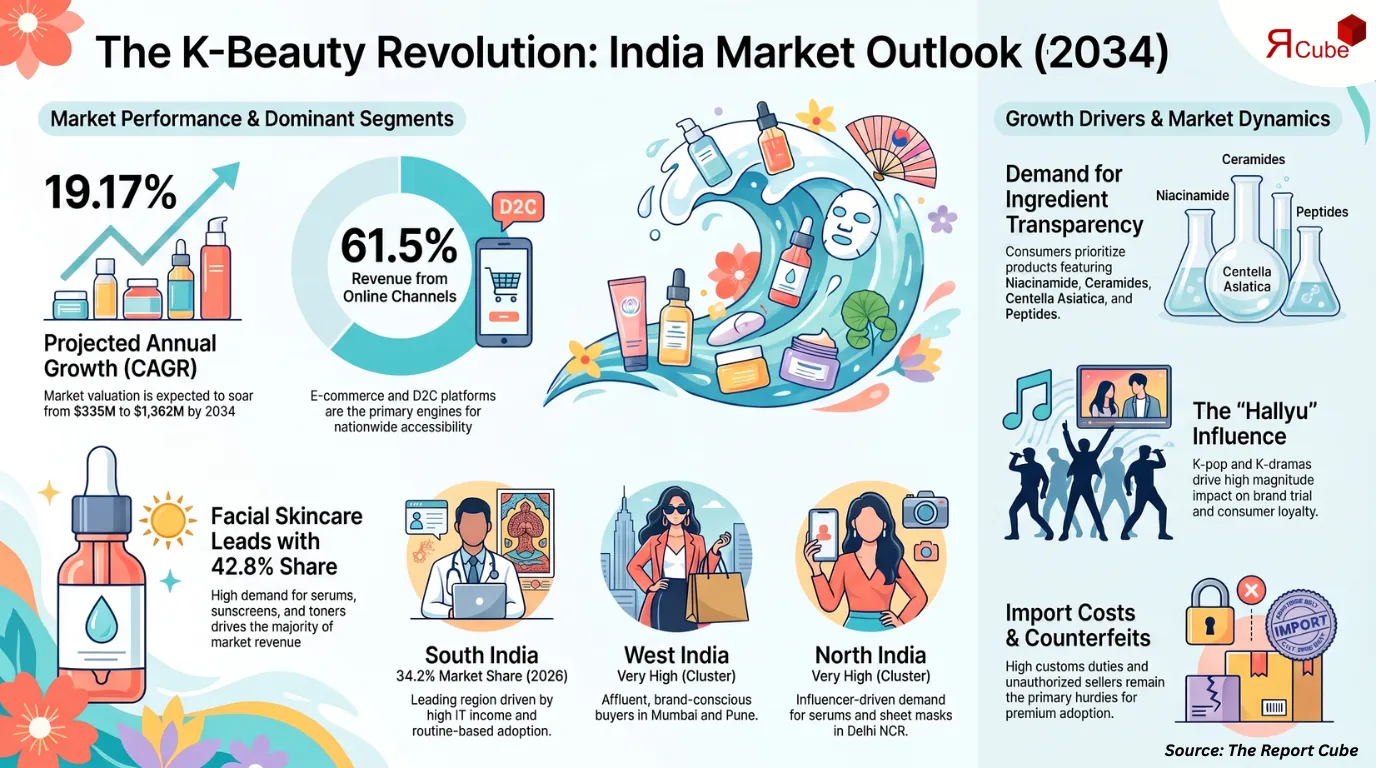
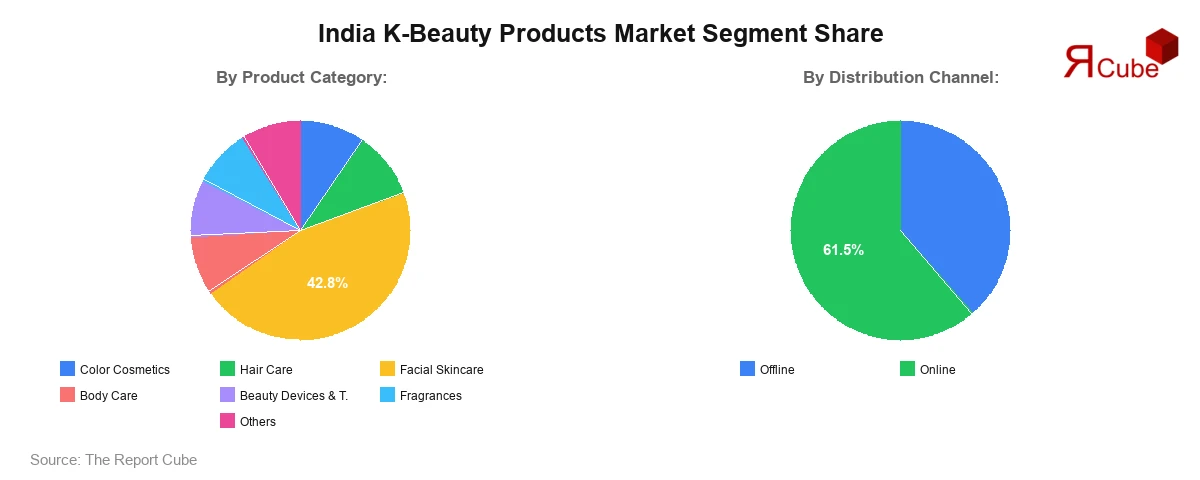
Facial Skincare segment leads the market with approximately 42.8% share.
By Distribution Channel:
Online segment dominates the market with nearly 61.5% of total revenue.
Regional Outlook:
South India dominates the India K-Beauty Products Market with around 34.2% market share.
India K-Beauty Products Market Insights & Analysis
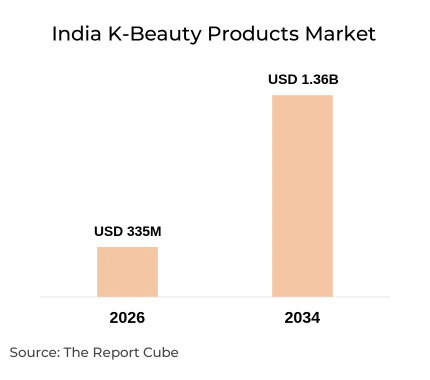
The India K-Beauty Products Market is anticipated to register a CAGR of around 19.17% during the forecast period 2026-2034. The market size is valued at USD 335 million in 2026 and is projected to reach USD 1,362.64 million by 2034. The industry has entered a high-growth phase as Korean skincare transitions from a niche premium category to a mainstream beauty segment across India. Consumers are increasingly investing in products that combine advanced formulations with clinically recognized ingredients such as niacinamide, ceramides, centella asiatica, peptides, hyaluronic acid, and fermented botanical extracts. Daily skincare routines emphasizing hydration, sun protection, pigmentation control, and skin barrier restoration have gained widespread acceptance among younger professionals and wellness-conscious consumers. International brands are responding by broadening their product portfolios and introducing formulations suitable for India's diverse climatic conditions and skin concerns. These developments continue to strengthen market demand while encouraging higher spending across premium skincare categories.
Competitive intensity has increased considerably as established Korean beauty companies strengthen their presence through strategic partnerships with leading Indian beauty retailers and omnichannel distribution networks. Several brands have expanded beyond digital commerce by introducing exclusive collections through specialty beauty stores and organized retail outlets, improving accessibility across metropolitan cities and emerging urban centers. Product innovation remains a defining feature of the market, with manufacturers emphasizing dermatologist-tested formulations, sensitive skin solutions, microbiome-friendly skincare, and lightweight textures designed for tropical climates. At the same time, rising household expenditure on personal care, improved retail infrastructure, and greater availability of premium imported cosmetics are supporting sustained market expansion. The continued entry of globally recognized Korean brands is expected to accelerate product innovation, enhance competitive differentiation, and reinforce India's position as one of the fastest-growing destinations for K-beauty products in Asia.
India K-Beauty Products Market Impact Analysis
| Factor | Type | Specific Impact on Market | Magnitude | Business Implication |
|---|---|---|---|---|
| Influence of K‑pop and dramas | Consumer | Fans emulate Korean looks, driving trial of K‑beauty brands | High | Leverage celebrity tie‑ups and content led brand storytelling |
| Social media and beauty influencers | Market | Reels and tutorials accelerate awareness of multi step routines | High | Invest in creator partnerships and education focused campaigns |
| Rising premium skincare spending | Market | Higher incomes spur demand for advanced serums and masks | Medium | Expand mid premium lines tailored to Indian skin concerns |
| E‑commerce and cross‑border platforms | Technological | Online channels ease access to niche Korean labels nationwide | High | Prioritize marketplace presence and D2C logistics capability |
| Shift toward clean and vegan beauty | Environmental | Conscious buyers scrutinize ingredients and sourcing ethics | Medium | Adapt formulas and communication to highlight cruelty free claims |
| Regulatory scrutiny on imports | Regulatory | Compliance on labeling and safety can slow product launches | Medium | Need strong local partners for approvals and documentation |
| Competition from domestic K‑inspired brands | Competitive | Local players offer similar routines at more accessible prices | Medium | Differentiate through authentic Korean sourcing and innovation |
India K-Beauty Products Market Dynamics
Key Driver: Rising Demand for Science-Based Skincare and Ingredient Transparency
Indian consumers are becoming increasingly selective about skincare formulations, creating favorable conditions for Korean beauty products that emphasize efficacy, safety, and ingredient transparency. Rather than purchasing products based solely on brand recognition, buyers are evaluating active ingredients, formulation quality, and dermatological benefits before making purchasing decisions. Korean skincare brands have successfully positioned themselves around advanced formulations containing ceramides, peptides, centella asiatica, heartleaf, rice extracts, and niacinamide, which address common skin concerns including dehydration, acne, uneven pigmentation, and weakened skin barriers. This shift toward informed skincare purchasing continues to strengthen demand across facial skincare categories.
Consumer confidence has also been reinforced by consistent product innovation and visible product performance across multiple skin types. Brands are introducing formulations tailored for humid weather, sensitive skin, and prolonged sun exposure, making Korean skincare increasingly relevant for Indian consumers. Educational campaigns led by dermatologists, skincare specialists, and beauty professionals have further improved awareness regarding preventive skincare and long-term skin health. As premium skincare becomes an essential component of personal wellness, demand for clinically developed Korean beauty products is expected to remain strong throughout the forecast period.
Industry Trend: Premiumization Supported by Omnichannel Retail Expansion
The premium beauty segment is witnessing sustained momentum as consumers increasingly prioritize product quality, formulation technology, and long-term skincare benefits over conventional cosmetic purchases. Korean beauty companies are responding by introducing premium collections featuring specialized serums, advanced sunscreen technologies, skin-repair treatments, and multifunctional skincare products. This transition reflects broader changes in India's beauty industry, where consumers are demonstrating greater willingness to invest in products offering clinically supported performance and superior ingredient quality.
Retail expansion is further accelerating category growth through integrated online and offline strategies. Leading Korean brands are collaborating with established beauty retailers to launch products simultaneously across e-commerce platforms and physical stores, allowing consumers to experience products through multiple purchasing channels. Dedicated beauty stores, premium department stores, and experiential retail formats have improved product visibility while strengthening consumer confidence through authentic brand representation. These investments in omnichannel retail continue to enhance accessibility and contribute to long-term market development.
Book your FREE 30-minute expert consultation today
Contact UsMajor Challenge: Premium Import Costs and Counterfeit Product Penetration
Although demand for Korean beauty products continues to expand, pricing remains a key consideration for broader market adoption. Imported skincare products often carry higher retail prices because of customs duties, international freight costs, exchange rate fluctuations, and premium brand positioning. While consumers in metropolitan markets increasingly prioritize product performance over price, affordability continues to influence purchasing decisions across several developing urban markets. This pricing gap creates opportunities for lower-cost alternatives, intensifying competition within the premium skincare segment.
Counterfeit products distributed through unauthorized online sellers present another challenge for brand owners and consumers alike. Imitation products not only affect brand reputation but also create concerns regarding ingredient quality, product safety, and regulatory compliance. In response, international manufacturers are strengthening partnerships with authorized retailers, introducing product authentication measures, and expanding official distribution networks. These initiatives are improving consumer trust while reinforcing the importance of purchasing genuine Korean beauty products through verified sales channels.
Opportunity: Expanding Consumer Base Beyond Metropolitan Cities
Future growth of the India K-Beauty Products Market is expected to be supported by increasing adoption across Tier II and Tier III cities, where premium personal care spending is steadily rising. Better logistics infrastructure, faster delivery networks, and wider digital commerce penetration have significantly improved access to international skincare brands outside major metropolitan areas. Consumers in these cities are becoming more familiar with Korean beauty routines and ingredient-led skincare through digital media, resulting in stronger demand for premium facial care products.
Another promising opportunity lies in the rapid evolution of India's male grooming industry. Modern male consumers are increasingly adopting skincare routines focused on hydration, oil control, acne management, and sun protection, creating additional demand for minimalist and dermatologist-inspired Korean skincare products. Several international brands have already begun expanding gender-neutral product portfolios and introducing dedicated men's skincare collections. Continued investment in product innovation, retail expansion, and localized marketing initiatives is expected to unlock substantial growth opportunities for Korean beauty brands across the Indian market during the forecast period.
India K-Beauty Products Market Segment-wise Analysis
By Product Category:
- Color Cosmetics
- Lip Makeup
- Eye Makeup
- Nail Products
- Face Makeup
- Hair Care
- Styling Products
- Shampoo
- Hair Serums
- Scalp Treatments
- Hair Masks
- Conditioner
- Facial Skincare
- Sunscreens
- Serums & Ampoules
- Essences
- Toners
- Cleansers
- Moisturizers
- Sheet Masks
- Wash-off Masks
- Others
- Body Care
- Scrubs
- Hand & Foot Care
- Body Wash
- Body Lotion
- Beauty Devices & Tools
- Fragrances
- Others
Facial Skincare accounts for the largest share of the India K-Beauty Products Market, contributing approximately 42.8% of total revenue in 2026. The segment has established a dominant position as consumers increasingly prioritize preventive skincare over corrective treatments. Korean facial skincare products are widely recognized for their advanced formulations, combining ingredients such as centella asiatica, niacinamide, ceramides, hyaluronic acid, peptides, and fermented botanical extracts to address concerns including acne, pigmentation, dehydration, and skin barrier repair. Growing awareness of daily skincare routines has significantly increased demand for serums, sunscreens, toners, moisturizers, cleansers, and sheet masks across urban households.
Leading Korean brands continue expanding their facial skincare portfolios by introducing products tailored to Indian climatic conditions, including lightweight moisturizers, high-SPF sunscreens, and soothing formulations suitable for humid weather and sensitive skin. Strategic partnerships with retailers such as Nykaa, Tira, and premium beauty chains have improved nationwide accessibility through both digital and physical retail channels. Continued innovation in ingredient-focused skincare, coupled with rising consumer expenditure on premium beauty products, is expected to reinforce the leadership of the Facial Skincare segment throughout the forecast period.
By Distribution Channel:
- Offline
- Pharmacies & Drugstores
- Convenience Stores
- Hypermarkets & Supermarkets
- Specialty Beauty Stores
- Department Stores
- Online
- Third-Party E-commerce Platforms
- Direct-to-Consumer (Brand Websites)
The Online segment holds the largest revenue share of nearly 61.5% in the India K-Beauty Products Market. Digital commerce has become the preferred purchasing channel for Korean beauty products due to its broad product assortment, exclusive brand launches, competitive pricing, and convenient shopping experience. Major beauty platforms have played a critical role in introducing globally recognized Korean brands to Indian consumers through exclusive partnerships, promotional campaigns, and educational product content. The availability of customer reviews, ingredient information, and personalized skincare recommendations further supports informed purchasing decisions.
Rapid improvements in digital payment systems, nationwide logistics networks, and smartphone penetration have enabled Korean beauty brands to reach consumers across both metropolitan and emerging cities. International brands are also strengthening their direct-to-consumer websites to offer authentic products, loyalty benefits, and personalized shopping experiences while reducing dependence on third-party marketplaces. As omnichannel retail strategies continue evolving and online beauty retail expands into underserved markets, digital sales are expected to remain the primary growth engine for the India K-Beauty Products Market over the coming years.
Regional Projection of India K-Beauty Products Industry
- North
- South
- West
- East
- Central
South India represents the largest regional market, accounting for approximately 34.2% of the India K-Beauty Products Market in 2026. The region benefits from a well-developed retail ecosystem, high urbanization, and relatively stronger consumer spending on premium personal care products. Metropolitan cities including Bengaluru, Hyderabad, Chennai, and Kochi have witnessed increasing adoption of Korean skincare routines, supported by greater awareness of ingredient-led skincare and growing demand for premium international beauty brands. The presence of organized beauty retailers and efficient e-commerce networks has further strengthened product accessibility across the region.
Regional growth is also supported by a younger consumer demographic with higher digital engagement and greater willingness to invest in dermatologist-inspired skincare products. Consumers in South India have shown strong preference for lightweight moisturizers, hydrating serums, broad-spectrum sunscreens, and products formulated for tropical climates, aligning well with the strengths of Korean beauty brands. Continuous expansion of premium retail stores, exclusive product launches, and increasing investments by international companies are expected to help South India maintain its leadership position while contributing significantly to the long-term growth of the India K-Beauty Products Market.
Need insights for a specific region within this market?
Request Regional DataIndia K-Beauty Products Market Regional Analysis
The India K-Beauty products market shows varied regional adoption driven by urbanization, income levels, digital influence, and skincare awareness.
| Cluster | Demand Level | Key Areas | System Dominance | Core Demand Logic | Growth Nature |
|---|---|---|---|---|---|
| North India Metros | Very High | Delhi NCR, Chandigarh | Serums & sheet masks | Digitally-led premium skincare | Influencer-driven upgrade |
| South India Urban | High | Bengaluru, Hyderabad, Chennai | Routine-based K-skincare sets | High IT income & skin health focus | Strong routine adoption |
| West India Affluent | Very High | Mumbai, Pune, Ahmedabad | Premium K-beauty & hybrids | Brand-conscious, mall & e-commerce | Rapid premiumization |
| East India Emerging | Medium | Kolkata, Guwahati, Bhubaneswar | Entry-level K-cleansers | Price-aware digital first buyers | Awareness-led expansion |
| Central & Tier-2 India | Low to Medium | Indore, Bhopal, Nagpur | Online-only starter kits | Young users trying viral trends | Gradual penetration growth |
Government Initiatives & Policies
- National Logistics Policy (2025 Implementation Expansion): The Government of India continues strengthening integrated logistics infrastructure to improve supply chain efficiency, reduce transportation costs, and facilitate faster movement of imported beauty and personal care products across domestic markets.
- Open Network for Digital Commerce (ONDC) Expansion (2025-2026): The continued expansion of ONDC supports wider digital commerce participation by enabling beauty brands and retailers to improve online accessibility, enhance competition, and reach consumers across emerging Indian cities through interoperable e-commerce infrastructure.
India K-Beauty Products Industry Recent Developments
- 2026: APR Corp. expanded its presence in India through the launch of its flagship skincare brand Medicube via a strategic partnership with Nykaa. The company introduced popular product lines including Zero, PDRN, Collagen, and Deep Vita C, with initial online availability followed by planned expansion into offline retail stores. The initiative strengthens APR's premium skincare portfolio while improving accessibility for Indian consumers seeking science-backed Korean skincare solutions.
- 2025: Laneige partnered with fashion retailer ONLY to introduce a fashion and beauty collaboration designed to integrate premium skincare with lifestyle retail experiences. The campaign targeted younger consumers through experiential marketing, enhanced brand engagement, and cross-category promotions, reflecting the growing convergence between fashion and premium beauty within India's evolving consumer landscape.
- 2025: Anua officially entered the Indian market through an exclusive partnership with Nykaa. The launch introduced leading products such as the Heartleaf 77% Soothing Toner, Niacinamide 10% + TXA 4% Serum, and Heartleaf Pore Control Cleansing Oil across Nykaa's digital platform and more than 230 retail stores, significantly expanding consumer access to ingredient-focused Korean skincare products nationwide.
Why Choose This Report?
- Provides a comprehensive overview of the overall market analysis, encompassing key trends, consumer behavior analysis, and risk assessment to support strategic decision-making.
- Provides accurate, up-to-date insights into market size, segmentation, and emerging opportunities, helping to minimize risk while capitalizing on growth.
- Gives deep understanding of target audience preferences, investment habits, and communication channels for enhanced product development and marketing effectiveness.
- Delivers competitive analysis and benchmarking, uncovering the strengths and weaknesses of market competitors to guide strategic planning.
- Consolidates comprehensive market intelligence, reducing research efforts while improving business decision-making efficiency.
- Facilitates customized market segmentation and risk mitigation strategies tailored to business objectives and investment priorities.
- Helps identify both market challenges and untapped opportunities within the industry to support sustainable long-term business growth.
- Provides valuable insights based on actual customer behavior, industry developments, regulatory trends, and evolving market demand.
Table of Contents
- Introduction
- Objective of the Study
- Product and Category Definition
- Market Segmentation
- Study Variables
- Research Methodology
- Secondary Data Points
- Breakdown of Secondary Sources
- Primary Data Points
- Breakdown of Primary Interviews
- Secondary Data Points
- Executive Summary
- Market Dynamics
- Emerging Opportunities
- Adoption Trends
- Demand Drivers
- Disruption Analysis (Challenges)
- Industry Analysis & Strategic Insights
- Supply/Value Chain Analysis
- Pricing Analysis
- Go-To-Market (GTM) Strategy
- BCG Matrix
- Recent Trends and Developments
- Import and Export Analysis
- Regulatory and Policy Landscape
- Region-wise Policies
- Government Initiatives
- India K-Beauty Products Market Overview and Forecast Analysis (2021-2034)
- Market Size, By Value and Growth Rate (CAGR/USD Billion)
- Market Share, By Product Category
- Color Cosmetics
- Lip Makeup
- Eye Makeup
- Nail Products
- Face Makeup
- Hair Care
- Styling Products
- Shampoo
- Hair Serums
- Scalp Treatments
- Hair Masks
- Conditioner
- Facial Skincare
- Sunscreens
- Serums & Ampoules
- Essences
- Toners
- Cleansers
- Moisturizers
- Sheet Masks
- Wash-off Masks
- Others
- Body Care
- Scrubs
- Hand & Foot Care
- Body Wash
- Body Lotion
- Beauty Devices & Tools
- Fragrances
- Others
- Color Cosmetics
- Market Share, By Distribution Channel
- Offline
- Pharmacies & Drugstores
- Convenience Stores
- Hypermarkets & Supermarkets
- Specialty Beauty Stores
- Department Stores
- Online
- Third-Party E-commerce Platforms
- Direct-to-Consumer (Brand Websites)
- Offline
- Market Share, By Price Tier
- Luxury
- Mid-Premium
- Premium
- Mass
- Market Share, By End User
- Female
- Male
- Market Share, By Region
- North
- South
- West
- East
- Central
- Market Share, By Company
- Revenue Shares & Analysis
- Competitive Landscape
- North India K-Beauty Products Market Overview and Forecast Analysis (2021-2034)
- Market Size, By Value and Growth Rate (CAGR/USD Billion/Million)
- Market Share, By Product Category
- Market Share, By Distribution Channel
- Market Share, By Price Tier
- Market Share, By End User
- South India K-Beauty Products Market Overview and Forecast Analysis (2021-2034)
- Market Size, By Value and Growth Rate (CAGR/USD Billion/Million)
- Market Share, By Product Category
- Market Share, By Distribution Channel
- Market Share, By Price Tier
- Market Share, By End User
- West India K-Beauty Products Market Overview and Forecast Analysis (2021-2034)
- Market Size, By Value and Growth Rate (CAGR/USD Billion/Million)
- Market Share, By Product Category
- Market Share, By Distribution Channel
- Market Share, By Price Tier
- Market Share, By End User
- East India K-Beauty Products Market Overview and Forecast Analysis (2021-2034)
- Market Size, By Value and Growth Rate (CAGR/USD Billion/Million)
- Market Share, By Product Category
- Market Share, By Distribution Channel
- Market Share, By Price Tier
- Market Share, By End User
- Central India K-Beauty Products Market Overview and Forecast Analysis (2021-2034)
- Market Size, By Value and Growth Rate (CAGR/USD Billion/Million)
- Market Share, By Product Category
- Market Share, By Distribution Channel
- Market Share, By Price Tier
- Market Share, By End User
- Competitive Analysis, 2026
- Market Share of Key Players
- Competitive Mapping for Each Product Category and Companies Operating Regionally
- North India K-Beauty Products Companies Share & Competitive Analysis, 2026
- South India K-Beauty Products Companies Share & Competitive Analysis, 2026
- West India K-Beauty Products Companies Share & Competitive Analysis, 2026
- East India K-Beauty Products Companies Share & Competitive Analysis, 2026
- Central India K-Beauty Products Companies Share & Competitive Analysis, 2026
- Company Profile (Partial List)
- Nature Republic Co., Ltd.
- Company Overview
- Product Portfolio
- Strategic Alliances/Partnerships
- Recent Developments
- APR Corp.
- Company Overview
- Product Portfolio
- Strategic Alliances/Partnerships
- Recent Developments
- Beauty of Joseon
- Company Overview
- Product Portfolio
- Strategic Alliances/Partnerships
- Recent Developments
- LG Household & Health Care (LG H&H)
- Company Overview
- Product Portfolio
- Strategic Alliances/Partnerships
- Recent Developments
- TONYMOLY Co., Ltd.
- Company Overview
- Product Portfolio
- Strategic Alliances/Partnerships
- Recent Developments
- Round Lab
- Company Overview
- Product Portfolio
- Strategic Alliances/Partnerships
- Recent Developments
- Amorepacific Corporation
- Company Overview
- Product Portfolio
- Strategic Alliances/Partnerships
- Recent Developments
- COSRX, Inc.
- Company Overview
- Product Portfolio
- Strategic Alliances/Partnerships
- Recent Developments
- SOME By MI
- Company Overview
- Product Portfolio
- Strategic Alliances/Partnerships
- Recent Developments
- Anua
- Company Overview
- Product Portfolio
- Strategic Alliances/Partnerships
- Recent Developments
- CLIO Cosmetics Co., Ltd.
- Company Overview
- Product Portfolio
- Strategic Alliances/Partnerships
- Recent Developments
- Able C&C Co., Ltd. (Missha)
- Company Overview
- Product Portfolio
- Strategic Alliances/Partnerships
- Recent Developments
- Isntree
- Company Overview
- Product Portfolio
- Strategic Alliances/Partnerships
- Recent Developments
- Aekyung Industrial Co., Ltd.
- Company Overview
- Product Portfolio
- Strategic Alliances/Partnerships
- Recent Developments
- Abib Co., Ltd.
- Company Overview
- Product Portfolio
- Strategic Alliances/Partnerships
- Recent Developments
- Others (Partial List)
- Nature Republic Co., Ltd.
- Contact Us and Disclaimer
Top Key Players & Market Share Outlook
- Nature Republic Co., Ltd.
- APR Corp.
- Beauty of Joseon
- LG Household & Health Care (LG H&H)
- TONYMOLY Co., Ltd.
- Round Lab
- Amorepacific Corporation
- COSRX, Inc.
- SOME BY MI
- Anua
- CLIO Cosmetics Co., Ltd.
- Able C&C Co., Ltd. (Missha)
- Isntree
- Aekyung Industrial Co., Ltd.
- Abib Co., Ltd.
- Others
Frequently Asked Questions






