




Build Your Custom Market Intelligence Report
Customize Your ReportAustralia Offshore Wind Energy Market Insights & Analysis
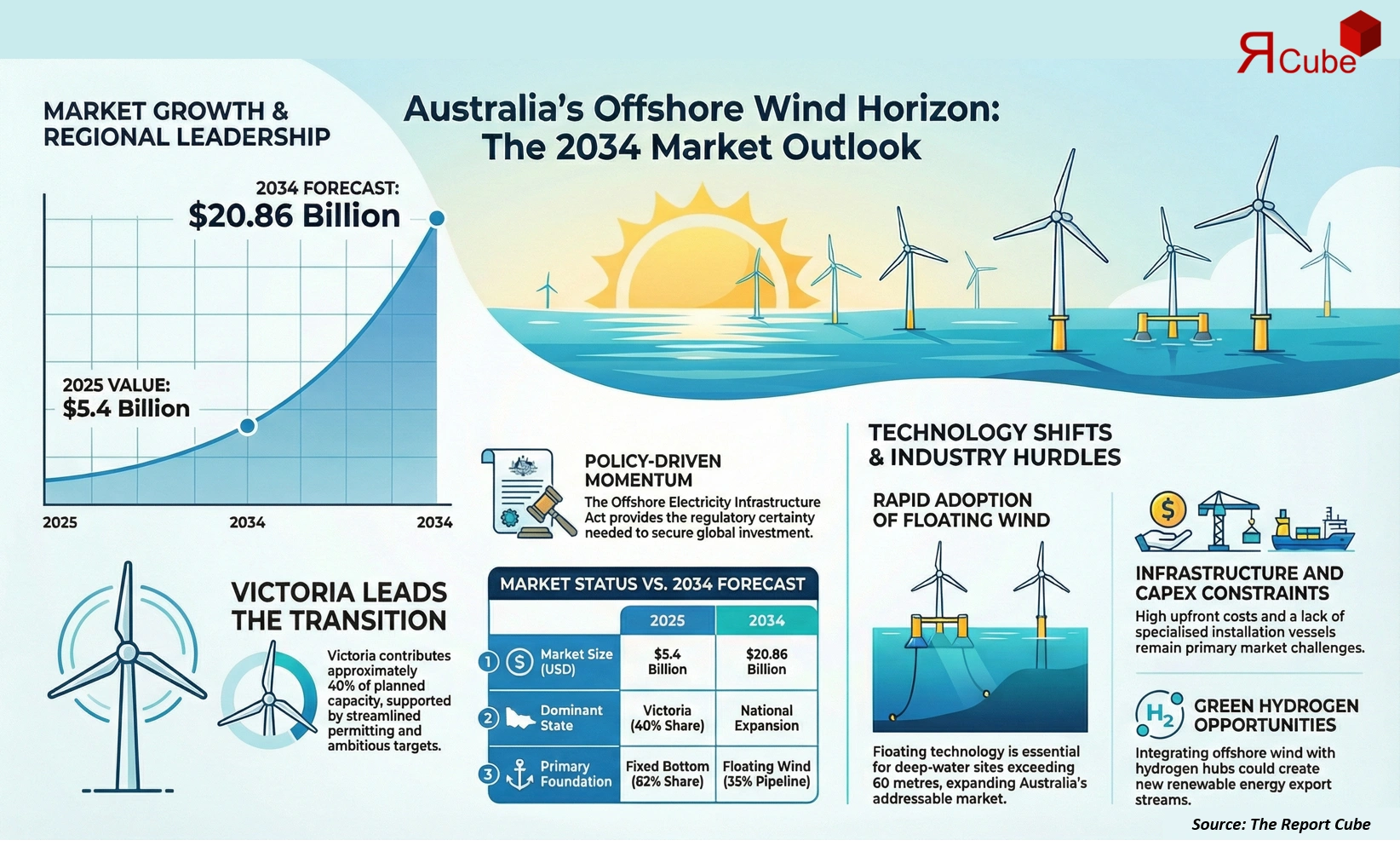
The Australia Offshore Wind Energy Market is anticipated to register a CAGR of 16.20% during 2026-2034. The market size was valued at USD 5.4 billion in 2025 and is projected to reach USD 20.86 billion by 2034. This rapid expansion reflects Australia’s accelerating transition toward renewable energy sources as the country targets net-zero emissions and long-term energy security. Offshore wind is emerging as a strategic solution due to Australia’s vast coastline, strong wind resources, and proximity of demand centers to coastal regions.
Unlike onshore renewables, offshore wind offers higher capacity factors and more consistent generation, making it increasingly attractive for large-scale grid stability. State-led renewable energy targets, combined with declining turbine and installation costs, are improving project economics. Additionally, global developers are entering the Australian market, bringing technical expertise and financing capacity that further accelerates project pipelines. These developments are strengthening investor confidence and positioning offshore wind as a cornerstone of Australia’s future power mix.
Furthermore, advancements in floating wind technology are unlocking deeper waters previously considered unviable, expanding the national addressable market. As grid infrastructure upgrades and port developments gain momentum, the Australia Offshore Wind Energy Market is expected to experience sustained double-digit growth through 2034.
Australia Offshore Wind Energy Market Recent Developments
- 2025: Equinor advanced feasibility studies for large-scale offshore wind projects along the southeastern Australian coastline.
- 2025: RWE partnered with local stakeholders to assess grid integration options for future offshore wind farms.
Government Initiatives & Policies
- Offshore Electricity Infrastructure Act: Establishes regulatory frameworks for offshore renewable projects in Commonwealth waters.
- National Renewable Energy Target Expansion: Supports large-scale renewable deployment, including offshore wind capacity development.
Australia Offshore Wind Energy Market Dynamics
Key Driver: Strong Policy Support and Decarbonization Commitments
Robust federal and state-level policy support is a primary driver of the Australia Offshore Wind Energy Market. Australia’s commitment to reducing greenhouse gas emissions by 43% by 2030 and achieving net-zero by 2050 has intensified focus on scalable clean energy solutions. Offshore wind aligns well with these goals due to its high output potential and reliability. Several states have designated offshore wind zones, streamlining approvals and reducing project uncertainty. As a result, over 15 GW of offshore wind capacity is currently under various stages of planning, highlighting strong long-term growth momentum driven by policy certainty.
Book your FREE 30-minute expert consultation today
Contact UsIndustry Trends: Rapid Adoption of Floating Wind Technology
A defining trend in the market is the increasing adoption of floating offshore wind technology. Given Australia’s relatively deep coastal waters, floating foundations are becoming essential for unlocking large-scale capacity. These systems allow deployment in waters exceeding 60 meters, significantly expanding viable project areas. Technological advancements are reducing installation complexity and improving stability, while global experience is lowering costs. By 2030, floating wind is expected to represent over 35% of Australia’s offshore wind pipeline, signaling a structural shift in project design and development strategies.
Major Challenge: High Capital Expenditure and Infrastructure Constraints
Despite strong growth prospects, high upfront capital requirements remain a significant challenge. Offshore wind projects require substantial investment in turbines, foundations, subsea cables, and grid connections. Australia also faces port infrastructure limitations and a shortage of specialized installation vessels. These factors can delay project timelines and increase costs, particularly during early market development. Additionally, grid connection constraints in certain coastal regions may limit near-term capacity additions, requiring coordinated infrastructure planning.
Opportunity: Export-Oriented Renewable Energy and Industrial Demand
The rising demand for green electricity from energy-intensive industries presents a major opportunity for offshore wind developers. Sectors such as green hydrogen, ammonia, and advanced manufacturing are seeking reliable renewable power sources. Offshore wind’s large-scale output makes it ideal for supporting these industries and potential energy exports. Strategic integration of offshore wind with hydrogen hubs could significantly enhance Australia’s renewable export competitiveness, creating long-term revenue streams beyond domestic power markets.
Australia Offshore Wind Energy Market Segment-wise Analysis
By Foundation Type:
- Fixed Bottom
- Floating Wind
Fixed-bottom foundations currently dominate the market, accounting for approximately 62% of installed capacity in 2025. These structures are cost-effective in shallow and transitional waters and benefit from proven engineering designs. However, floating wind is the fastest-growing sub-segment, driven by Australia’s deep-water conditions. Floating wind projects are expected to gain significant market share post-2028 as costs decline and pilot projects transition to commercial-scale deployment.
By Depth:
- Deep-water (>60 m)
- Transitional Water (30-60 m)
- Shallow Water (<30 m)
Transitional water projects lead the market with nearly 45% share, offering an optimal balance between installation feasibility and wind resource quality. These depths allow both fixed-bottom and early floating technologies, making them attractive for initial developments. Deep-water segments are projected to witness the highest growth rate, supported by floating wind innovation and expanding project pipelines in deeper offshore zones.
Regional Projection of Australia Offshore Wind Energy Industry
- New South Wales
- Victoria
- Queensland
- Western Australia
Victoria leads the Australia Offshore Wind Energy Market, contributing approximately 40% of planned capacity in 2025. The state benefits from strong wind resources, supportive policies, and established renewable infrastructure. Victoria’s ambitious offshore wind targets and streamlined permitting processes have attracted major global developers. New South Wales follows closely, while Western Australia is emerging as a long-term growth region due to its industrial energy demand and export-oriented renewable strategies.
Need insights for a specific region within this market?
Request Regional DataWhy Choose This Report?
- Provides a comprehensive overview of the overall market analysis, encompassing key trends, consumer behavior analysis, and risk assessment to support strategic decision-making.
- Provides accurate, up-to-date insights into market size, segmentation, and emerging opportunities, helping to minimize risk & capitalizing on growth.
- Gives deep understanding of target audience preferences, investment habits, and communication channels for enhanced product development & marketing effectiveness.
- Delivers competitive analysis & benchmarking, uncovering the strengths & weaknesses of market competitors to guide strategies.
- Consolidate comprehensive market intelligence, reducing reasoning & streamlining research efforts.
- Facilitates customized market segmentation & risk mitigation strategies, fine-tuned to the business objectives.
- Aids in identifying both market challenges & untapped opportunities within the industry to drive long-term business growth.
- Provides valuable information based on actual customer data & search trends.
Table of Contents
- Introduction
- Objective of the Study
- Product and Category Definition
- Market Segmentation
- Study Variables
- Research Methodology
- Secondary Data Points
- Breakdown of Secondary Sources
- Primary Data Points
- Breakdown of Primary Interviews
- Secondary Data Points
- Executive Summary
- Market Dynamics
- Drivers
- Challenges
- Opportunity Assessment
- Recent Trends and Developments
- Regulatory and Policy Landscape
- Australia Offshore Wind Energy Market Overview (2021-2034)
- Market Size, By Value (USD Billion)
- Market Share, By Foundation Type
- Fixed Bottom
- Floating Wind
- Market Share, By Depth
- Deep-water (depth >60 m)
- Transitional Water (depth 30-60 m)
- Shallow water (depth < 30 m)
- Market Share, By Turbine Capacity
- Up to 5 MW
- 5-10 MW
- Above 10 MW
- Market Share, By Application
- Grid Power
- Industrial Supply
- Hydrogen Projects
- Others
- Market Share, By Component
- Turbines
- Rotor & Blades
- Tower
- Nacelle
- Substructures
- Jacket
- Monopile
- Substructure (steel)
- Others
- Electrical infrastructure
- Wires & cables
- Substation
- Others
- Others
- Turbines
- Market Share, By Development Stage
- Feasibility Phase
- Construction Phase
- Operational Assets
- Market Share, By Region
- New South Wales
- Victoria
- Queensland
- South Australia
- Western Australia
- Tasmania
- Northern Territory
- Australian Capital Territory
- Market Share, By Company
- Competition Characteristics
- Revenue Shares & Analysis
- New South Wales Offshore Wind Market
- Market Size, By Value (USD Billion)
- Market Share, By Foundation Type
- Market Share, By Depth
- Market Share, By Turbine Capacity
- Market Share, By Application
- Market Share, By Component
- Market Share, By Development Stage
- Victoria Offshore Wind Market
- Market Size, By Value (USD Billion)
- Market Share, By Foundation Type
- Market Share, By Depth
- Market Share, By Turbine Capacity
- Market Share, By Application
- Market Share, By Component
- Market Share, By Development Stage
- Queensland Offshore Wind Market
- Market Size, By Value (USD Billion)
- Market Share, By Foundation Type
- Market Share, By Depth
- Market Share, By Turbine Capacity
- Market Share, By Application
- Market Share, By Component
- Market Share, By Development Stage
- South Australia Offshore Wind Market
- Market Size, By Value (USD Billion)
- Market Share, By Foundation Type
- Market Share, By Depth
- Market Share, By Turbine Capacity
- Market Share, By Application
- Market Share, By Component
- Market Share, By Development Stage
- Western Australia Offshore Wind Market
- Market Size, By Value (USD Billion)
- Market Share, By Foundation Type
- Market Share, By Depth
- Market Share, By Turbine Capacity
- Market Share, By Application
- Market Share, By Component
- Market Share, By Development Stage
- Tasmania Offshore Wind Market
- Market Size, By Value (USD Billion)
- Market Share, By Foundation Type
- Market Share, By Depth
- Market Share, By Turbine Capacity
- Market Share, By Application
- Market Share, By Component
- Market Share, By Development Stage
- Northern Territory Offshore Wind Market
- Market Size, By Value (USD Billion)
- Market Share, By Foundation Type
- Market Share, By Depth
- Market Share, By Turbine Capacity
- Market Share, By Application
- Market Share, By Component
- Market Share, By Development Stage
- Australian Capital Territory Offshore Wind Market
- Market Size, By Value (USD Billion)
- Market Share, By Foundation Type
- Market Share, By Depth
- Market Share, By Turbine Capacity
- Market Share, By Application
- Market Share, By Component
- Market Share, By Development Stage
- Competitive Outlook and Company Profiles
- Vestas
- Company Overview
- Offshore Portfolio
- Strategic Alliances/Partnerships
- Recent Developments
- Siemens Gamesa
- Company Overview
- Offshore Portfolio
- Strategic Alliances/Partnerships
- Recent Developments
- GE Renewable Energy
- Company Overview
- Offshore Portfolio
- Strategic Alliances/Partnerships
- Recent Developments
- Ørsted
- Company Overview
- Offshore Portfolio
- Strategic Alliances/Partnerships
- Recent Developments
- RWE
- Company Overview
- Offshore Portfolio
- Strategic Alliances/Partnerships
- Recent Developments
- EDF Renewables
- Company Overview
- Offshore Portfolio
- Strategic Alliances/Partnerships
- Recent Developments
- Equinor
- Company Overview
- Offshore Portfolio
- Strategic Alliances/Partnerships
- Recent Developments
- Macquarie Group
- Company Overview
- Offshore Portfolio
- Strategic Alliances/Partnerships
- Recent Developments
- CIP (Copenhagen Infrastructure Partners)
- Company Overview
- Offshore Portfolio
- Strategic Alliances/Partnerships
- Recent Developments
- Oceanex Energy
- Company Overview
- Offshore Portfolio
- Strategic Alliances/Partnerships
- Recent Developments
- Others
- Vestas
- Contact Us and Disclaimer
Top Key Players & Market Share Outlook
- Vestas
- Siemens Gamesa
- GE Renewable Energy
- Ørsted
- RWE
- EDF Renewables
- Equinor
- Macquarie Group
- CIP (Copenhagen Infrastructure Partners)
- Oceanex Energy
- Others
Frequently Asked Questions






