



Build Your Custom Market Intelligence Report
Customize Your ReportAsia Pacific Online Language Learning Market Key Highlights
By Language:
English language learning leads the market, contributing nearly 38% of total revenue.
By Age Group:
The 18-30 years segment dominates the market, accounting for approximately 42% share.
Regional Outlook:
China remains the leading country in the Asia Pacific online language learning market with around 34% share.
Government Initiatives & Policies
- China Digital Education Action Plan: National strategy promoting online education platforms and AI-enabled learning solutions across K-12 and higher education.
- India National Education Policy (NEP 2020): Encourages technology-driven language learning and multilingual education access.
Asia Pacific Online Language Learning Market Insights & Analysis
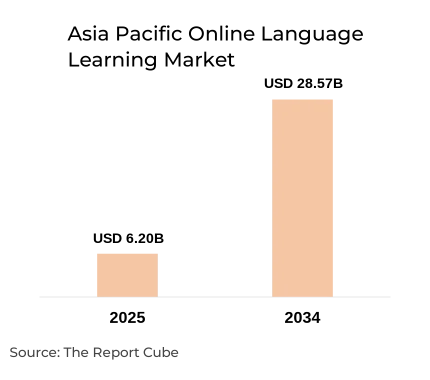
The Asia Pacific Online Language Learning Market is anticipated to register a CAGR of 18.5% during 2026-2034. The market size was valued at USD 6.2 billion in 2025 and is projected to reach USD 28.57 billion by 2034. Rapid digitalization of education, combined with rising cross-border mobility for education and employment, has transformed online language learning into a mainstream academic and professional development tool across the region.
Asia Pacific represents one of the most linguistically diverse and digitally dynamic regions globally. More than 60% of the world’s internet users reside in this region, creating fertile ground for scalable online education platforms. Governments are actively promoting digital classrooms to address teacher shortages and expand rural access. Meanwhile, private platforms are leveraging mobile-first strategies, AI-driven personalization, and gamification to improve learner engagement. Venture capital investment in EdTech across Asia Pacific exceeded USD 12 billion between 2022 and 2024, with language learning platforms attracting a significant portion due to predictable subscription revenue models. These interconnected factors collectively underpin strong long-term market expansion.
Asia Pacific Online Language Learning Market Dynamics
Key Driver: Rising Demand for English and Career-Oriented Language Skills
Across Asia Pacific, language proficiency is increasingly viewed as an economic enabler rather than an academic luxury. English remains the dominant language for global business, higher education, and digital employment, motivating millions of learners to adopt online platforms for flexible skill acquisition. In countries such as India, Vietnam, and Indonesia, over 70% of university students actively pursue online English courses alongside formal education. Multinational corporations operating in Asia Pacific also prioritize language proficiency, particularly in customer service, IT, and remote work roles. Online platforms address this demand by offering affordable, scalable, and self-paced learning models. The ability to access native speakers, standardized testing preparation, and real-time feedback further strengthens learner preference for digital solutions over traditional classroom formats.
Book your FREE 30-minute expert consultation today
Contact UsIndustry Trend: AI-Powered Personalization and Immersive Learning Models
One of the most prominent trends shaping the market is the integration of artificial intelligence to deliver adaptive learning experiences. Platforms now analyze learner behavior, pronunciation accuracy, and progress patterns to tailor lesson difficulty and pacing. AI-driven speech recognition has improved pronunciation accuracy by nearly 30% compared to static content models. Another growing trend is immersive learning using VR and simulated conversational environments, particularly for Japanese, Mandarin, and Korean language training. These approaches enhance contextual learning and retention rates. Subscription-based microlearning, short daily lessons, and gamified streak systems are also gaining popularity, especially among younger learners, reinforcing long-term user engagement.
Major Challenge: Uneven Digital Access and Learner Retention Issues
Although the market is expanding rapidly, uneven digital infrastructure across Asia Pacific poses challenges. Rural and semi-urban regions in countries such as Indonesia, India, and Vietnam still face inconsistent internet connectivity, limiting seamless access to live classes and multimedia content. Additionally, learner retention remains a persistent issue, with completion rates for self-paced language courses averaging below 40%. Many users struggle with motivation without structured accountability. Price sensitivity also affects long-term subscriptions, particularly in emerging economies. Platforms must balance affordability with content quality while addressing engagement gaps through blended models and localized curriculum design.
Opportunity: Growth of Young Learners and Blended Learning Models
The expansion of online language learning among children and early teenagers presents a significant growth opportunity. Parents increasingly invest in language education to enhance global competitiveness and academic readiness. The below-13 age group is emerging as one of the fastest-growing segments, supported by interactive content and parental involvement tools. Blended learning models that combine online instruction with offline support centers are gaining traction, improving trust and learning outcomes. Corporate language training and government-backed reskilling programs also represent untapped opportunities, particularly for workforce upskilling in export-driven economies.
Asia Pacific Online Language Learning Market Segment-wise Analysis
By Language:
- English
- Mandarin
- Japanese
- Korean
- French
- Spanish
- German
- Arabic
- Italian
- Other Languages
English language learning leads the market with approximately 38% share in 2025, reflecting its role as the primary medium for higher education, international trade, and digital employment. Demand is particularly strong in India, China, and Southeast Asia, where English proficiency is closely linked to income growth. Platforms offering test preparation for IELTS, TOEFL, and corporate communication skills see higher subscription renewal rates. Mandarin and Japanese follow as key growth languages, driven by regional trade integration and cultural exchange.
By Age Group:
- Below 13 Years
- 13-17 Years
- 18-30 Years
- 31-45 Years
- Above 45 Years
The 18-30 years segment dominates the market, accounting for nearly 42% share. This demographic actively pursues language skills for higher education, overseas employment, and remote work opportunities. Digital-native behavior, comfort with mobile learning, and willingness to invest in self-improvement fuel strong adoption. Platforms targeting this segment emphasize flexible scheduling, certification, and conversational fluency. Meanwhile, the below-13 years segment is expanding rapidly, supported by parental spending on early skill development.
Regional Projection of Asia Pacific Online Language Learning Industry
- China
- Japan
- South Korea
- India
- Indonesia
- Australia & New Zealand
- Taiwan
- Hong Kong
- Singapore
- Malaysia
- Vietnam
- Rest of Asia Pacific
China leads the Asia Pacific online language learning market with around 34% share, driven by strong demand for English and test preparation services alongside growing interest in multilingual education. India follows as a high-growth market, supported by a large youth population and rapid smartphone penetration. Japan and South Korea maintain steady demand for English and business communication training, while Southeast Asian countries such as Vietnam and Indonesia exhibit accelerating adoption due to expanding middle-class populations and workforce globalization.
Asia Pacific Online Language Learning Market Recent Developments
- July 2025: LingoAce expanded its blended-learning strategy by opening its fifth ACE Academy Learning Center, integrating online Mandarin education with in-person academic support for learners aged 4-15 across multiple international locations.
- 2025: BYJU’S announced plans to embed advanced AI capabilities across its learning platform, aiming to deliver real-time adaptive tutoring, personalized content pathways, and improved learner engagement.
- 2025: EF Education First strengthened its EF English Live platform by scaling personalized learning plans, placement tests, and 24/7 access to certified teachers to meet rising global demand.
Need insights for a specific region within this market?
Request Regional DataWhy Choose This Report?
- Provides a comprehensive overview of the overall market analysis, encompassing key trends, consumer behavior analysis, and risk assessment to support strategic decision-making.
- Provides accurate, up-to-date insights into market size, segmentation, and emerging opportunities, helping to minimize risk & capitalizing on growth.
- Gives deep understanding of target audience preferences, investment habits, and communication channels for enhanced product development & marketing effectiveness.
- Delivers competitive analysis & benchmarking, uncovering the strengths & weaknesses of market competitors to guide strategies.
- Consolidate comprehensive market intelligence, reducing reasoning & streamlining research efforts.
- Facilitates customized market segmentation & risk mitigation strategies, fine-tuned to the business objectives.
- Aids in identifying both market challenges & untapped opportunities within the industry to drive long-term business growth.
- Provides valuable information based on actual customer data & search trends.
Table of Contents
- Introduction
- Objective of the Study
- Product and Category Definition
- Market Segmentation
- Study Variables
- Research Methodology
- Secondary Data Points
- Breakdown of Secondary Sources
- Primary Data Points
- Breakdown of Primary Interviews
- Secondary Data Points
- Executive Summary
- Market Dynamics
- Drivers
- Challenges
- Opportunity Assessment
- Recent Trends and Developments
- Regulatory and Policy Landscape
- Asia Pacific Online Language Learning Market Overview (2021-2034)
- Market Size, By Value (USD Billion)
- Market Share, By Language
- French
- Japanese
- English
- Arabic
- Mandarin
- Spanish
- German
- Italian
- Korean
- Overview
- Other Languages
- Market Share, By Age Group
- Below 13 Years
- 13-17 Years
- 18-30 Years
- 31-45 Years
- Above 45 Years
- Market Share, By Technology Platform
- VR and AR Tools
- Web-based Platforms
- Conversational Voice Assistants
- Mobile Applications
- Market Share, By Learning Mode
- Blended Learning
- AI-Adaptive Platforms
- Self-Learning Apps
- Tutor-Led
- Market Share, By End-user
- Corporate Learners
- Government and Non-profit Bodies
- Individual Learners
- Educational Institutions (K-12 and Higher-Ed)
- Others
- Market Share, By Platform
- Mobile Apps
- Web-based Portals
- Market Share, By Subscription
- Monthly Plans
- Annual Plans
- One-time Courses
- Market Share, By Country
- China
- Japan
- South Korea
- India
- Indonesia
- Australia & New Zealand
- Taiwan
- Hong Kong
- Singapore
- Malaysia
- Vietnam
- Rest of Asia Pacific
- Market Share, By Company
- Revenue Shares & Analysis
- Competitive Landscape
- China Online Language Learning Market
- Market Size, By Value (USD Billion/Million)
- Market Share, By Language
- Market Share, By Age Group
- Market Share, By Technology Platform
- Market Share, By Learning Mode
- Market Share, By End-user
- Market Share, By Platform
- Market Share, By Subscription
- Japan Online Language Learning Market
- Market Size, By Value (USD Billion/Million)
- Market Share, By Language
- Market Share, By Age Group
- Market Share, By Technology Platform
- Market Share, By Learning Mode
- Market Share, By End-user
- Market Share, By Platform
- Market Share, By Subscription
- South Korea Online Language Learning Market
- Market Size, By Value (USD Billion/Million)
- Market Share, By Language
- Market Share, By Age Group
- Market Share, By Technology Platform
- Market Share, By Learning Mode
- Market Share, By End-user
- Market Share, By Platform
- Market Share, By Subscription
- India Online Language Learning Market
- Market Size, By Value (USD Billion/Million)
- Market Share, By Language
- Market Share, By Age Group
- Market Share, By Technology Platform
- Market Share, By Learning Mode
- Market Share, By End-user
- Market Share, By Platform
- Market Share, By Subscription
- Indonesia Online Language Learning Market
- Market Size, By Value (USD Billion/Million)
- Market Share, By Language
- Market Share, By Age Group
- Market Share, By Technology Platform
- Market Share, By Learning Mode
- Market Share, By End-user
- Market Share, By Platform
- Market Share, By Subscription
- Australia & New Zealand Online Language Learning Market
- Market Size, By Value (USD Billion/Million)
- Market Share, By Language
- Market Share, By Age Group
- Market Share, By Technology Platform
- Market Share, By Learning Mode
- Market Share, By End-user
- Market Share, By Platform
- Market Share, By Subscription
- Taiwan Online Language Learning Market
- Market Size, By Value (USD Billion/Million)
- Market Share, By Language
- Market Share, By Age Group
- Market Share, By Technology Platform
- Market Share, By Learning Mode
- Market Share, By End-user
- Market Share, By Platform
- Market Share, By Subscription
- Hong Kong Online Language Learning Market
- Market Size, By Value (USD Billion/Million)
- Market Share, By Language
- Market Share, By Age Group
- Market Share, By Technology Platform
- Market Share, By Learning Mode
- Market Share, By End-user
- Market Share, By Platform
- Market Share, By Subscription
- Singapore Online Language Learning Market
- Market Size, By Value (USD Billion/Million)
- Market Share, By Language
- Market Share, By Age Group
- Market Share, By Technology Platform
- Market Share, By Learning Mode
- Market Share, By End-user
- Market Share, By Platform
- Market Share, By Subscription
- Malaysia Online Language Learning Market
- Market Size, By Value (USD Billion/Million)
- Market Share, By Language
- Market Share, By Age Group
- Market Share, By Technology Platform
- Market Share, By Learning Mode
- Market Share, By End-user
- Market Share, By Platform
- Market Share, By Subscription
- Vietnam Online Language Learning Market
- Market Size, By Value (USD Billion/Million)
- Market Share, By Language
- Market Share, By Age Group
- Market Share, By Technology Platform
- Market Share, By Learning Mode
- Market Share, By End-user
- Market Share, By Platform
- Market Share, By Subscription
- Competitive Outlook and Company Profiles
- LingoAce
- Company Overview
- Product Portfolio
- Strategic Alliances/Partnerships
- Recent Developments
- AmazingTalker
- Company Overview
- Product Portfolio
- Strategic Alliances/Partnerships
- Recent Developments
- LingoDeer
- Company Overview
- Product Portfolio
- Strategic Alliances/Partnerships
- Recent Developments
- Cakap
- Company Overview
- Product Portfolio
- Strategic Alliances/Partnerships
- Recent Developments
- RareJob
- Company Overview
- Product Portfolio
- Strategic Alliances/Partnerships
- Recent Developments
- HelloTalk
- Company Overview
- Product Portfolio
- Strategic Alliances/Partnerships
- Recent Developments
- BYJU'S
- Company Overview
- Product Portfolio
- Strategic Alliances/Partnerships
- Recent Developments
- EnglishCentral
- Company Overview
- Product Portfolio
- Strategic Alliances/Partnerships
- Recent Developments
- 51Talk
- Company Overview
- Product Portfolio
- Strategic Alliances/Partnerships
- Recent Developments
- Unacademy
- Company Overview
- Product Portfolio
- Strategic Alliances/Partnerships
- Recent Developments
- Eigox
- Company Overview
- Product Portfolio
- Strategic Alliances/Partnerships
- Recent Developments
- YBM Net
- Company Overview
- Product Portfolio
- Strategic Alliances/Partnerships
- Recent Developments
- iTutorGroup
- Company Overview
- Product Portfolio
- Strategic Alliances/Partnerships
- Recent Developments
- Education First (EF)
- Company Overview
- Product Portfolio
- Strategic Alliances/Partnerships
- Recent Developments
- Lingvist
- Company Overview
- Product Portfolio
- Strategic Alliances/Partnerships
- Recent Developments
- Native Camp
- Company Overview
- Product Portfolio
- Strategic Alliances/Partnerships
- Recent Developments
- Vyoma Labs
- Company Overview
- Product Portfolio
- Strategic Alliances/Partnerships
- Recent Developments
- Others
- LingoAce
- Contact Us and Disclaimer
Top Key Players & Market Share Outlook
- LingoAce
- AmazingTalker
- LingoDeer
- Cakap
- RareJob
- HelloTalk
- BYJU'S
- EnglishCentral
- 51Talk
- Unacademy
- Eigox
- YBM Net
- iTutorGroup
- Education First (EF)
- Lingvist
- Native Camp
- Vyoma Labs
- Others
Frequently Asked Questions