



Build Your Custom Market Intelligence Report
Customize Your ReportNew Zealand Real Estate Market Insights & Analysis
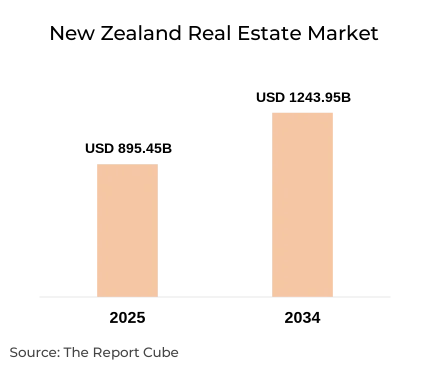
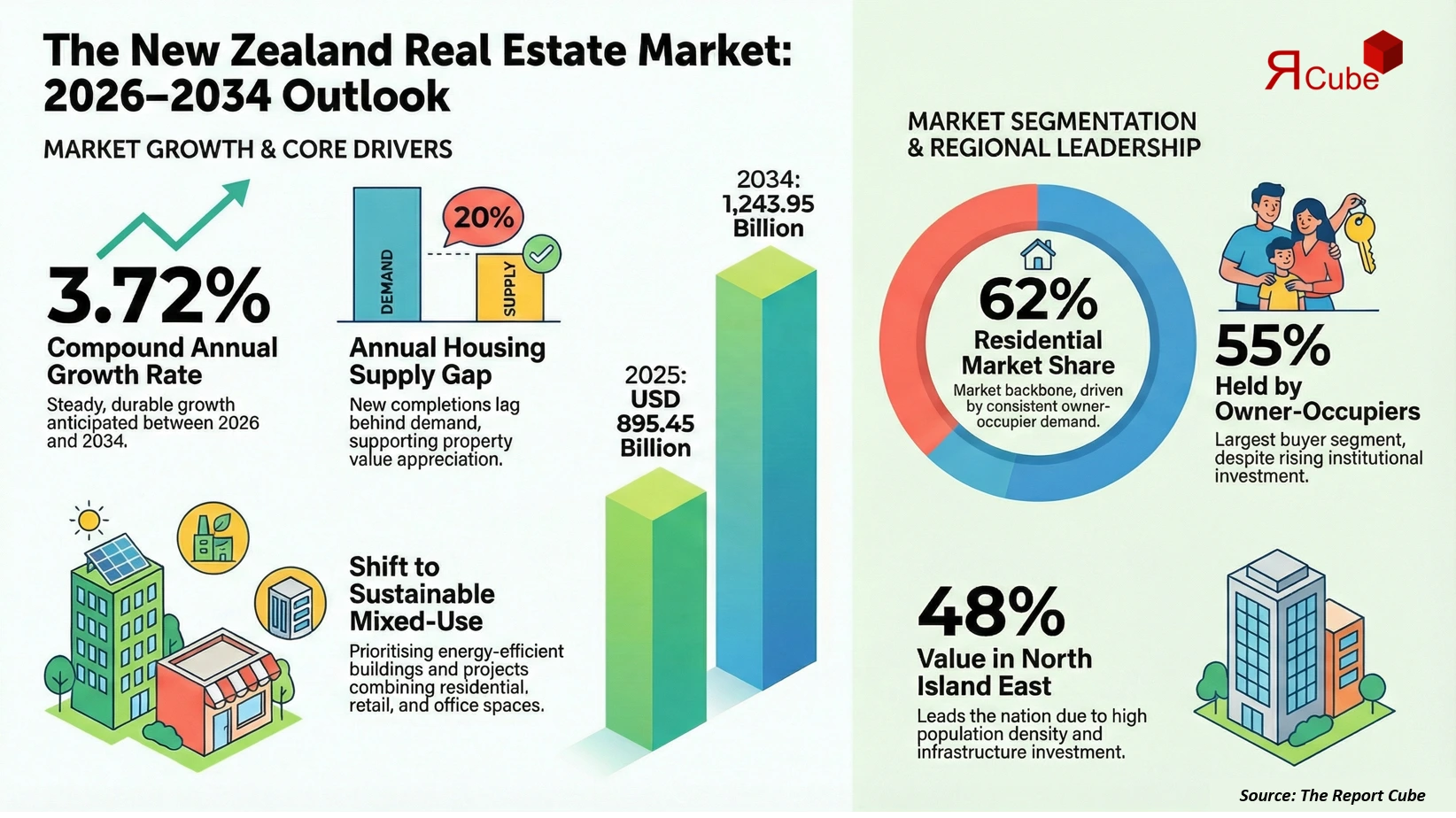
The New Zealand Real Estate Market is anticipated to register a CAGR of 3.72% during 2026-2034. The market size was valued at USD 895.45 billion in 2025 and is projected to reach USD 1,243.95 billion by 2034. The market continues to play a foundational role in the country’s economic structure, supported by steady population growth, urban expansion, and long-term housing demand. Despite cyclical fluctuations in pricing, real estate remains a preferred asset class due to its stability, tangible value, and ability to generate long-term capital appreciation.
Residential real estate remains the backbone of the market, driven by consistent owner-occupier demand and constrained housing supply in major urban centers. At the same time, commercial and industrial segments are benefiting from business decentralization, logistics expansion, and infrastructure investments. While higher interest rates moderated transaction volumes in recent years, improving affordability conditions and gradual monetary easing are expected to revive buyer confidence during the forecast period.
Additionally, regulatory clarity around foreign investment and sustainability-focused construction practices is shaping a more transparent and resilient market landscape. Together, these factors position the New Zealand Real Estate Market for measured but durable growth through 2034.
New Zealand Real Estate Market Recent Developments
- 2025: Ray White expanded its data-driven property valuation tools to improve pricing accuracy nationwide.
- 2025: Bayleys Real Estate launched new mixed-use advisory services targeting urban redevelopment projects.
Government Initiatives & Policies
- National Policy Statement on Urban Development: Supports higher-density housing and efficient land use.
- KiwiBuild Program: Government initiative increasing affordable housing supply across regions.
New Zealand Real Estate Market Dynamics
Key Driver: Persistent Housing Demand Amid Limited Supply
Ongoing housing demand driven by population growth, urban migration, and household formation remains a primary driver of the New Zealand Real Estate Market. Major cities continue to experience supply shortages, with new housing completions lagging behind demand by an estimated 20% annually. This imbalance supports long-term property value appreciation and sustains investor interest. Furthermore, lifestyle-driven migration toward regional centers is expanding demand beyond traditional urban hubs, creating new development corridors and broadening market depth.
Book your FREE 30-minute expert consultation today
Contact UsIndustry Trends: Shift Toward Sustainable and Mixed-Use Developments
Sustainability and mixed-use development models are increasingly shaping investment decisions. Developers are prioritizing energy-efficient buildings, green certifications, and community-centric designs to align with evolving buyer preferences. Mixed-use projects combining residential, retail, and office spaces are gaining traction, particularly in urban regeneration zones. These developments enhance land-use efficiency while providing diversified income streams, making them attractive to institutional investors and developers alike.
Major Challenge: Interest Rate Sensitivity and Affordability Constraints
Affordability pressures and sensitivity to interest rate movements remain key challenges. Elevated mortgage rates have reduced borrowing capacity, particularly among first-time buyers. Construction cost inflation and regulatory compliance expenses further add to development costs, limiting new supply. These factors collectively restrain transaction volumes and delay project timelines, particularly within the residential segment.
Opportunity: Rising Institutional and Build-to-Rent Investments
The growing participation of institutional investors presents a notable opportunity. Build-to-rent housing, logistics assets, and premium commercial properties are attracting long-term capital due to stable yields and inflation hedging benefits. Institutional investment is expected to improve housing quality, introduce professional asset management practices, and enhance rental supply, supporting market stability through the forecast period.
New Zealand Real Estate Market Segment-wise Analysis
By Type:
- Residential
- Commercial
- Industrial
- Retail
- Rural/Lifestyle
Residential real estate dominates the market, accounting for approximately 62% of total market value in 2025. Strong owner-occupier demand and limited housing stock underpin this dominance. Industrial assets follow, supported by logistics and warehousing demand linked to e-commerce growth. Commercial and retail segments remain stable, with selective growth in prime locations.
By Buyer Type:
- Owner-Occupier
- Domestic Investor
- Institutional
- Foreign Investor
Owner-occupiers represent the largest buyer group, holding nearly 55% market share. However, institutional buyers are steadily increasing their presence, particularly in rental housing and commercial assets, driven by long-term income stability and portfolio diversification.
Regional Projection of New Zealand Real Estate Industry
- North Island East
- North Island West
- South Island East
- South Island West
The North Island East region leads the market, contributing around 48% of total real estate value in 2025. Strong economic activity, population density, and infrastructure investment support sustained demand. Other regions are witnessing moderate growth, driven by lifestyle migration and regional development initiatives.
Need insights for a specific region within this market?
Request Regional DataWhy Choose This Report?
- Provides a comprehensive overview of the overall market analysis, encompassing key trends, consumer behavior analysis, and risk assessment to support strategic decision-making.
- Provides accurate, up-to-date insights into market size, segmentation, and emerging opportunities, helping to minimize risk & capitalizing on growth.
- Gives deep understanding of target audience preferences, investment habits, and communication channels for enhanced product development & marketing effectiveness.
- Delivers competitive analysis & benchmarking, uncovering the strengths & weaknesses of market competitors to guide strategies.
- Consolidate comprehensive market intelligence, reducing reasoning & streamlining research efforts.
- Facilitates customized market segmentation & risk mitigation strategies, fine-tuned to the business objectives.
- Aids in identifying both market challenges & untapped opportunities within the industry to drive long-term business growth.
- Provides valuable information based on actual customer data & search trends.
Table of Contents
- Introduction
- Objective of the Study
- Product and Category Definition
- Market Segmentation
- Study Variables
- Research Methodology
- Secondary Data Points
- Breakdown of Secondary Sources
- Primary Data Points
- Breakdown of Primary Interviews
- Secondary Data Points
- Executive Summary
- Market Dynamics
- Drivers
- Challenges
- Opportunity Assessment
- Recent Trends and Developments
- Regulatory and Policy Landscape
- New Zealand Real Estate Market Overview (2020-2034)
- Market Size, By Value (NZD Billion)
- Market Share, By Type
- Residential
- Commercial
- Industrial
- Retail
- Rural/Lifestyle
- Market Share, By Buyer Type
- Owner-Occupier
- Domestic Investor
- Institutional
- Foreign Investor
- Market Share, By Transaction Type
- Sales
- Leasing
- Development
- Market Share, By Customer Segment
- First-Home Buyers
- Upsizers
- Downsizers
- Corporate Occupiers
- Market Share, By Region
- North Island East
- North Island West
- South Island East
- South Island West
- Market Share, By Company
- Competition Characteristics
- Revenue Shares & Analysis
- North Island East Real Estate Market
- Market Size, By Value (NZD Billion)
- Market Share, By Segment
- Market Share, By Buyer Type
- Market Share, By Transaction Type
- Market Share, By Customer Segment
- Market Share, By Sub‑Region
- Auckland
- Tauranga
- Hawke's Bay
- Gisborne
- North Island West Real Estate Market
- Market Size, By Value (NZD Billion)
- Market Share, By Segment
- Market Share, By Buyer Type
- Market Share, By Transaction Type
- Market Share, By Customer Segment
- Market Share, By Sub‑Region
- Waikato
- Hamilton
- Taranaki
- Northland
- South Island East Real Estate Market
- Market Size, By Value (NZD Billion)
- Market Share, By Segment
- Market Share, By Buyer Type
- Market Share, By Transaction Type
- Market Share, By Customer Segment
- Market Share, By Sub‑Region
- Christchurch
- Queenstown Lakes
- Canterbury
- Otago
- South Island West Real Estate Market
- Market Size, By Value (NZD Billion)
- Market Share, By Segment
- Market Share, By Buyer Type
- Market Share, By Transaction Type
- Market Share, By Customer Segment
- Market Share, By Sub‑Region
- West Coast
- Southland
- Nelson Tasman
- Marlborough
- Competitive Outlook and Company Profiles
- Bayleys Real Estate
- Company Overview
- Service Portfolio
- Strategic Alliances/Partnerships
- Recent Developments
- Harcourts
- Company Overview
- Service Portfolio
- Strategic Alliances/Partnerships
- Recent Developments
- Barfoot & Thompson
- Company Overview
- Service Portfolio
- Strategic Alliances/Partnerships
- Recent Developments
- Ray White
- Company Overview
- Service Portfolio
- Strategic Alliances/Partnerships
- Recent Developments
- Bayleys Commercial
- Company Overview
- Service Portfolio
- Strategic Alliances/Partnerships
- Recent Developments
- CBRE
- Company Overview
- Service Portfolio
- Strategic Alliances/Partnerships
- Recent Developments
- Colliers
- Company Overview
- Service Portfolio
- Strategic Alliances/Partnerships
- Recent Developments
- JLL
- Company Overview
- Service Portfolio
- Strategic Alliances/Partnerships
- Recent Developments
- Property Brokers
- Company Overview
- Service Portfolio
- Strategic Alliances/Partnerships
- Recent Developments
- LJ Hooker
- Company Overview
- Service Portfolio
- Strategic Alliances/Partnerships
- Recent Developments
- Others
- Bayleys Real Estate
- Contact Us and Disclaimer
Top Key Players & Market Share Outlook
- Bayleys Real Estate
- Harcourts
- Barfoot & Thompson
- Ray White
- Bayleys Commercial
- CBRE
- Colliers
- JLL
- Property Brokers
- LJ Hooker
- Others
Frequently Asked Questions






