


Build Your Custom Market Intelligence Report
Customize Your ReportSouth Korea Real Estate Market Insights & Analysis
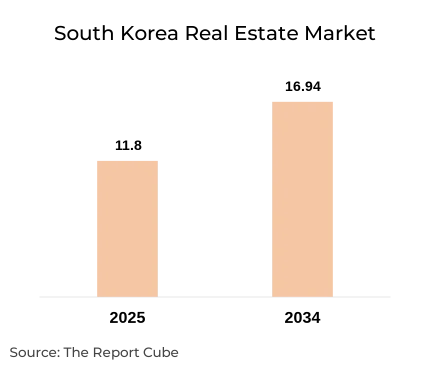
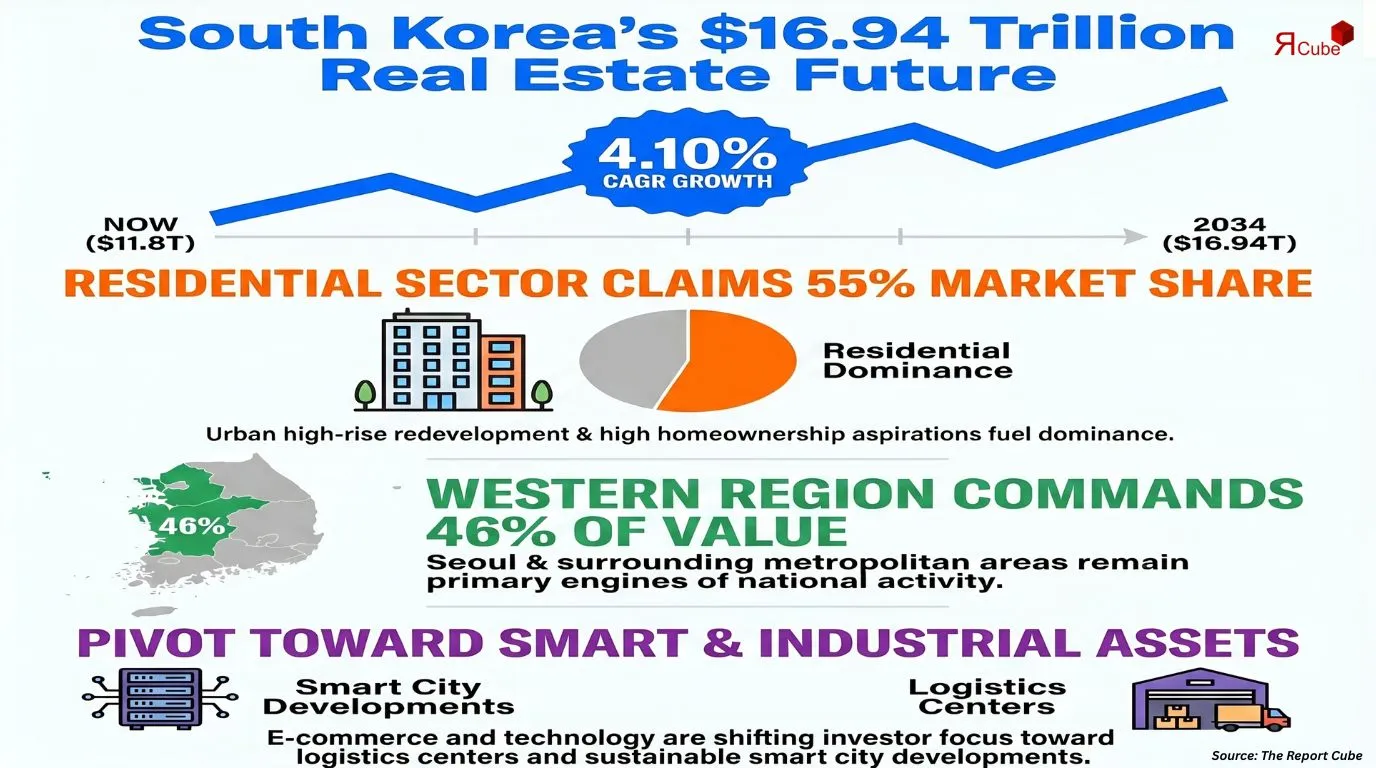
The South Korea Real Estate Market is anticipated to register a CAGR of 4.10% during 2026-2034. The market size was valued at USD 11.8 trillion in 2025 and is projected to reach USD 16.94 trillion by 2034. The market remains a cornerstone of South Korea’s economic structure, supported by strong urbanization, infrastructure maturity, and consistent government involvement in housing stabilization. Real estate continues to function not only as a housing necessity but also as a preferred long-term investment asset for households, institutions, and developers.
Market expansion is closely linked with demographic shifts, evolving household structures, and redevelopment-driven supply in metropolitan areas. High population density in urban centers such as Seoul and its surrounding regions continues to drive residential and mixed-use developments. Simultaneously, demand for logistics, data centers, and smart industrial parks is reshaping non-residential real estate. These trends collectively reinforce market resilience, even amid interest rate fluctuations and regulatory tightening.
Furthermore, digital transformation across property transactions, valuation, and asset management is improving transparency and efficiency. While short-term volatility remains due to macroeconomic conditions, long-term fundamentals such as limited land availability and sustained infrastructure investment underpin the South Korea Real Estate Market’s steady growth outlook through 2034.
South Korea Real Estate Market Recent Developments
- 2025: Samsung C&T expanded high-rise residential redevelopment projects in Seoul’s central districts.
- 2025: Hyundai Engineering & Construction accelerated smart city housing initiatives integrating energy-efficient designs.
Government Initiatives & Policies
- National Housing Stability Plan: Government program to increase affordable housing supply and regulate speculative demand.
- Korean New Deal Urban Regeneration Policy: Focused on redeveloping aging urban infrastructure and residential zones.
South Korea Real Estate Market Dynamics
Key Driver: Sustained Urban Housing Demand and Redevelopment Activity
One of the primary drivers of the South Korea Real Estate Market is sustained housing demand in urban and metropolitan regions. More than 92% of the population now resides in urban areas, intensifying pressure on residential supply. Redevelopment of aging apartment complexes, particularly those over 30 years old, has become a major growth engine. These projects replace low-density housing with high-rise, mixed-use developments that maximize land efficiency. Additionally, smaller household sizes and delayed family formation have increased demand for compact, high-quality residential units, supporting consistent transaction volumes and price stability.
Book your FREE 30-minute expert consultation today
Contact UsIndustry Trends: Growth of Commercial and Industrial Real Estate Assets
Beyond residential real estate, commercial and industrial assets are emerging as key growth segments. Demand for logistics centers has risen sharply due to e-commerce expansion, while office spaces are evolving toward flexible and hybrid layouts. Industrial real estate is benefiting from investments in semiconductors, electric vehicles, and advanced manufacturing, driving demand for specialized facilities. Approximately 28% of total real estate investment volume in 2025 was allocated to non-residential assets, reflecting portfolio diversification among institutional investors.
Major Challenge: Regulatory Controls and Interest Rate Sensitivity
Strict regulatory oversight remains a significant challenge for the market. Government-imposed transaction taxes, mortgage lending restrictions, and ownership caps aim to curb speculation but can also dampen short-term market activity. Additionally, interest rate sensitivity directly affects affordability and borrowing capacity. Rising rates increase mortgage burdens for households and financing costs for developers, potentially delaying project launches. These factors contribute to cautious sentiment among buyers and investors, particularly in high-priced urban markets.
Opportunity: Smart Cities and Sustainable Real Estate Development
The transition toward smart and sustainable cities presents long-term opportunities. Developers are increasingly integrating smart technologies, energy-efficient systems, and green building certifications into new projects. Government-backed sustainability incentives and carbon reduction targets further support this shift. Smart city developments in secondary cities are attracting investment by offering modern infrastructure at comparatively lower costs, positioning sustainability-driven real estate as a major growth avenue through the forecast period.
South Korea Real Estate Market Segment-wise Analysis
By Property Type:
- Residential
- Commercial
- Industrial
- Land
Residential real estate remains the leading property type, accounting for approximately 55% of total market value in 2025. Demand is driven by urban redevelopment, high homeownership aspirations, and limited land availability. High-rise apartment complexes dominate residential supply, particularly in metropolitan areas. Commercial properties follow, supported by office modernization and retail space repositioning, while industrial real estate continues to gain traction through logistics and manufacturing-driven investments.
By Use Type:
- Owner-Occupied
- Rental
- Investment
Owner-occupied properties constitute the largest use segment, representing nearly 48% of market demand. Cultural emphasis on homeownership and long-term asset security supports this dominance. However, the rental segment is expanding steadily, fueled by young professionals and flexible living preferences. Investment-driven real estate, including income-generating commercial assets, is gaining momentum as institutional participation increases, diversifying market demand dynamics.
Regional Projection of South Korea Real Estate Industry
- Eastern
- Western
- Southern
- Jeju Island
The Western region leads the South Korea Real Estate Market, accounting for approximately 46% of total market value in 2025. This dominance is driven by Seoul and its surrounding metropolitan areas, which concentrate population density, economic activity, and infrastructure investment. The region benefits from extensive redevelopment projects, premium commercial assets, and strong rental demand. While Western Korea remains dominant, the Southern region is emerging as a high-growth area due to industrial expansion and port-driven logistics development.
Need insights for a specific region within this market?
Request Regional DataWhy Choose This Report?
- Provides a comprehensive overview of the overall market analysis, encompassing key trends, consumer behavior analysis, and risk assessment to support strategic decision-making.
- Provides accurate, up-to-date insights into market size, segmentation, and emerging opportunities, helping to minimize risk & capitalizing on growth.
- Gives deep understanding of target audience preferences, investment habits, and communication channels for enhanced product development & marketing effectiveness.
- Delivers competitive analysis & benchmarking, uncovering the strengths & weaknesses of market competitors to guide strategies.
- Consolidate comprehensive market intelligence, reducing reasoning & streamlining research efforts.
- Facilitates customized market segmentation & risk mitigation strategies, fine-tuned to the business objectives.
- Aids in identifying both market challenges & untapped opportunities within the industry to drive long-term business growth.
- Provides valuable information based on actual customer data & search trends.
Table of Contents
- Introduction
- Objective of the Study
- Product and Category Definition
- Market Segmentation
- Study Variables
- Research Methodology
- Secondary Data Points
- Breakdown of Secondary Sources
- Primary Data Points
- Breakdown of Primary Interviews
- Secondary Data Points
- Executive Summary
- Market Dynamics
- Drivers
- Challenges
- Opportunity Assessment
- Recent Trends and Developments
- Regulatory and Policy Landscape
- South Korea Real Estate Market Overview (2021-2034)
- Market Size, By Value (USD Billion)
- Market Share, By Property Type
- Residential
- Commercial
- Industrial
- Land
- Market Share, By Use Type
- Owner-Occupied
- Rental
- Investment
- Market Share, By Asset Class
- Office
- Retail
- Logistics
- Multifamily
- Hospitality
- Market Share, By Development Stage
- Pre-Construction
- Under Construction
- Completed
- Market Share, By Region
- Eastern
- Western
- Southern
- Jeju Island
- Market Share, By Company
- Revenue Shares
- Competitive Landscape
- Regional Market Analysis (East-West View)
- Eastern Market
- Market Size, By Value (USD Billion)
- Market Share, By Property Type
- Market Share, By Asset Class
- Market Share, By Use Type
- Western Market
- Market Size, By Value (USD Billion)
- Market Share, By Property Type
- Market Share, By Asset Class
- Market Share, By Use Type
- Southern Market
- Market Size, By Value (USD Billion)
- Market Share, By Property Type
- Market Share, By Asset Class
- Market Share, By Use Type
- Jeju Island Market
- Market Size, By Value (USD Billion)
- Market Share, By Property Type
- Market Share, By Asset Class
- Market Share, By Use Type
- Eastern Market
- Competitive Outlook and Company Profiles
- Samsung C&T Corporation
- Company Overview
- Project Portfolio
- Strategic Alliances/Partnerships
- Recent Developments
- Hyundai Engineering & Construction Co., Ltd.
- Company Overview
- Project Portfolio
- Strategic Alliances/Partnerships
- Recent Developments
- Daewoo Engineering & Construction Co., Ltd.
- Company Overview
- Project Portfolio
- Strategic Alliances/Partnerships
- Recent Developments
- GS Engineering & Construction Corp.
- Company Overview
- Project Portfolio
- Strategic Alliances/Partnerships
- Recent Developments
- SK ecoplant Co., Ltd.
- Company Overview
- Project Portfolio
- Strategic Alliances/Partnerships
- Recent Developments
- POSCO E&C Co., Ltd.
- Company Overview
- Project Portfolio
- Strategic Alliances/Partnerships
- Recent Developments
- Hanwha Engineering & Construction Corp.
- Company Overview
- Project Portfolio
- Strategic Alliances/Partnerships
- Recent Developments
- HDC Hyundai Development Company
- Company Overview
- Project Portfolio
- Strategic Alliances/Partnerships
- Recent Developments
- Lotte Engineering & Construction Co., Ltd.
- Company Overview
- Project Portfolio
- Strategic Alliances/Partnerships
- Recent Developments
- Hyosung & Dongbu Construction
- Company Overview
- Project Portfolio
- Strategic Alliances/Partnerships
- Recent Developments
- Others
- Samsung C&T Corporation
- Contact Us and Disclaimer
Top Key Players & Market Share Outlook
- Samsung C&T Corporation
- Hyundai Engineering & Construction Co., Ltd.
- Daewoo Engineering & Construction Co., Ltd.
- GS Engineering & Construction Corp.
- SK ecoplant Co., Ltd.
- POSCO E&C Co., Ltd.
- Hanwha Engineering & Construction Corp.
- HDC Hyundai Development Company
- Lotte Engineering & Construction Co., Ltd.
- Hyosung & Dongbu Construction
- Others
Frequently Asked Questions