



Build Your Custom Market Intelligence Report
Customize Your ReportEurope Refuse-Derived Fuel Market Key Highlights
By Fuel Form:
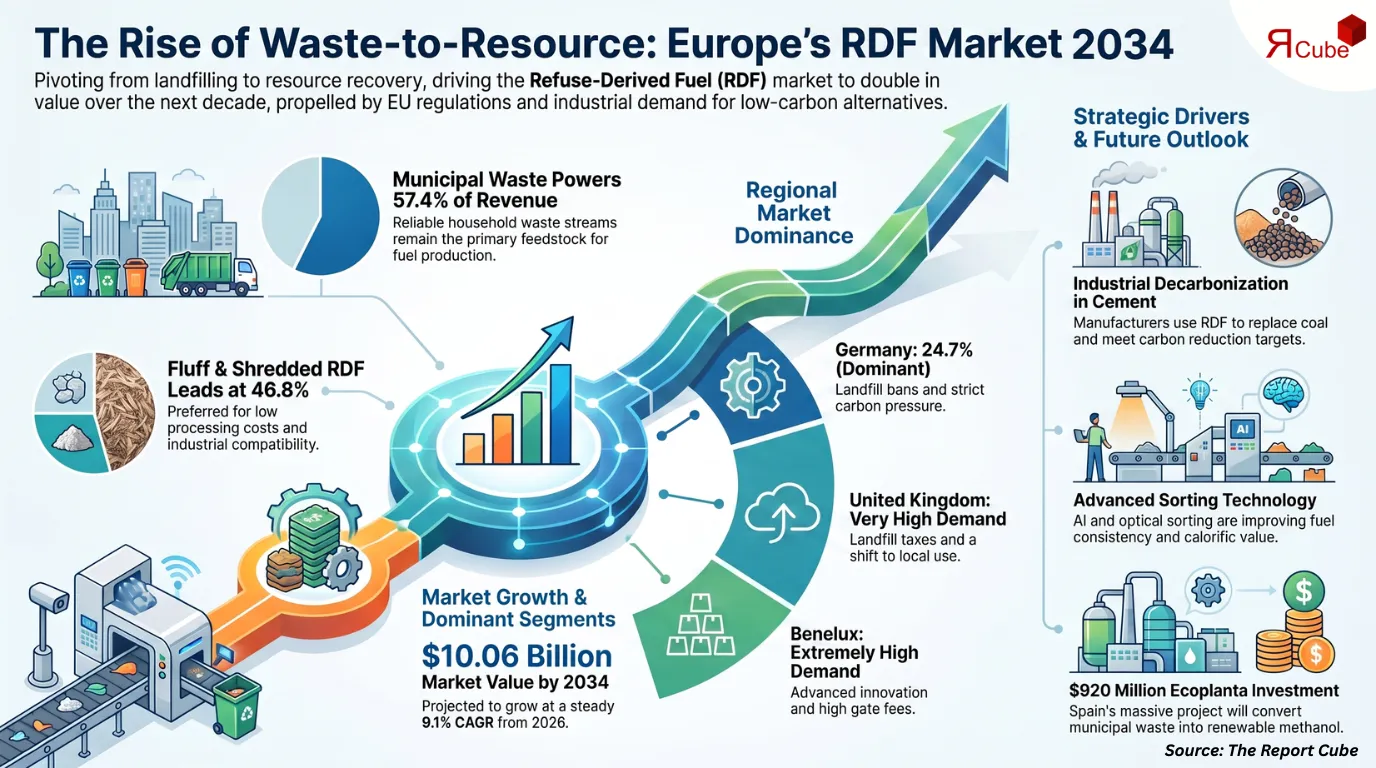
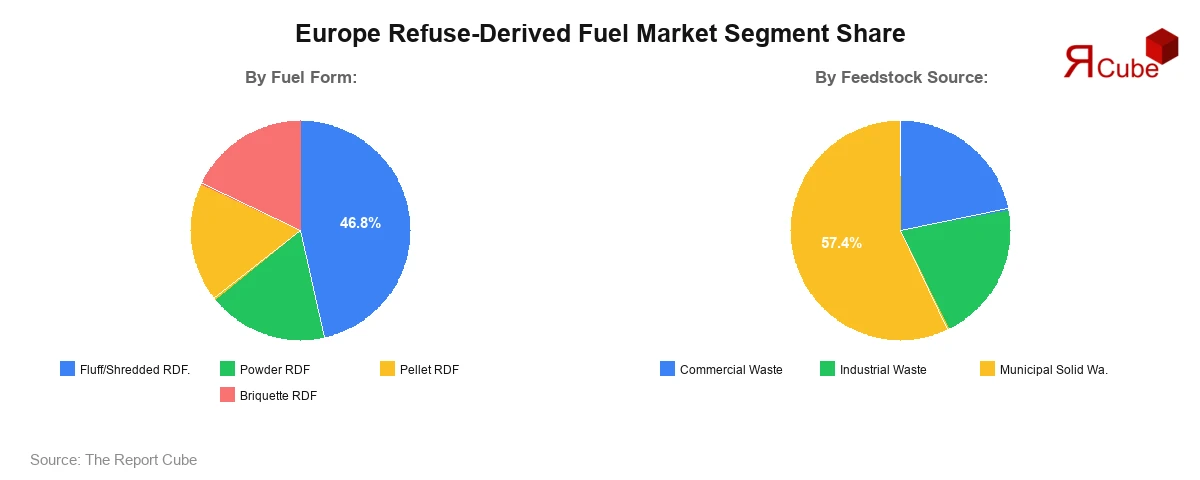
Fluff/Shredded RDF segment leads the market with nearly 46.8% share.
By Feedstock Source:
Municipal Solid Waste (MSW) segment dominates the market with around 57.4% of total revenue.
Regional Outlook:
Germany dominates the Europe Refuse-Derived Fuel Market with approximately 24.7% share.
Europe Refuse-Derived Fuel Market Insights & Analysis
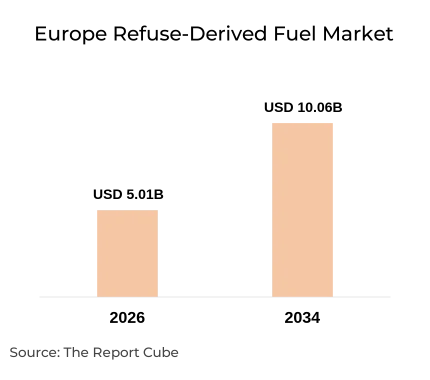
The Europe Refuse-Derived Fuel Market is anticipated to register a CAGR of around 9.1% during the forecast period 2026-2034. The market size is valued at USD 5.01 billion in 2026 and is projected to reach USD 10.06 billion by 2034. The growth of the market is primarily driing by rising demand for RDF fuel in Europe as governments tighten landfill restrictions and encourage the recovery of energy from non-recyclable waste. Industries are increasingly replacing coal and petroleum coke with fuel from municipal, commercial, or industrial waste to reduce operating costs and comply with carbon reduction targets. The cement sector remains the largest end user because RDF delivers a reliable calorific value while helping manufacturers lower fossil fuel consumption. Continued investment in mechanical biological treatment facilities, optical sorting systems, and high-efficiency shredding equipment is improving fuel consistency, making refuse-derived fuel a dependable energy source for multiple industrial applications across Europe.
Recent capital investments illustrate the long-term confidence in Europe's waste-to-resource industry. In 2025, Repsol approved the Ecoplanta project in Tarragona, Spain, which will convert residual municipal waste into renewable methanol at commercial scale, creating an additional high-value outlet for non-recyclable waste streams. Institutional investors are also increasing their presence in the sector, highlighted by the acquisition of Renewi, which is expected to strengthen waste processing capacity and logistics across the Benelux region. At the same time, equipment manufacturers are introducing next-generation shredding, screening, and material recovery technologies that improve RDF quality while reducing energy consumption during processing. These developments are strengthening feedstock availability, improving supply chain efficiency, and expanding the commercial role of RDF fuel in Europe within the broader circular economy.
Europe Refuse-Derived Fuel Market Impact Analysis
| Factor | Type | Specific Impact on Market | Magnitude | Business Implication |
|---|---|---|---|---|
| EU landfill diversion policies | Regulatory | Stricter waste rules push residual waste toward RDF output | High | Supports long term feedstock and offtake stability for producers |
| Renewable energy and decarbonization goals | Environmental | Climate targets increase interest in RDF as low carbon fuel | High | Enables positioning of RDF in cement kilns and CHP plants |
| Growth in waste to energy facilities | Market | New plants expand installed capacity to consume RDF volumes | Medium | Creates regional demand hubs and long term supply agreements |
| Advances in RDF processing technology | Technological | Improved sorting raises calorific value and fuel consistency | Medium | Allows premium pricing and entry into more demanding industries |
| High initial investment for RDF plants | Market | Capital intensity slows new capacity and small player entry | Medium | Favors larger firms and encourages partnerships or joint ventures |
| Competition from other renewables | Competitive | Solar and wind projects compete for policy and finance support | Medium | Requires clear RDF value case as baseload and waste solution |
| Cross border RDF trade dynamics | Regulatory | Export and import rules affect flows between EU member states | Medium | Necessitates flexible sourcing, logistics, and contract structures |
Europe Refuse-Derived Fuel Market Dynamics
Key Driver: Landfill Diversion Regulations and Industrial Decarbonization Accelerating RDF Consumption
Strict European waste legislation continues to reshape the regional energy landscape by encouraging greater recovery of valuable resources from residual waste. National governments have progressively limited landfill disposal while promoting recycling and energy recovery under circular economy policies. As a result, industries are increasing the use of fuel from municipal, commercial, or industrial waste as an alternative to conventional fossil fuels. Cement manufacturers, district heating operators, steel producers, and industrial boiler facilities are expanding RDF utilization to reduce greenhouse gas emissions while maintaining competitive production costs. Growing carbon pricing mechanisms across Europe further improve the economic case for refuse-derived fuel, particularly for energy-intensive industries seeking practical pathways toward decarbonization.
Private investment is reinforcing these regulatory measures by expanding waste treatment capacity and improving fuel preparation technologies throughout Europe. Modern mechanical biological treatment plants equipped with advanced sorting, drying, and metal separation systems are producing higher-quality RDF with more consistent calorific values. Municipal authorities are also strengthening waste collection infrastructure to ensure a stable supply of residual waste suitable for fuel production. These combined developments are supporting sustained growth in the Europe Refuse-Derived Fuel Market, allowing industrial users to secure reliable alternative fuel supplies while contributing to regional sustainability and resource efficiency objectives.
Industry Trends: Advanced Processing Technologies and Cross-Border Supply Networks Strengthening the RDF Value Chain
Technology upgrades are transforming the production of RDF fuel in Europe by improving operational efficiency and fuel quality. Waste processors are increasingly investing in automated optical sorting systems, artificial intelligence-assisted material identification, ballistic separators, and high-capacity shredders to recover combustible fractions more effectively. Enhanced drying and densification technologies are producing RDF with lower moisture content and higher calorific performance, enabling greater utilization in cement manufacturing, district heating, and industrial power generation. Equipment introduced during 2025, including high-efficiency shredding solutions, reflects the industry's focus on lowering processing costs while delivering fuel that meets strict industrial specifications.
Cross-border movement of refuse-derived fuel is also becoming more structured as countries with surplus processed waste supply industrial users in neighboring markets where alternative fuel demand exceeds domestic production. Long-term contracts between waste management companies, logistics providers, and heavy industries are improving supply security and reducing dependence on fossil fuels. At the same time, greater investment in storage, transportation, and fuel quality certification is increasing confidence among industrial buyers. These developments continue to strengthen the Europe Refuse-Derived (RDF) Fuel Market by creating a more integrated and resilient regional supply chain.
Book your FREE 30-minute expert consultation today
Contact UsMajor Challenge: Feedstock Quality Variations and Regulatory Differences Across European Markets
The quality of refuse-derived fuel depends heavily on the composition of incoming waste streams, creating an ongoing challenge for producers across Europe. Differences in municipal collection practices, recycling performance, seasonal waste generation, and contamination levels can significantly influence moisture content, calorific value, and combustion efficiency. Industrial consumers require fuel with predictable characteristics to maintain operational stability, particularly in cement kilns and industrial boilers. Producers that lack advanced sorting and quality control systems often face difficulties supplying RDF that consistently meets industrial fuel specifications, limiting market competitiveness.
Operational complexity is further increased by differences in waste classification, permitting procedures, transportation rules, and environmental compliance requirements across European countries. Companies involved in cross-border RDF trade must navigate varying regulatory frameworks that can increase administrative costs and delay project implementation. Public scrutiny of waste treatment facilities also contributes to longer approval timelines in some jurisdictions. Continued harmonization of technical standards and sustained investment in modern waste processing infrastructure will be essential to improving market efficiency and supporting long-term growth across the market.
Opportunity: Expanding Demand for Alternative Industrial Fuels Creating Long-Term Market Potential
Europe's transition toward low-carbon manufacturing is creating significant opportunities for suppliers of RDF fuel in Europe. Energy-intensive industries are actively diversifying their fuel mix to reduce emissions and manage energy costs, increasing demand for high-quality refuse-derived fuel. Cement production remains the largest opportunity, while steel manufacturing, district heating, chemical processing, and industrial boilers are steadily expanding their use of alternative fuels. Stable availability of fuel from municipal, commercial, or industrial waste provides manufacturers with a practical solution that supports both environmental objectives and long-term energy security.
Emerging investments in waste-to-chemicals and advanced fuel production are further increasing the economic value of residual waste across Europe. Projects converting non-recyclable waste into renewable methanol, sustainable fuels, and other circular products are creating additional demand for processed waste streams beyond conventional waste-to-energy applications. Ongoing improvements in fuel preparation technologies, logistics infrastructure, and industrial combustion systems are expected to broaden the application scope of refuse-derived fuel over the coming decade. These structural changes position the market for sustained expansion while reinforcing the region's commitment to resource recovery and industrial decarbonization.
Europe Refuse-Derived Fuel Market Segment-wise Analysis
By Fuel Form:
- Fluff/Shredded RDF
- Powder RDF
- Pellet RDF
- Briquette RDF
Among all fuel forms, Fluff/Shredded RDF accounted for nearly 46.8% of the Europe Refuse-Derived Fuel Market in 2026, making it the preferred fuel form across major industrial sectors. Its leadership is supported by lower processing costs, consistent availability, and compatibility with existing combustion systems used in cement manufacturing, district heating facilities, and industrial boilers. Compared with densified fuel forms, shredded RDF requires fewer processing stages, allowing waste treatment companies to improve plant throughput while maintaining competitive production costs. Growing investments in high-capacity shredders, magnetic separation, optical sorting, and drying technologies have also improved fuel consistency and calorific performance, enabling industrial users to achieve stable combustion with lower fossil fuel dependence.
Demand for RDF fuel in Europe continues to favor the shredded format because it can be produced from a broad range of fuel from municipal, commercial, or industrial waste streams without extensive densification. Germany, France, Italy, Spain, and the UK have expanded waste recovery infrastructure to increase the production of high-quality shredded RDF for industrial applications. Rising carbon reduction commitments among cement producers and power generators are further encouraging long-term procurement agreements for this fuel form. As processing technologies continue to improve and industrial users seek reliable alternative fuels, the Fluff/Shredded RDF segment is expected to maintain its leading position throughout the forecast period.
By Feedstock Source:
- Commercial Waste
- Industrial Waste
- Municipal Solid Waste (MSW)
Municipal Solid Waste (MSW) captured around 57.4% of total market revenue in 2026, establishing it as the primary feedstock source for the Europe Refuse-Derived Fuel Market. The segment benefits from a continuous supply of residual household waste generated across urban and suburban areas, supported by well-developed municipal collection and waste segregation systems. After recyclable materials are removed, the remaining combustible fraction provides a dependable raw material for RDF production. Investments in mechanical biological treatment facilities and automated material recovery plants have further improved the recovery of high-calorific combustible materials, enhancing both fuel quality and production efficiency across European waste processing facilities.
European governments continue to strengthen landfill diversion targets and circular economy policies, encouraging municipalities to maximize resource recovery from residual waste rather than disposal. This regulatory environment has increased the availability of processed MSW for alternative fuel production while supporting long-term feedstock security for industrial consumers. Countries including Germany, France, Italy, and the Benelux region continue expanding waste sorting capacity and recycling infrastructure, generating a steady supply of combustible materials suitable for RDF manufacturing. Reliable feedstock availability, combined with rising industrial demand for lower-carbon fuels, is expected to sustain the dominance of the Municipal Solid Waste segment during the forecast period.
Regional Projection of Europe Refuse-Derived Fuel Industry
- Germany
- Italy
- France
- The UK
- Spain
- Benelux
- Rest of Europe
Germany held the largest share of the Europe Refuse-Derived Fuel Market, accounting for approximately 24.7% in 2026. The country's leadership is supported by one of Europe's most mature waste management systems, high recycling rates, and extensive investment in resource recovery infrastructure. Strict landfill regulations and well-established waste segregation practices ensure a consistent supply of combustible residual waste suitable for RDF production. Industrial demand remains strong across cement manufacturing, district heating networks, power generation, and heavy industries that continue replacing conventional fossil fuels with alternative energy sources to reduce emissions and operating costs.
Continuous investment in advanced sorting technologies, mechanical biological treatment plants, and high-efficiency shredding systems has strengthened Germany's position as a leading producer and consumer of RDF fuel in Europe. The country also benefits from close integration with neighboring European waste and energy markets, enabling efficient movement of processed fuels where demand is highest. Ongoing industrial decarbonization initiatives, combined with supportive environmental regulations and private-sector investment, continue to expand the commercial use of fuel from municipal, commercial, or industrial waste. These factors are expected to preserve Germany's market leadership while supporting steady growth across the regional refuse-derived fuel industry through 2034.
Need insights for a specific region within this market?
Request Regional DataEurope Refuse-Derived Fuel (RDF) Market – Countries Analysis
The Europe RDF market shows varied dynamics by country cluster, driven by regulation, cement co-processing, and waste-to-energy use.
| Cluster | Demand Level | Key Areas | System Dominance | Core Demand Logic | Growth Nature |
|---|---|---|---|---|---|
| Germany | Very High | North Rhine-Westphalia, Bavaria | RDF to WtE & cement kilns | Landfill bans and strict ETS pressure | Mature, regulatory-led expansion |
| Italy | High | Lombardy, Emilia-Romagna | RDF co-processing in cement | Municipal waste diversion from landfill | Steady growth via plant upgrades |
| France | Medium to High | Île-de-France, Grand Est, Hauts-de-France | RDF to industrial boilers, WtE | Decarbonization of heat and power | Policy-driven acceleration |
| United Kingdom | Very High | England industrial belts, Scotland | Domestic WtE and RDF export flows | Landfill tax and capacity gaps | Transition from export to local use |
| Spain | Medium | Catalonia, Andalusia, Madrid | RDF in cement and WtE plants | EU targets on circular economy | Emerging, project-based growth |
| Benelux | Extremely High | Netherlands, Belgium, Luxembourg | Advanced SRF/RDF export and WtE | Early landfill bans and high gate fees | Highly developed, innovation-led |
| Rest of Europe | Low to Medium | CEE, Nordics, Baltics, Balkans | Patchy RDF use, rising SRF plants | EU funding and infrastructure catch-up | Fastest relative growth from low base |
Government Initiatives & Policies
- EU Circular Economy Act (2025): The European Union continued implementing Circular Economy Action Plan measures that encourage higher municipal waste recovery, landfill reduction, and greater use of secondary raw materials and alternative fuels, supporting long-term RDF production across member states.
- EU Innovation Fund (2025): The European Commission expanded Innovation Fund support for large-scale decarbonization projects, including advanced waste-to-fuel facilities such as Repsol's Ecoplanta project, accelerating investment in renewable fuels and resource recovery infrastructure.
Europe Refuse-Derived Fuel Industry Recent Developments
- 2025: Repsol S.A. approved the final investment decision for its USD 920 million Ecoplanta project in Tarragona, Spain. The commercial-scale facility will convert up to 400,000 tonnes of municipal solid waste annually into approximately 240,000 tonnes of renewable methanol and circular products using advanced gasification technology. The project is expected to begin operations in 2029 and significantly expand Europe's advanced waste-to-fuel value chain.
- 2025: Renewi plc was acquired by a consortium comprising Macquarie Asset Management and British Columbia Investment Management Corporation (BCI) for approximately USD 957 million. The transaction provides long-term institutional capital to strengthen waste processing capacity, logistics infrastructure, and alternative fuel production across the Netherlands, Belgium, France, and Portugal while accelerating the company's "One Renewi" transformation strategy.
- 2025: Lindner Recyclingtech introduced its Urraco Evo mobile twin-shaft shredder series together with the Micromat Series IV featuring an IE6-class synchronous reluctance motor exceeding 97% energy efficiency. The new systems improve RDF pre-processing efficiency, reduce operating costs, and produce particle sizes that meet European cement kiln fuel specifications, supporting higher-quality refuse-derived fuel production.
Why Choose This Report?
- Provides a comprehensive overview of the overall market analysis, encompassing key trends, consumer behavior analysis, and risk assessment to support strategic decision-making.
- Provides accurate, up-to-date insights into market size, segmentation, and emerging opportunities, helping to minimize risk while capitalizing on growth opportunities.
- Gives a deep understanding of target audience preferences, investment patterns, industry developments, and communication channels for enhanced product development and marketing effectiveness.
- Delivers competitive analysis and benchmarking, uncovering the strengths and weaknesses of leading market participants to support informed business strategies.
- Consolidates comprehensive market intelligence into a single report, reducing research efforts while improving operational efficiency.
- Facilitates customized market segmentation, investment planning, and risk mitigation strategies aligned with organizational objectives.
- Assists in identifying both market challenges and untapped growth opportunities across the Europe Refuse-Derived Fuel industry to support long-term business expansion.
- Provides valuable information based on industry developments, regulatory updates, customer demand patterns, and market trends.
Table of Contents
- Introduction
- Objective of the Study
- Product and Category Definition
- Market Segmentation
- Study Variables
- Research Methodology
- Secondary Data Points
- Breakdown of Secondary Sources
- Primary Data Points
- Breakdown of Primary Interviews
- Secondary Data Points
- Executive Summary
- Market Dynamics
- Emerging Opportunities
- Adoption Trends
- Demand Drivers
- Disruption Analysis (Challenges)
- Industry Analysis & Strategic Insights
- Supply/Value Chain Analysis
- Pricing Analysis
- Go-To-Market (GTM) Strategy
- BCG Matrix
- Recent Trends and Developments
- Import and Export Analysis
- Regulatory and Policy Landscape
- Country-wise Policies
- Government Initiatives
- Europe Refuse-Derived Fuel Market Overview and Forecast Analysis (2021-2034)
- Market Size, By Value, By Growth Rate (CAGR/USD Million)
- Market Share, By Fuel Form
- Fluff / Shredded RDF
- Powder RDF
- Pellet RDF
- Briquette RDF
- Market Share, By Calorific Value (Grade)
- Medium Calorific Value
- Low Calorific Value RDF
- High Calorific Value
- Market Share, By Feedstock Source
- Commercial Waste
- Industrial Waste
- Municipal Solid Waste (MSW)
- Market Share, By Application
- Steel & Metals
- Industrial Boilers
- Power Generation
- District Heating
- Chemical Industry
- Cement Manufacturing
- Others
- Market Share, By Country
- Italy
- France
- Benelux
- The UK
- Spain
- Germany
- Rest of Europe
- Market Share, By Company
- Revenue Shares & Analysis
- Competitive Landscape
- United Kingdom Refuse-Derived Fuel Market Overview and Forecast Analysis (2021-2034)
- Market Size, By Value, By Growth Rate (CAGR/USD Million)
- Market Share, By Fuel Form
- Market Share, By Calorific Value (Grade)
- Market Share, By Feedstock Source
- Market Share, By Application
- Germany Refuse-Derived Fuel Market Overview and Forecast Analysis (2021-2034)
- Market Size, By Value, By Growth Rate (CAGR/USD Million)
- Market Share, By Fuel Form
- Market Share, By Calorific Value (Grade)
- Market Share, By Feedstock Source
- Market Share, By Application
- France Refuse-Derived Fuel Market Overview and Forecast Analysis (2021-2034)
- Market Size, By Value, By Growth Rate (CAGR/USD Million)
- Market Share, By Fuel Form
- Market Share, By Calorific Value (Grade)
- Market Share, By Feedstock Source
- Market Share, By Application
- Italy Refuse-Derived Fuel Market Overview and Forecast Analysis (2021-2034)
- Market Size, By Value, By Growth Rate (CAGR/USD Million)
- Market Share, By Fuel Form
- Market Share, By Calorific Value (Grade)
- Market Share, By Feedstock Source
- Market Share, By Application
- Spain Refuse-Derived Fuel Market Overview and Forecast Analysis (2021-2034)
- Market Size, By Value, By Growth Rate (CAGR/USD Million)
- Market Share, By Fuel Form
- Market Share, By Calorific Value (Grade)
- Market Share, By Feedstock Source
- Market Share, By Application
- Benelux Refuse-Derived Fuel Market Overview and Forecast Analysis (2021-2034)
- Market Size, By Value, By Growth Rate (CAGR/USD Million)
- Market Share, By Fuel Form
- Market Share, By Calorific Value (Grade)
- Market Share, By Feedstock Source
- Market Share, By Application
- Competitive Analysis, 2026
- Market Share of Key Players
- Competitive Mapping for Each Segment and Companies Operating Countryally
- United Kingdom Refuse-Derived Fuel Companies Share & Competitive Analysis, 2026
- Germany Refuse-Derived Fuel Companies Share & Competitive Analysis, 2026
- France Refuse-Derived Fuel Companies Share & Competitive Analysis, 2026
- Italy Refuse-Derived Fuel Companies Share & Competitive Analysis, 2026
- Spain Refuse-Derived Fuel Companies Share & Competitive Analysis, 2026
- Benelux Refuse-Derived Fuel Companies Share & Competitive Analysis, 2026
- Company Profile (Partial List)
- Holcim Ltd
- Company Overview
- Product Portfolio
- Strategic Alliances/Partnerships
- Recent Developments
- Renewi plc
- Company Overview
- Product Portfolio
- Strategic Alliances/Partnerships
- Recent Developments
- Geminor AS
- Company Overview
- Product Portfolio
- Strategic Alliances/Partnerships
- Recent Developments
- FCC Medio Ambiente, S.A.U.
- Company Overview
- Product Portfolio
- Strategic Alliances/Partnerships
- Recent Developments
- Fortum Oyj
- Company Overview
- Product Portfolio
- Strategic Alliances/Partnerships
- Recent Developments
- Veolia Environnement S.A.
- Company Overview
- Product Portfolio
- Strategic Alliances/Partnerships
- Recent Developments
- N+P Group B.V.
- Company Overview
- Product Portfolio
- Strategic Alliances/Partnerships
- Recent Developments
- PreZero International GmbH
- Company Overview
- Product Portfolio
- Strategic Alliances/Partnerships
- Recent Developments
- Biffa Limited
- Company Overview
- Product Portfolio
- Strategic Alliances/Partnerships
- Recent Developments
- Heidelberg Materials AG
- Company Overview
- Product Portfolio
- Strategic Alliances/Partnerships
- Recent Developments
- SUEZ S.A.
- Company Overview
- Product Portfolio
- Strategic Alliances/Partnerships
- Recent Developments
- Andusia Recovered Fuels Ltd
- Company Overview
- Product Portfolio
- Strategic Alliances/Partnerships
- Recent Developments
- Others (Partial List)
- Holcim Ltd
- Contact Us and Disclaimer
Top Key Players & Market Share Outlook
- Holcim Ltd
- Renewi plc
- Geminor AS
- FCC Medio Ambiente, S.A.U.
- Fortum Oyj
- Veolia Environnement S.A.
- N+P Group B.V.
- PreZero International GmbH
- Biffa Limited
- Heidelberg Materials AG
- SUEZ S.A.
- Andusia Recovered Fuels Ltd
- Others
Frequently Asked Questions






