



Build Your Custom Market Intelligence Report
Customize Your ReportItaly Smart Home Devices Market Insights & Analysis
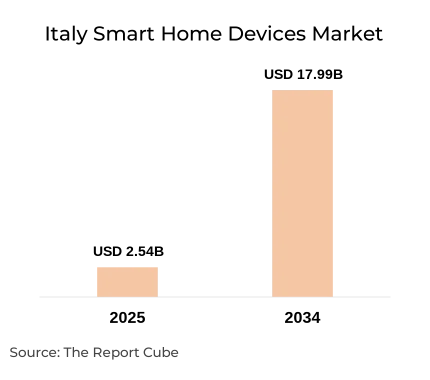
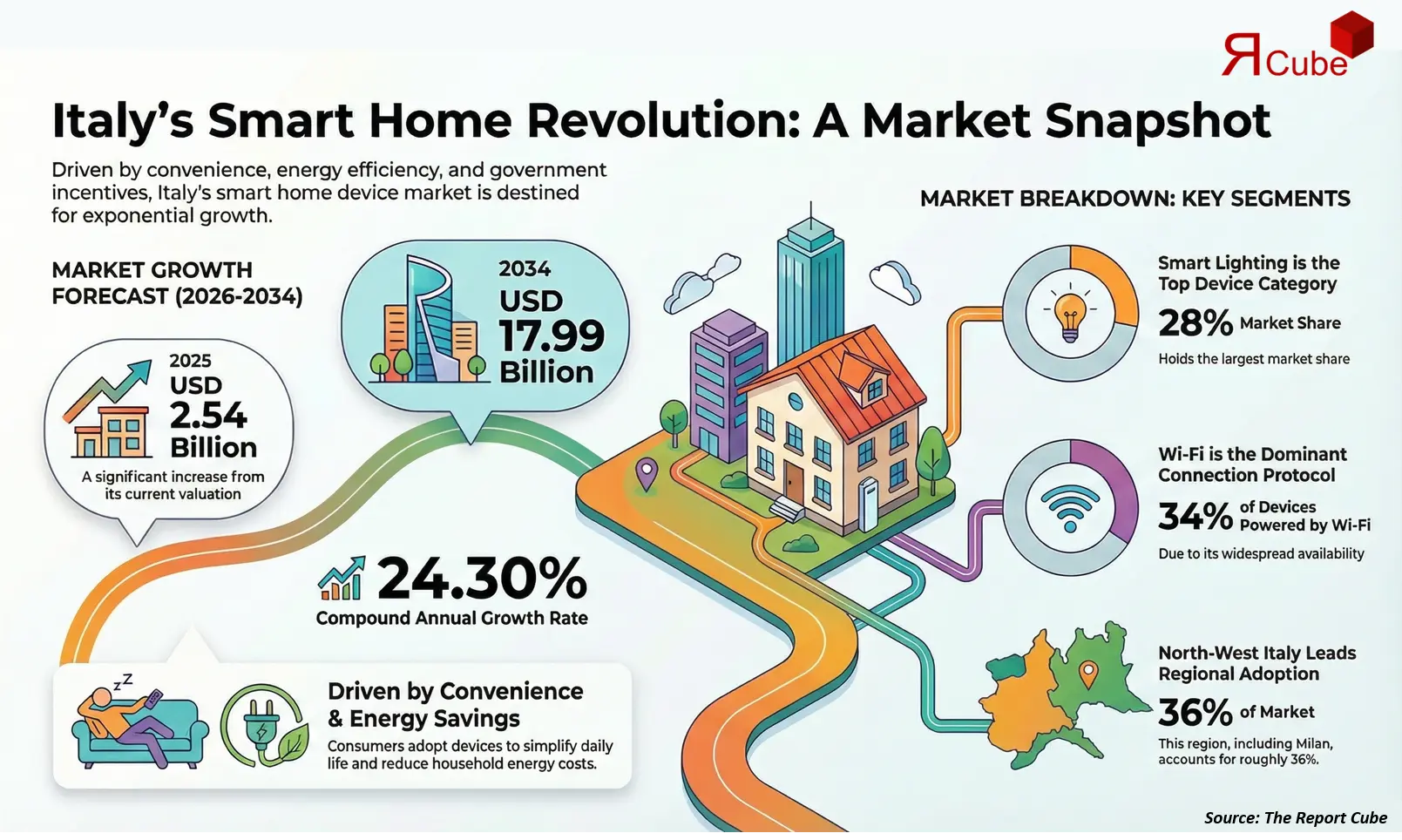
The Italy Smart Home Devices Market is projected to grow at a 24.30% CAGR during 2026-2034. The market stood at USD 2.54 billion in 2025 and is expected to reach USD 17.99 billion by 2034. Rapid adoption is driven by rising consumer demand for convenience, energy savings, and safety, together with strong investment by local and global players in interoperable ecosystems and retrofit-friendly solutions. Italian households are increasingly adopting voice assistants, connected lighting, and smart security systems that integrate with existing electrical infrastructure, enabling fast scale-up across urban apartments and renovated homes. Government energy-efficiency programmes, building renovation incentives, and growth in smart building projects are catalysing demand for thermostats, sensors, and smart HVAC controls that reduce consumption and increase occupant comfort. In parallel, improved broadband coverage and falling device component costs are encouraging both first-time adopters and tech-savvy early adopters to expand device portfolios, creating a multi-year runway for exponential market expansion across retail, trade, and professional installation channels.
Channel evolution and product innovation together are shaping adoption patterns across Italy’s regions. Major professional installers, electrical distributors, and home-improvement retailers are partnering with platform providers and chipset vendors to offer bundled smart-home packages combining smart lighting, security, and voice-control hubs with professional installation and extended warranties. The rise of Matter and Thread standards is easing interoperability concerns and encouraging manufacturers to design cross-protocol gateways, making integration with legacy KNX and bus systems simpler for retrofit projects. Urban consumers in metro regions show strong affinity for aesthetically designed devices from brands such as Legrand / BTicino, Vimar, and Gewiss, while global tech giants (Amazon, Google, Apple) boost mainstream awareness via voice ecosystems and ecosystem-driven convenience. As professional installation services scale and DIY-friendly options multiply, Italy’s smart-home market is transitioning from niche early-adopter pockets toward broad mainstream penetration across both new-build and retrofit segments, supporting robust revenue and device-per-home growth through 2034.
Italy Smart Home Devices Market Recent Developments
- 2025: Major Italian manufacturers expanded Matter-enabled product lines, launching new smart switches, lighting solutions, and KNX-compatible gateways for retrofit markets.
- 2025: Several multi-utility pilots integrated smart thermostats and demand-response capable devices with local grid operators to trial residential flexibility programmes.
Government Initiatives & Policies
- Building Retrofit & Energy Efficiency Incentives: National and regional renovation incentives (including tax-credit programmes) encourage installation of smart thermostats, efficient lighting, and energy-monitoring devices in renovated housing stock.
- IoT Security & Interoperability Guidance: Public standards bodies and regulators are promoting device cybersecurity best practices and support for open interoperability frameworks to build consumer trust and scale adoption.
Italy Smart Home Devices Market Dynamics
Driver: Convenience, Energy Savings & Integrated Voice Ecosystems
Consumers increasingly value the day-to-day convenience and measurable energy savings delivered by smart home devices. Smart thermostats, energy meters, and HVAC controls provide tangible reductions in heating and cooling bills a compelling benefit in Italy where seasonal heating consumption remains a household cost driver. Voice assistants and hub-centric ecosystems simplify control across lighting, entertainment, and security devices, reducing friction for less technical users. For landlords and multi-dwelling building managers, integrated building-level controls and occupancy sensors deliver operational efficiencies and lower maintenance costs. Combined with expanding retrofit financing and tax incentives for energy-efficient upgrades, these cost-saving narratives accelerate purchase decisions. As more devices support common voice platforms and Matter-based interoperability, consumers feel more confident buying mixed-brand systems that work together, which further accelerates device penetration and recurring service revenues for installers and subscription platforms.
Challenge: Fragmented Standards, Professional Installation Needs & Cybersecurity Concerns
Despite strong demand, fragmentation of communication standards and residual concerns over device security slow mass-market conversion for certain buyer segments. While Matter, Thread, and Wi-Fi are emerging standards, many legacy KNX and proprietary bus systems remain in Italy’s older housing stock and commercial buildings, requiring hybrid solutions and professional integration. Consumers and professional buyers also express concerns about data privacy, device vulnerabilities, and long-term firmware support; these issues elevate the importance of certified security practices and trusted vendor warranties. Additionally, a substantial portion of smart-home value depends on professional installation and configuration particularly for HVAC integration and KNX retrofits which adds labour cost and can lengthen payback periods. Addressing cybersecurity certification, installer training, and clear interoperability roadmaps is critical to avoid churn and build sustained adoption among mainstream households and multi-unit residential owners.
Opportunity: Energy Management, Demand-Response & Service Monetization
Significant opportunity exists around energy-management services, demand-response integration, and recurring revenue streams from subscriptions and managed services. Utilities and aggregators are piloting programs that leverage residential thermostats, smart plugs, and EV-charging coordination to provide grid flexibility, creating monetizable services for consumers and device vendors. Brands that combine hardware sales with value-added cloud services predictive maintenance, energy-optimisation algorithms, and extended warranties can capture higher lifetime value per customer. Professional channels also have room to expand managed-installation, warranty, and monitoring contracts for multi-dwelling buildings and commercial clients. Partnerships between device manufacturers, telecom operators, and energy suppliers can accelerate scale by bundling consumer offers and financing installation through energy savings, thereby lowering upfront barriers to adoption and increasing market penetration across both urban and suburban segments.
Trend: Interoperability (Matter), Edge Intelligence & Seamless Retrofit Solutions
The industry is moving rapidly toward open interoperability standards and increased on-device intelligence to reduce cloud dependency and privacy exposure. Matter and Thread adoption facilitates simpler cross-brand pairing, while edge compute and local automation logic reduce latency and keep sensitive data within the home. Manufacturers are launching retrofit-friendly, form-factor-compatible products and KNX-to-Matter gateways that make it easier to upgrade existing wiring and bus systems without deep rewiring. Additionally, advances in machine learning at the edge enable contextual automation for example, occupancy-driven heating schedules or lighting scenes that adapt to homeowner routines. These technical improvements lower consumer friction, increase perceived value, and make it easier for installers to deliver consistent, high-quality smart-home experiences across Italy’s diverse housing stock.
Italy Smart Home Devices Market Segment-wise Analysis
By Device Category:
- Smart Speakers & Hubs
- Smart Lighting Devices
- Smart Thermostats & HVAC Controls
- Smart Security & Surveillance (Cameras, Locks, Sensors)
- Smart Appliances (Large & Small)
- Smart Plugs & Sockets
- Other Smart Home Devices
Smart Lighting Devices currently hold the largest product-category share at around 28%. Lighting is often the first practical gateway for consumers into connected homes because smart bulbs, switches, and integrated luminaires combine visible immediate benefits, low perceived installation risk, and strong price-point variety. In Italy, aesthetic-integrated lighting from legacy electrical players (Legrand / BTicino, Vimar, Gewiss) is particularly attractive for retrofit projects where finish and design matter as much as smart capability. Smart lighting frequently pairs with voice assistants and motion sensors to create simple automation scenes that demonstrate value to end users quickly. As Matter-compatible LED drivers and professional lighting fixtures proliferate, lighting will continue to be the highest-volume category and a key cross-sell anchor for thermostats, security sensors, and appliance control modules.
By Connectivity / Protocol:
- Wi-Fi
- Bluetooth / BLE
- Zigbee
- Thread / Matter
- Z-Wave
- Wired (KNX, Bus Systems)
- Others
Wi-Fi remains the dominant connectivity option with an estimated approximately 34% share due to its ubiquity, ease of use, and low incremental cost for many device categories. Wi-Fi’s broad availability in Italian homes makes it the default for video cameras, smart plugs, and many smart appliances that require high bandwidth. However, lower-power mesh protocols such as Thread and legacy fieldbus systems like KNX continue to play crucial roles for sensors, lighting networks, and professional installations. With the progress of Matter, devices will increasingly support multi-protocol bridging, enabling Wi-Fi devices to interoperate with Thread, Zigbee, and wired KNX systems through certified gateways. The resulting hybrid networks will leverage Wi-Fi strengths for bandwidth-heavy use cases while using low-power mesh protocols for reliability and battery-operated sensors.
Regional Projection of Italy Smart Home Devices Industry
By Region:
- North-West Italy
- North-East Italy
- Central Italy
- South Italy
- Islands (Sicily & Sardinia)
- Others
North-West Italy leads the market with an estimated approximately 36% share, driven by Milan’s high-income households, dense new-build and retrofit activity in Lombardy and Piedmont, and a concentration of distributor and installer networks. The region’s advanced retail infrastructure, strong professional electrical-trade ecosystem, and early-adopter urban consumers accelerate uptake of smart lighting, thermostats, and integrated security systems. Additionally, commercial and multi-dwelling retrofit projects in North-West Italy often include bundled smart-home packages as part of energy-efficiency renovations, further reinforcing the region’s leading position. While other regions particularly the North-East and Central Italy show rapid growth, North-West Italy’s combination of purchasing power and installer density establishes it as the primary revenue driver during the forecast period.
What Does Our Italy Smart Home Devices Market Research Study Entail?
- Provides comprehensive market sizing and forecasting from 2026-2034, showing growth from USD 2.54 billion to USD 17.99 billion at a 24.30% CAGR, with device-unit and revenue models by category and connectivity.
- Delivers detailed segmentation across Device Categories and Connectivity/Protocol options, identifying high-opportunity pockets such as lighting, thermostats, and KNX-to-Matter retrofit gateways.
- Offers regional analysis covering North-West, North-East, Central, South, and Islands to identify installer density, retail penetration, and retrofit versus new-build dynamics.
- Presents competitive profiling of leading players including Legrand / BTicino, Vimar, Gewiss, ABB, Schneider Electric, Signify (Philips Hue), Samsung (SmartThings), LG, Amazon, Google, Apple, and other local and global ecosystem participants.
- Reviews regulatory drivers, energy-efficiency incentives, cybersecurity recommendations, go-to-market strategies for manufacturers and installers, and practical monetization models for subscription and managed services.
Top Key Players
Legrand / BTicino, Vimar S.p.A., Gewiss S.p.A., ABB Ltd, Schneider Electric, Signify (Philips Hue), Samsung Electronics (SmartThings), LG Electronics, Amazon (Alexa & Ring Ecosystem), Google (Nest), Apple (HomeKit Ecosystem), and Others.
Table of Contents
- Introduction
- Objective of the Study
- Product/Technology Definition
- Market Segmentation
- Study Variables
- Research Methodology
- Secondary Data Points
- Breakdown of Secondary Sources
- Primary Data Points
- Breakdown of Primary Interviews
- Secondary Data Points
- Executive Summary
- Market Dynamics
- Drivers
- Challenges
- Opportunity Assessment
- Recent Trends and Developments
- Policy and Regulatory Landscape
- Italy Smart Home Devices Market Overview (2021–2034)
- Market Size, By Volume (Units) & Value (USD Million)
- Market Share, By Device Category
- Smart Speakers & Hubs
- Smart Lighting Devices
- Smart Thermostats & HVAC Controls
- Smart Security & Surveillance (Cameras, Locks, Sensors)
- Smart Appliances (Large & Small)
- Smart Plugs & Sockets
- Other Smart Home Devices
- Market Share, By Connectivity / Protocol
- Wi-Fi
- Bluetooth / BLE
- Zigbee
- Thread / Matter
- Z-Wave
- Wired (KNX, Bus Systems)
- Others
- Market Share, By Application Cluster
- Energy Management & HVAC Control
- Security & Access Control
- Comfort & Convenience
- Entertainment & Media
- Health, Wellness & Assisted Living
- Market Share, By Housing Type
- Apartments & Condominiums
- Single-family Houses / Villas
- Mixed-use & Small Commercial Premises
- Market Share, By Sales & Delivery Channel
- Retail (Electronics & DIY Stores)
- Online / E-commerce
- Installer / System Integrator Channel
- Telecom & Utility Bundles
- Others
- Market Share, By Region
- North-West Italy
- North-East Italy
- Central Italy
- South Italy
- Islands (Sicily & Sardinia)
- Market Share, By Company
- Revenue Shares
- Competitive Landscape
- Segment-wise & Industry-wise Market Forecast (2026–2034)
- By Device Category
- By Connectivity / Protocol
- By Application Cluster
- By Housing Type
- By Sales & Delivery Channel
- By Region
- Regional Analysis (2020–2034)
- North-West Italy Smart Home Devices Market
- Market Size, By Volume & Value (USD Million)
- Market Share, By Device Category
- Market Share, By Connectivity / Protocol
- Market Share, By Application Cluster
- Market Share, By Sales & Delivery Channel
- North-East Italy Smart Home Devices Market
- Market Size, By Volume & Value (USD Million)
- Market Share, By Device Category
- Market Share, By Connectivity / Protocol
- Market Share, By Application Cluster
- Market Share, By Sales & Delivery Channel
- Central Italy Smart Home Devices Market
- Market Size, By Volume & Value (USD Million)
- Market Share, By Device Category
- Market Share, By Connectivity / Protocol
- Market Share, By Application Cluster
- Market Share, By Sales & Delivery Channel
- South Italy Smart Home Devices Market
- Market Size, By Volume & Value (USD Million)
- Market Share, By Device Category
- Market Share, By Connectivity / Protocol
- Market Share, By Application Cluster
- Market Share, By Sales & Delivery Channel
- Islands (Sicily & Sardinia) Smart Home Devices Market
- Market Size, By Volume & Value (USD Million)
- Market Share, By Device Category
- Market Share, By Connectivity / Protocol
- Market Share, By Application Cluster
- Market Share, By Sales & Delivery Channel
- Competitive Outlook & Company Profiles
- Legrand / BTicino
- Company Overview
- Business Segments
- Strategic Alliances/Partnerships
- Recent Developments
- Vimar S.p.A.
- Company Overview
- Business Segments
- Strategic Alliances/Partnerships
- Recent Developments
- Gewiss S.p.A.
- Company Overview
- Business Segments
- Strategic Alliances/Partnerships
- Recent Developments
- ABB Ltd
- Company Overview
- Business Segments
- Strategic Alliances/Partnerships
- Recent Developments
- Schneider Electric
- Company Overview
- Business Segments
- Strategic Alliances/Partnerships
- Recent Developments
- Signify (Philips Hue)
- Company Overview
- Business Segments
- Strategic Alliances/Partnerships
- Recent Developments
- Samsung Electronics (SmartThings)
- Company Overview
- Business Segments
- Strategic Alliances/Partnerships
- Recent Developments
- LG Electronics
- Company Overview
- Business Segments
- Strategic Alliances/Partnerships
- Recent Developments
- Amazon (Alexa & Ring Ecosystem)
- Company Overview
- Business Segments
- Strategic Alliances/Partnerships
- Recent Developments
- Google (Nest)
- Company Overview
- Business Segments
- Strategic Alliances/Partnerships
- Recent Developments
- Apple (HomeKit Ecosystem)
- Company Overview
- Business Segments
- Strategic Alliances/Partnerships
- Recent Developments
- Others
- Legrand / BTicino
- Contact Us / Disclaimer
Top Key Players & Market Share Outlook
- Legrand / BTicino
- Vimar S.p.A.
- Gewiss S.p.A.
- ABB Ltd
- Schneider Electric
- Signify (Philips Hue)
- Samsung Electronics (SmartThings)
- LG Electronics
- Amazon (Alexa & Ring Ecosystem)
- Google (Nest)
- Apple (HomeKit Ecosystem)
- Others
Frequently Asked Questions






