



Build Your Custom Market Intelligence Report
Customize Your ReportAsia Pacific Smart Medical Device Market Statistics and Insights
Market Insight
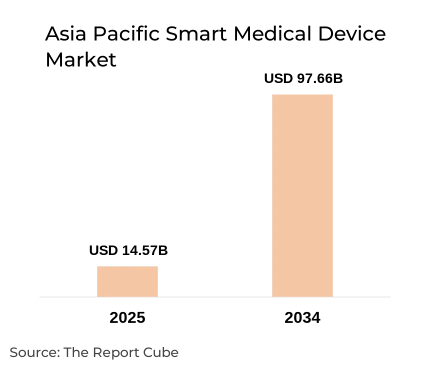
- Asia Pacific Smart Medical Device Market was valued at USD 14.57 billion in 2025.
- Asia Pacific Smart Medical Device Market is projected to reach USD 97.66 billion by 2034.
- The market is anticipated to grow at a CAGR of 23.54% during 2026-2034.
By End User
- Hospitals segment dominated with approximately 42% of total market revenue.
Competitive Landscape
- More than 10 companies are actively engaged in producing Asia Pacific Smart Medical Devices.
- Top 5 companies acquired around 38% of the market share.
- Nipro Europe Group Companies, Shenzhen Mindray Bio-Medical Electronics Co., Ltd., Olympus Corporation, Terumo Corporation, NIHON KOHDEN CORPORATION, and others.
By Distribution Channel
- Pharmacies segment led with approximately 47% of total distribution revenue share.
Asia Pacific Smart Medical Device Market Insights & Analysis
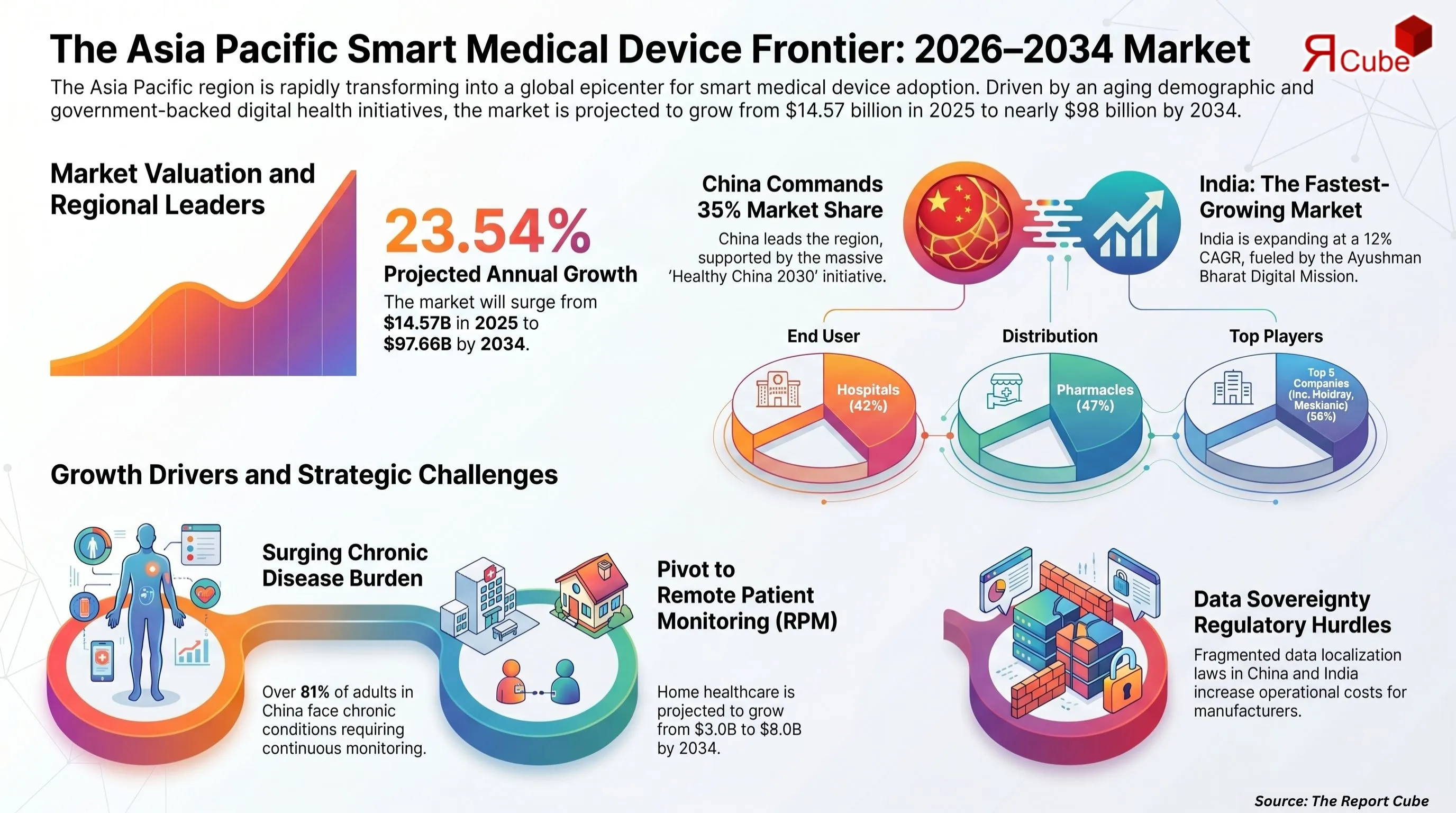
The Asia Pacific Smart Medical Device Market is anticipated to register a 23.54% CAGR during 2026-2034. The market size was valued at USD 14.57 billion in 2025 and is projected to reach USD 97.66 billion by 2034. The Asia Pacific region is transforming rapidly into a global epicenter for smart medical device adoption, propelled by the convergence of rising chronic disease burden, aging demographics, and aggressive government-backed digital health initiatives. China and India alone account for over 257 million people living with diabetes and cardiovascular conditions, creating a sustained, multi-decade demand for continuous monitoring solutions including connected glucose sensors, AI-enabled ECG patches, and smart infusion systems.
Japan's PMDA streamlined software-as-a-medical-device approvals in 2024, enabling manufacturers to push algorithm updates faster and reducing time-to-market for next-generation devices. Government programs such as India's Ayushman Bharat Digital Mission (ABDM) and China's Healthy China 2030 initiative are channeling billions into digital health infrastructure. Regional health tech investment is projected to surpass USD 5 billion by 2025, reinforcing the expansion of connected care ecosystems across hospital, clinic, homecare, and sports wellness settings.
Asia Pacific Smart Medical Device Market Dynamics
Key Market Driver Surging Chronic Disease Burden Accelerating Adoption
The unprecedented prevalence of non-communicable diseases across Asia Pacific is the single most potent force propelling smart medical device uptake. Chronic conditions such as diabetes, cardiovascular disease, hypertension, and chronic obstructive pulmonary disease affect a combined population in the hundreds of millions throughout China, India, Japan, South Korea, and Southeast Asia. According to Elsevier B.V. data published in 2023, chronic diseases affected approximately 81.1% of the adult population in China alone. These conditions require continuous, real-time monitoring, precisely the functionality that smart diagnostic and therapeutic devices deliver. Continuous glucose monitors (CGMs), smart cardiac monitors, AI-driven blood pressure wearables, and connected inhalers have emerged as essential tools for long-term disease management. Healthcare systems are increasingly incentivizing device adoption to reduce hospitalizations and optimize clinical outcomes at the population level.
Major Industry Challenge Data Sovereignty Regulations Fragmenting Cloud Ecosystems
One of the most structurally complex challenges in the Asia Pacific Smart Medical Device Market is the growing maze of data localization and sovereignty regulations across the region's diverse jurisdictions. China's Personal Information Protection Law mandates domestic server storage of all health data, while India's Digital Personal Data Protection framework imposes strict cross-border data transfer constraints. These regulatory requirements compel device manufacturers and platform operators to build fragmented, country-specific cloud architectures rather than unified regional systems, significantly increasing infrastructure expenditure and operational complexity. Furthermore, interoperability between nationally siloed systems remains limited, hampering the development of pan-regional clinical analytics platforms, telehealth integration, and multi-market AI training datasets. Companies must allocate substantial compliance resources, diverting investment away from product innovation.
Emerging Trend Shaping Outlook Remote Patient Monitoring Reshaping Home Healthcare Delivery
The rapid adoption of remote patient monitoring (RPM) solutions represents a defining structural shift in the Asia Pacific smart medical device landscape. Driven by post-pandemic behavioral change, 5G network expansion, and a growing preference for home-centered care, RPM technology is enabling patients to transmit real-time biometric data, including oxygen saturation, heart rate variability, and blood glucose, directly to clinical teams without requiring in-person visits. The home healthcare segment in Asia Pacific is forecast to grow from USD 3.0 billion to USD 8.0 billion through the forecast period, reflecting a sharp pivot toward decentralized care models. Insurer pilots linking premium structures to patient adherence data collected via smart devices are further accelerating adoption, while teleconsultation mandates introduced in several ASEAN nations during 2024 have embedded RPM into mainstream care pathways.
Need Specific Data, Let’s Customize the Report for You
Request CustomizationAsia Pacific Smart Medical Device Market Segment-wise Analysis
Smart medical devices in Asia Pacific serve a highly diversified end-user base and are distributed through multiple channels, reflecting the region's heterogeneous healthcare infrastructure and patient behavior. Understanding the segment-level dynamics is essential for identifying high-growth pockets and targeting investment. The following analysis examines the two primary segmentation dimensions: By End User and by Distribution Channel.
By End User
- Hospitals
- Clinics
- Home Care
- Sports Clubs
- Others
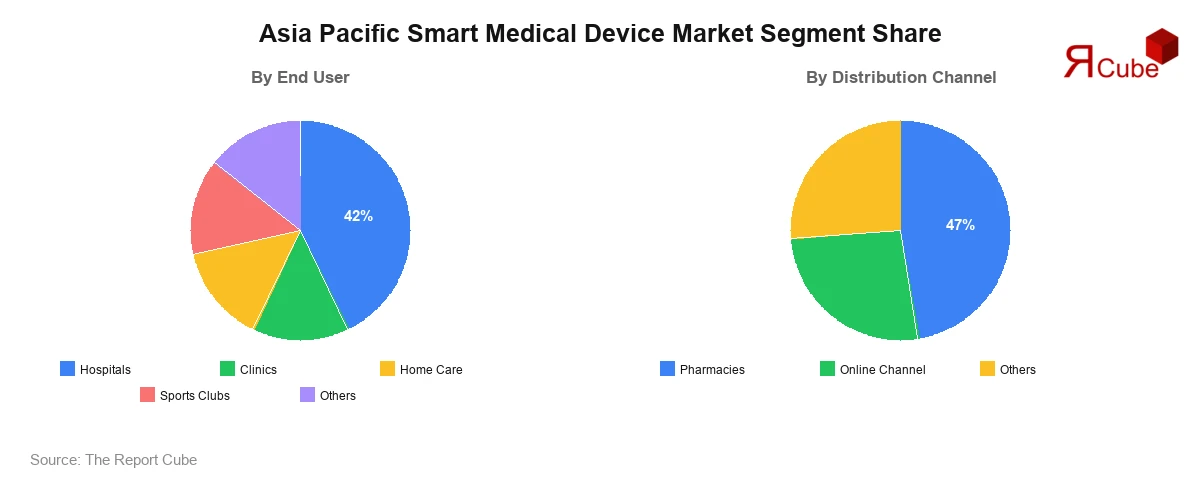
Hospitals represent the dominant end-user segment, commanding approximately 42% of total market revenue in 2025. This leadership reflects the concentration of high-acuity patients, institutional procurement budgets, and the need for advanced diagnostic infrastructure in tertiary care settings. Hospitals across China, Japan, India, and South Korea are rapidly integrating smart monitoring systems, including patient surveillance platforms, connected infusion pumps, and AI-assisted imaging devices, to enhance clinical efficiency and reduce adverse events.
The Clinics segment is emerging as the fastest-growing end-user category, expanding at an estimated CAGR exceeding 15% through the forecast period, driven by decentralized care models and the proliferation of specialty clinics in urban and semi-urban centers. Home Care is the third major segment, recording substantial demand as aging populations in Japan, Australia, and South Korea increasingly opt for home-based management of chronic conditions using portable smart devices. Sports Clubs represent a niche but rapidly expanding sub-segment, with demand for real-time biometric tracking and performance monitoring fueled by Asia Pacific's booming fitness culture and wearable adoption among younger demographics.
By Distribution Channel
- Pharmacies
- Online Channel
- Others
The Pharmacies segment currently holds the leading position in distribution, accounting for approximately 47% of total channel revenue in 2025. Retail pharmacies remain the primary point of access for consumer-grade smart devices including glucose monitors, blood pressure wearables, and smart thermometers across both mature markets such as Japan and high-growth markets including India and Southeast Asia. Pharmacies offer patients the benefit of immediate product availability, in-store guidance from trained professionals, and established reimbursement pathways.
The Online Channel is the fastest-growing distribution segment, reflecting the accelerating digitalization of retail and e-commerce penetration across Asia Pacific. Platforms including JD Health, Flipkart Health+, and regional telehealth portals are enabling seamless device procurement alongside digital consultations, shortening purchase cycles. The Others category encompasses direct hospital procurement, wholesalers, and government tender channels, which remain significant for institutional buyers across emerging markets.
Country Projection of Asia Pacific Smart Medical Device Market
The Asia Pacific Smart Medical Device Market encompasses:
- China
- Japan
- India
- South Korea
- Australia
- Rest of Asia Pacific
China leads the Asia Pacific Smart Medical Device Market with an estimated 35% revenue share in 2025, driven by the world's largest diabetic population, massive healthcare infrastructure investment under the Healthy China 2030 plan, and a mature domestic manufacturing ecosystem anchored by players such as Shenzhen Mindray Bio-Medical Electronics and Lepu Medical Technology. Japan and South Korea follow as high-value markets, supported by strong per-capita healthcare spending, rapid 5G rollout, and progressive regulatory environments for software-as-a-medical-device. India is emerging as the fastest-growing individual country market, registering a CAGR of approximately 11.9%–12%, propelled by the ABDM digital health initiative and surging wearable adoption in metropolitan and tier-2 cities.
Asia Pacific Smart Medical Device Market: Recent Development (2025)
- Olympus Corporation partnered with Southern Philippines Medical Center to launch an advanced endoscopy training center.
- Shenzhen Mindray reported a 14% year-on-year revenue gain from its BeneFusion smart infusion platform in Q1 2025.
- Medtronic expanded its Asia Pacific digital health platform through acquisition of a health analytics startup in August 2025.
- GE Healthcare announced USD 500 million R&D investment into AI-integrated monitoring devices targeting Asia Pacific hospitals.
Asia Pacific Smart Medical Device Market Future Outlook (2034)
By 2034, the Asia Pacific Smart Medical Device Market is poised to reach USD 97.66 billion, advancing at a 23.54% CAGR across the 2026–2034 forecast period. This trajectory will be shaped by deepening AI integration across diagnostic, therapeutic, and monitoring device categories, enabling predictive clinical decision support at both institutional and point-of-care levels. The proliferation of 5G and next-generation connectivity across Southeast Asia, India, and China will further unlock real-time remote monitoring at population scale. Home healthcare and sports wellness segments will emerge as high-growth demand centers as consumer health consciousness intensifies and reimbursement models evolve to reward preventive care. Local manufacturing ecosystems, particularly in China and India, will mature, reducing device costs and broadening access across emerging sub-markets, driving long-term structural expansion across the entire region.
Why Choose This Report?
- Provides a comprehensive overview of the overall market analysis, encompassing key trends, consumer behavior analysis, and risk assessment to support strategic decision-making.
- Provides accurate, up-to-date insights into market size, segmentation, and emerging opportunities, helping to minimize risk & capitalizing on growth.
- Gives deep understanding of target audience preferences, investment habits, and communication channels for enhanced product development & marketing effectiveness.
- Delivers competitive analysis & benchmarking, uncovering the strengths & weaknesses of market competitors to guide strategies.
- Consolidate comprehensive market intelligence, reducing reasoning & streamlining research efforts.
- Facilitates customized market segmentation & risk mitigation strategies, fine-tuned to the business objectives.
- Aids in identifying both market challenges & untapped opportunities within the industry to drive long-term business growth.
- Provides valuable information based on actual customer data & search trends.
Table of Contents
- Introduction
- Objective of the study
- Product Definition
- Market Segmentation
- Study Variables
- Research Methodology
- Secondary Data Points
- Companies Interviewed
- Primary Data Points
- Breakdown of Primary Interviews
- Secondary Data Points
- Executive Summary
- Market Dynamics
- Drivers
- Challenges
- Opportunity Assessment
- Recent Trends and Developments
- Policy and Regulatory Landscape
- Asia Pacific Asia Pacific Market Overview and Forecast Analysis (2021-2034)
- Market Size, By Value, By growth rate (CAGR/USD Billions)
- Demand - Supply Trends
- Market Share, By Product Type
- Diagnostics and Monitoring Devices
- Therapeutic Devices
- Market Share, By Type
- On-Body (Adhesive Patch)
- Off-Body (Belt Clip)
- Hand Held
- Market Share, By Technology
- Spring-Based
- Motor-Driven
- Rotary Pump
- Expanding Battery
- Pressurized Gas
- Others
- Market Share, By Modality
- Wearable
- Non-Wearable
- Market Share, By Application
- Oncology
- Diabetes
- Auto-Immune Disorders
- Infectious Diseases
- Sports and Fitness
- Sleep Disorders
- Others
- Market Share, By End User
- Hospitals
- Clinics
- Home Care
- Sports Clubs
- Others
- Market Share, By Distribution Channel
- Pharmacies
- Online Channel
- Others
- Market Share, By Country
- China
- Japan
- India
- South Korea
- Australia
- Rest of Asia Pacific
- Market Share, By Company
- Revenue Shares
- Competition Characteristics
- China Asia Pacific Market Overview, 2021-2034F
- Market Size, By Value (in USD Billions)
- By Product Type
- By Type
- By Technology
- By Modality
- By Application
- By End User
- By Distribution Channel
- Japan Asia Pacific Market Overview, 2021-2034F
- Market Size, By Value (in USD Billions)
- By Product Type
- By Type
- By Technology
- By Modality
- By Application
- By End User
- By Distribution Channel
- India Asia Pacific Market Overview, 2021-2034F
- Market Size, By Value (in USD Billions)
- By Product Type
- By Type
- By Technology
- By Modality
- By Application
- By End User
- By Distribution Channel
- South Korea Asia Pacific Market Overview, 2021-2034F
- Market Size, By Value (in USD Billions)
- By Product Type
- By Type
- By Technology
- By Modality
- By Application
- By End User
- By Distribution Channel
- Australia Asia Pacific Market Overview, 2021-2034F
- Market Size, By Value (in USD Billions)
- By Product Type
- By Type
- By Technology
- By Modality
- By Application
- By End User
- By Distribution Channel
- Competitive Outlook (Company Profile - Partial List)
- Nipro Europe Group Companies
- Company Overview
- Business Segments
- Strategic Alliances/Partnerships
- Recent Developments
- Shenzhen Mindray Bio-Medical Electronics Co., Ltd.
- Company Overview
- Business Segments
- Strategic Alliances/Partnerships
- Recent Developments
- Olympus Corporation
- Company Overview
- Business Segments
- Strategic Alliances/Partnerships
- Recent Developments
- Terumo Corporation
- Company Overview
- Business Segments
- Strategic Alliances/Partnerships
- Recent Developments
- NIHON KOHDEN CORPORATION
- Company Overview
- Business Segments
- Strategic Alliances/Partnerships
- Recent Developments
- Lepu Medical Technology
- Company Overview
- Business Segments
- Strategic Alliances/Partnerships
- Recent Developments
- GE Healthcare
- Company Overview
- Business Segments
- Strategic Alliances/Partnerships
- Recent Developments
- Hoffmann-La Roche Ltd
- Company Overview
- Business Segments
- Strategic Alliances/Partnerships
- Recent Developments
- Medtronic
- Company Overview
- Business Segments
- Strategic Alliances/Partnerships
- Recent Developments
- Others
- Nipro Europe Group Companies
- Contact Us & Disclaimer
Top Key Players & Market Share Outlook
- Nipro Europe Group Companies
- Shenzhen Mindray Bio-Medical Electronics Co., Ltd.
- Olympus Corporation
- Terumo Corporation
- NIHON KOHDEN CORPORATION
- Lepu Medical Technology
- GE Healthcare
- Hoffmann-La Roche Ltd
- Medtronic
- Others
Frequently Asked Questions






