



Build Your Custom Market Intelligence Report
Customize Your ReportAfrica Solar Water Pump Market Key Highlights
By Type:
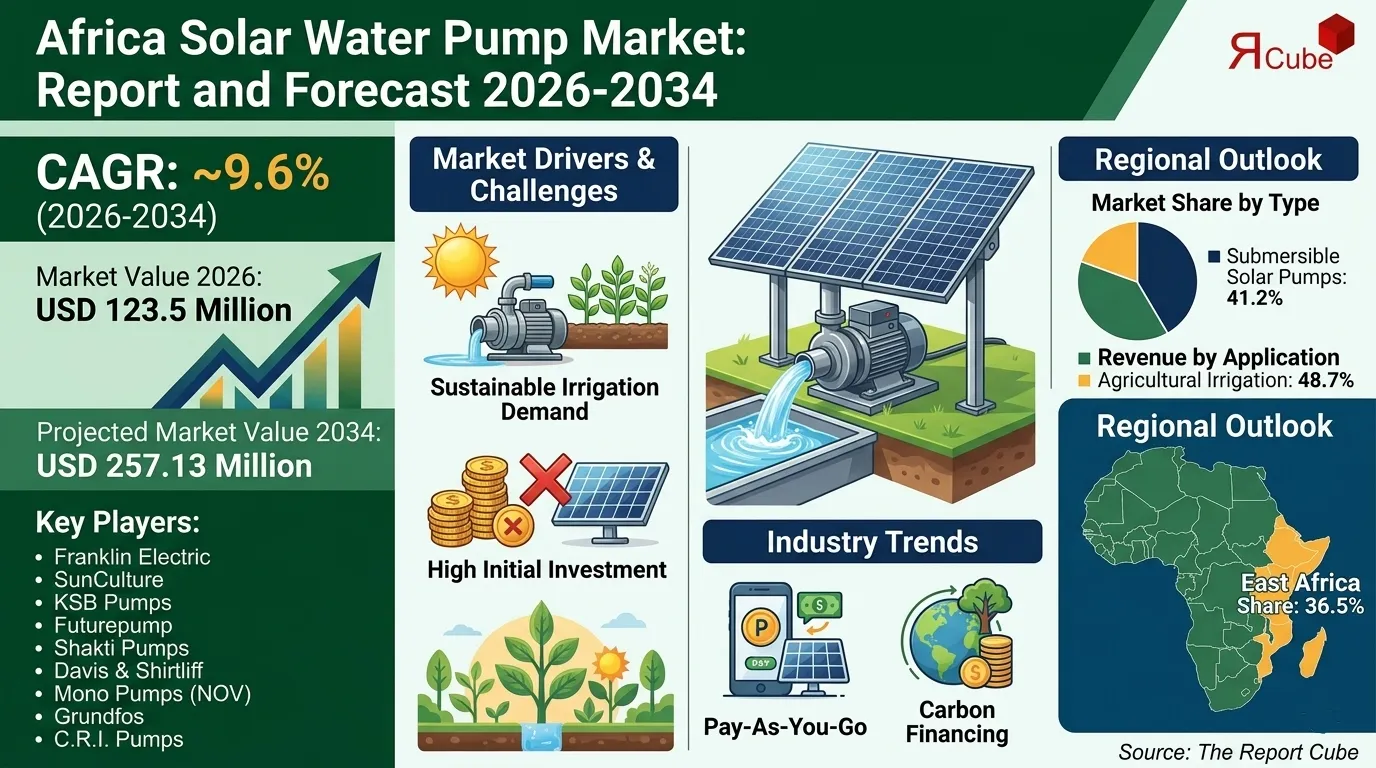
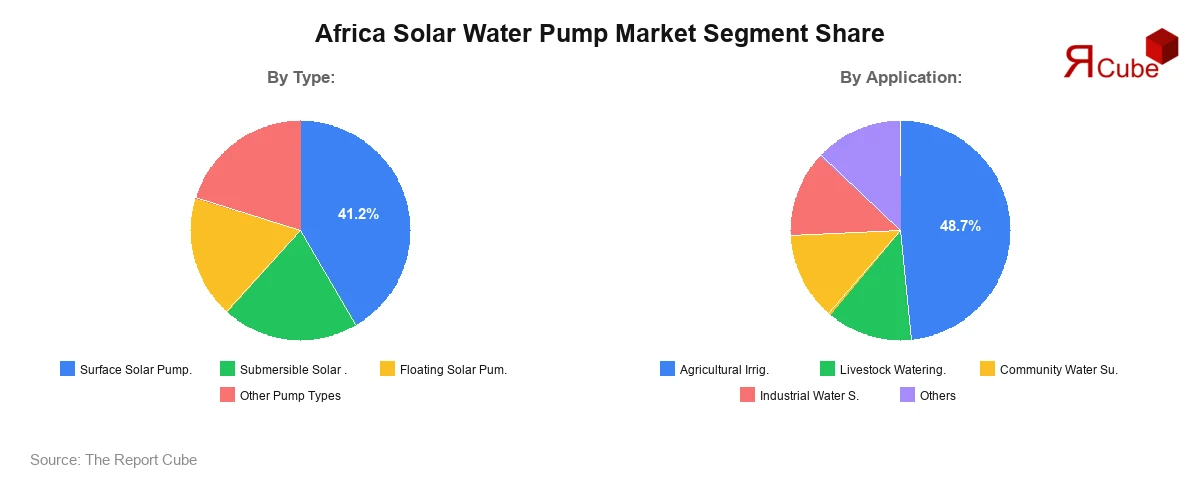
Submersible Solar Pumps segment leads the market with 41.2% share.
By Application:
Agricultural Irrigation segment dominates the market with 48.7% of revenue.
Regional Outlook:
East Africa region dominates the Africa Solar Water Pump market with 36.5% share.
Africa Solar Water Pump Market Insights & Analysis
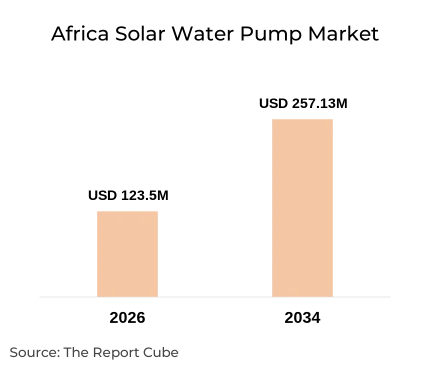
The Africa Solar Water Pump Market is anticipated to register a CAGR of around 9.6% during the forecast period 2026-2034. The market size is valued at USD 123.5 million in 2026 and is projected to reach USD 257.13 million by 2034. Rising investments in decentralized renewable energy infrastructure and irrigation modernization programs are shaping the market landscape across Africa. Countries such as Kenya, Ethiopia, and Nigeria are witnessing growing adoption of solar-powered irrigation systems, supported by international development funds and public-private partnerships. According to development finance data, over 35% of rural electrification projects in Sub-Saharan Africa now include solar-based water pumping components.
Technological advancements and business model innovation are also strengthening the market outlook. Companies are introducing pay-as-you-go financing and carbon credit-backed solutions to improve affordability for smallholder farmers. For instance, new financing mechanisms introduced in 2025 enabled farmers to reduce upfront system costs by nearly 30%. In addition, increasing solar panel efficiency and integration with smart controllers are improving system performance and reliability. These factors, combined with rising water demand and climate variability, continue to accelerate Africa solar water pump market growth and long-term demand.
Africa Solar Water Pump Market Dynamics
Key Driver: Rising demand for sustainable irrigation solutions
The growing need for efficient irrigation systems is a major driver of the Africa solar water pump market. Agriculture contributes over 20% of GDP in several African economies, yet irrigation coverage remains below 10% of arable land. Solar water pumps provide a reliable and cost-effective alternative to diesel-powered systems, helping farmers increase crop yields and reduce operational costs.
Moreover, fluctuating fuel prices and limited grid access in rural regions are accelerating the transition toward solar-powered solutions. Studies indicate that farmers using solar pumps can reduce irrigation costs by up to 60% annually. This economic advantage, combined with improved water access, is significantly boosting market demand and adoption rates.
Book your FREE 30-minute expert consultation today
Contact UsIndustry Trends: Expansion of pay-as-you-go and carbon financing models
The market is witnessing a strong shift toward innovative financing models designed to improve accessibility. Pay-as-you-go systems allow farmers to pay in small installments, reducing the financial burden associated with upfront investments. This approach has already enabled thousands of smallholder farmers to adopt solar pumping systems across East and West Africa.
In parallel, carbon credit programs are emerging as a key trend. Companies are leveraging carbon markets to subsidize equipment costs while promoting sustainable agricultural practices. These models are expected to play a crucial role in scaling adoption, particularly in regions with limited access to traditional financing channels.
Major Challenge: High initial investment and infrastructure limitations
One of the primary challenges affecting the Africa solar water pump market is the relatively high upfront cost of installation. While operational savings are significant, the initial capital requirement remains a barrier for many small-scale farmers, especially in low-income regions.
In addition, limited technical infrastructure and after-sales service networks in remote areas can hinder system performance and maintenance. A lack of trained technicians and spare parts availability further impacts long-term reliability, slowing down adoption in certain regions.
Opportunity: Growth in off-grid water supply and rural development programs
The expansion of off-grid energy solutions presents a major opportunity for the Africa solar water pump market. Governments and development organizations are increasingly focusing on rural water supply projects powered by renewable energy. Solar water pumps are becoming a preferred solution for community water systems due to their low maintenance and long lifespan.
Furthermore, increasing investment in climate-resilient agriculture and water management initiatives is expected to create new growth avenues. With rising awareness and policy support, solar-powered pumping systems are likely to become a central component of sustainable rural infrastructure development across Africa.
Africa Solar Water Pump Market Segment-wise Analysis
By Type:
- Surface Solar Pumps
- Submersible Solar Pumps
- Floating Solar Pumps
- Other Pump Types
Submersible solar pumps dominate the market, accounting for approximately 41.2% share due to their efficiency in deep water extraction and suitability for borewell applications. These pumps are widely used in regions with declining groundwater levels, such as parts of East Africa.
Their ability to operate efficiently under varying solar conditions and deliver consistent water output makes them a preferred choice among farmers. Additionally, technological improvements in motor efficiency and corrosion resistance have enhanced their durability, contributing to sustained demand. Market data suggests that adoption of submersible pumps has increased by nearly 18% annually in agricultural applications.
By Application:
- Agricultural Irrigation
- Livestock Watering
- Community Water Supply
- Industrial Water Supply
- Others
Agricultural irrigation remains the leading application segment, holding around 48.7% of the total market revenue. The strong dominance is driven by the growing need to improve crop productivity and ensure water availability during dry seasons. Solar pumps enable farmers to irrigate land without relying on inconsistent rainfall patterns, thereby increasing food security.
In addition, government-backed irrigation schemes and subsidies are encouraging farmers to adopt solar-powered solutions. Reports indicate that farms using solar irrigation systems have experienced yield improvements of up to 25%, further strengthening the segment’s market position.
Regional Projection of Africa Solar Water Pump Industry
- East Africa
- West Africa
- North Africa
- Southern Africa
East Africa leads the Africa solar water pump market with an estimated 36.5% share, supported by strong adoption in countries such as Kenya, Ethiopia, and Tanzania. The region benefits from favorable solar irradiance levels and a high dependence on agriculture, which drives demand for irrigation solutions.
Additionally, numerous development programs and international funding initiatives are focused on improving rural water access in this region. Kenya alone has seen a significant increase in solar pump installations, with annual growth exceeding 20% in recent years. The presence of innovative startups and distribution networks further strengthens the regional market outlook.
Need insights for a specific region within this market?
Request Regional DataGovernment Initiatives & Policies
- Kenya National Solar Irrigation Program (2025): The government expanded solar irrigation adoption through subsidies and financing schemes aimed at smallholder farmers.
- Ethiopia Climate Resilient Water Program (2026): Focused on solar-powered water systems, this initiative promotes sustainable irrigation and rural water supply.
Africa Solar Water Pump Industry Recent Developments
- 2025: SunCulture announced the sale of 10,000 Verified Carbon Units to EDF Trading, introducing a carbon financing mechanism to reduce upfront costs for solar irrigation systems and accelerate adoption among smallholder farmers across Africa.
- 2025: Futurepump expanded deployment of solar irrigation pumps into new African regions, improving accessibility for off-grid farmers and supporting increased adoption despite tightening funding conditions for distributors.
- 2025: Grundfos participated in a large-scale solar irrigation project in South Africa, supplying pumps and solar integration systems for a 750 kWp installation, demonstrating scalability of solar-powered pumping solutions.
- 2026: Jinko Solar expanded its solar project footprint in Tanzania, strengthening the renewable energy ecosystem and enabling better integration of solar-powered water pumping systems across agricultural regions.
Why Choose This Report? Africa Solar Water Pump Market
- Provides a comprehensive overview of the overall market analysis, encompassing key trends, consumer behavior analysis, and risk assessment to support strategic decision-making.
- Provides accurate, up-to-date insights into market size, segmentation, and emerging opportunities, helping to minimize risk & capitalizing on growth.
- Gives deep understanding of target audience preferences, investment habits, and communication channels for enhanced product development & marketing effectiveness.
- Delivers competitive analysis & benchmarking, uncovering the strengths & weaknesses of market competitors to guide strategies.
- Consolidate comprehensive market intelligence, reducing reasoning & streamlining research efforts.
- Facilitates customized market segmentation & risk mitigation strategies, fine-tuned to the business objectives.
- Aids in identifying both market challenges & untapped opportunities within the industry to drive long-term business growth.
- Provides valuable information based on actual customer data & search trends.
Table of Contents
- Introduction
- Objective of the Study
- Product and Category Definition
- Market Segmentation
- Study Variables
- Research Methodology
- Secondary Data Points
- Breakdown of Secondary Sources
- Primary Data Points
- Breakdown of Primary Interviews
- Secondary Data Points
- Executive Summary
- Market Dynamics
- Emerging Opportunities
- Adoption Trends
- Demand Drivers
- Disruption Analysis (Challenges)
- Industry Analysis and Strategic Insights
- Supply and Value Chain Analysis
- Pricing Analysis
- Go-To-Market Strategy
- BCG Matrix
- Recent Trends and Developments
- Import and Export Analysis
- Regulatory and Policy Landscape
- Region-Wise Policies
- Government Initiatives
- Africa Solar Water Pump Market Overview and Forecast Analysis (2021-2034)
- Market Size, By Value, By Growth Rate (CAGR/USD Million)
- Market Share, By Type
- Surface Solar Pumps
- Submersible Solar Pumps
- Floating Solar Pumps
- Other Pump Types
- Market Share, By Power
- AC Solar Pumps
- DC Solar Pumps
- Hybrid Solar Pumps
- Market Share, By Motor Type
- AC Induction Motors
- Permanent Magnet Motors
- Brushless DC Motors
- Others
- Market Share, By Power Rating
- Up to 3 HP
- Above 3 HP to 5 HP
- Above 5 HP to 7.5 HP
- Above 7.5 HP to 10 HP
- Above 10 HP
- Market Share, By Application
- Agricultural Irrigation
- Livestock Watering
- Community Water Supply
- Industrial Water Supply
- Others
- Market Share, By Sales Channel
- Direct Sales
- Tender-Based Sales
- Channel Partner Sales
- Online Sales
- Market Share, By Distribution Channel
- Manufacturer-Authorized Dealers
- Local Distributors
- Retail Outlets
- Online Platforms
- Market Share, By Region
- North Africa
- East Africa
- Southern Africa
- West Africa
- Central Africa
- Market Share, By Company
- Revenue Shares and Analysis
- Competitive Landscape
- North Africa Solar Water Pump Market Overview and Forecast Analysis (2021-2034)
- Market Size, By Value, By Growth Rate (CAGR/USD Million)
- Market Share, By Type
- Market Share, By Power
- Market Share, By Motor Type
- Market Share, By Power Rating
- Market Share, By Application
- Market Share, By Sales Channel
- Market Share, By Distribution Channel
- Market Share, By Country
- Algeria
- Egypt
- Morocco
- East Africa Solar Water Pump Market Overview and Forecast Analysis (2021-2034)
- Market Size, By Value, By Growth Rate (CAGR/USD Million)
- Market Share, By Type
- Market Share, By Power
- Market Share, By Motor Type
- Market Share, By Power Rating
- Market Share, By Application
- Market Share, By Sales Channel
- Market Share, By Distribution Channel
- Market Share, By Country
- Ethiopia
- Tanzania
- Other East Africa Countries
- Southern Africa Solar Water Pump Market Overview and Forecast Analysis (2021-2034)
- Market Size, By Value, By Growth Rate (CAGR/USD Million)
- Market Share, By Type
- Market Share, By Power
- Market Share, By Motor Type
- Market Share, By Power Rating
- Market Share, By Application
- Market Share, By Sales Channel
- Market Share, By Distribution Channel
- Market Share, By Country
- South Africa
- Other Southern Africa Countries
- West Africa Solar Water Pump Market Overview and Forecast Analysis (2021-2034)
- Market Size, By Value, By Growth Rate (CAGR/USD Million)
- Market Share, By Type
- Market Share, By Power
- Market Share, By Motor Type
- Market Share, By Power Rating
- Market Share, By Application
- Market Share, By Sales Channel
- Market Share, By Distribution Channel
- Market Share, By Country
- Nigeria
- Other West Africa Countries
- Central Africa Solar Water Pump Market Overview and Forecast Analysis (2021-2034)
- Market Size, By Value, By Growth Rate (CAGR/USD Million)
- Market Share, By Type
- Market Share, By Power
- Market Share, By Motor Type
- Market Share, By Power Rating
- Market Share, By Application
- Market Share, By Sales Channel
- Market Share, By Distribution Channel
- Market Share, By Country
- Other Central Africa Countries
- Competitive Analysis, 2026
- Market Share of Key Players
- Competitive Mapping for Each Type, Power, Motor Type, Power Rating, Application, and Channel
- North Africa Solar Water Pump Companies Share and Competitive Analysis, 2026
- East Africa Solar Water Pump Companies Share and Competitive Analysis, 2026
- Southern Africa Solar Water Pump Companies Share and Competitive Analysis, 2026
- West Africa Solar Water Pump Companies Share and Competitive Analysis, 2026
- Central Africa Solar Water Pump Companies Share and Competitive Analysis, 2026
- Company Profile (Partial List)
- Franklin Electric
- Company Overview
- Product Portfolio
- Strategic Alliances/Partnerships
- Recent Developments
- SunCulture
- Company Overview
- Product Portfolio
- Strategic Alliances/Partnerships
- Recent Developments
- KSB Pumps
- Company Overview
- Product Portfolio
- Strategic Alliances/Partnerships
- Recent Developments
- Futurepump
- Company Overview
- Product Portfolio
- Strategic Alliances/Partnerships
- Recent Developments
- Shakti Pumps
- Company Overview
- Product Portfolio
- Strategic Alliances/Partnerships
- Recent Developments
- Davis & Shirtliff
- Company Overview
- Product Portfolio
- Strategic Alliances/Partnerships
- Recent Developments
- Mono Pumps (NOV)
- Company Overview
- Product Portfolio
- Strategic Alliances/Partnerships
- Recent Developments
- Grundfos
- Company Overview
- Product Portfolio
- Strategic Alliances/Partnerships
- Recent Developments
- C.R.I. Pumps
- Company Overview
- Product Portfolio
- Strategic Alliances/Partnerships
- Recent Developments
- Kirloskar Brothers
- Company Overview
- Product Portfolio
- Strategic Alliances/Partnerships
- Recent Developments
- Suntree (Solar)
- Company Overview
- Product Portfolio
- Strategic Alliances/Partnerships
- Recent Developments
- Lorentz
- Company Overview
- Product Portfolio
- Strategic Alliances/Partnerships
- Recent Developments
- Jinko Solar
- Company Overview
- Product Portfolio
- Strategic Alliances/Partnerships
- Recent Developments
- Other Regional Players (Partial List)
- Franklin Electric
- Contact Us and Disclaimer
Top Key Players & Market Share Outlook
- Franklin Electric
- SunCulture
- KSB Pumps
- Futurepump
- Shakti Pumps
- Davis & Shirtliff
- Mono Pumps (NOV)
- Grundfos
- C.R.I. Pumps
- Kirloskar Brothers
- Suntree (Solar)
- Lorentz
- Jinko Solar
- Others
Frequently Asked Questions






