



Build Your Custom Market Intelligence Report
Customize Your ReportSoutheast Asia Third-Party Logistics Market Key Highlights
By Solution:
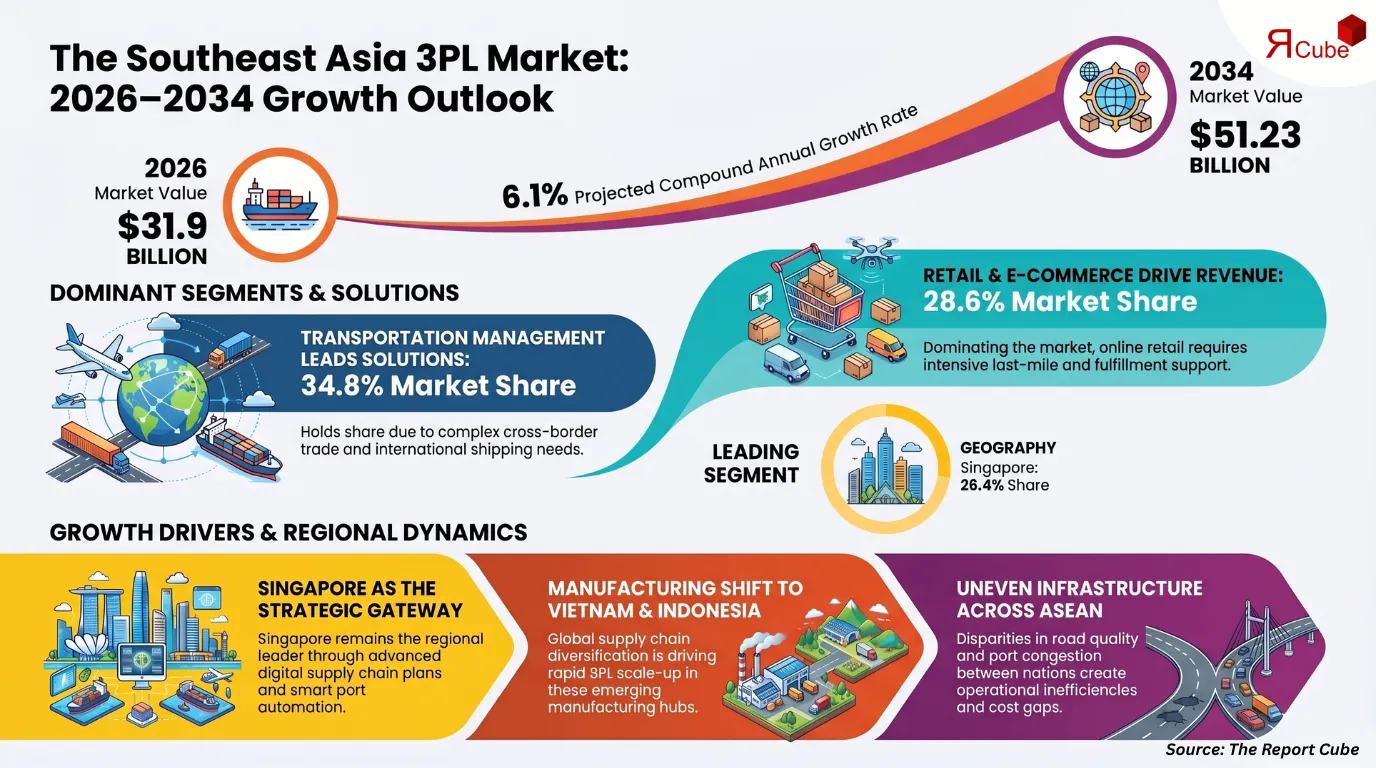
Transportation Management segment leads the market with approximately 34.8% share.
By End User:
Retail & E-commerce segment dominates the market with nearly 28.6% of revenue.
Regional Outlook:
Singapore dominates the Southeast Asia Third-Party Logistics market with around 26.4% share.
Southeast Asia Third-Party Logistics Market Insights & Analysis
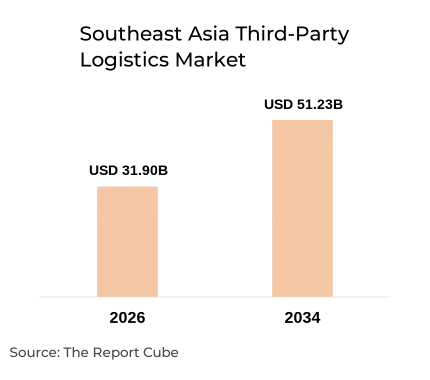
The Southeast Asia Third-Party Logistics Market is anticipated to register a CAGR of around 6.1% during the forecast period 2026-2034. The market size is valued at USD 31.9 billion in 2026 and is projected to reach USD 51.23 billion by 2034. The region has become one of the world's most dynamic logistics hubs, supported by rising intra-ASEAN trade, export-oriented manufacturing growth, and increasing foreign direct investment. Countries including Vietnam, Indonesia, Thailand, and Malaysia continue to attract global manufacturers seeking diversified production locations, creating sustained demand for warehousing, freight forwarding, transportation management, and contract logistics services. As supply chains become more geographically distributed, businesses are increasingly relying on third-party logistics providers to improve operational flexibility, reduce capital expenditure, and strengthen inventory management capabilities.
The Southeast Asia 3PL sector is also benefiting from substantial investments in logistics infrastructure and digital supply chain modernization. Regional governments are expanding ports, industrial corridors, free-trade zones, and multimodal transport networks to improve trade efficiency. Major logistics providers are simultaneously investing in automated fulfillment centers, smart warehouses, and integrated transportation platforms to address growing customer expectations for visibility and speed. The expansion of cross-border e-commerce, healthcare distribution, and temperature-controlled logistics services is further accelerating demand for specialized logistics solutions. These developments collectively strengthen the region's position as a strategic logistics gateway connecting Asia-Pacific manufacturing and consumer markets.
Southeast Asia Third-Party Logistics Market Impact Analysis
| Factor | Type | Specific Impact on Market | Magnitude | Business Implication |
|---|---|---|---|---|
| Expansion of E‑Commerce Platforms | Market | Online retail growth increases parcel volume and last mile needs | High | Supports investment in omnichannel fulfilment and delivery capacity |
| Manufacturing and Industrial Growth | Market | Rising output in FMCG, automotive and electronics boosts freight | High | Drives demand for contract logistics and value added warehousing |
| Cost Optimization Focus by Shippers | Consumer | Companies outsource logistics to cut assets and improve efficiency | High | Enables 3PLs to win long term deals with integrated service bundles |
| Infrastructure and Connectivity Projects | Environmental | New ports, highways and logistics hubs enhance regional flows | Medium | Creates chances to build multimodal networks and new corridors |
| Technology Adoption in Logistics | Technological | Use of TMS, WMS and tracking tools improves visibility and control | Medium | Supports service differentiation through data driven logistics design |
| Regulatory and Trade Policy Changes | Regulatory | Customs reforms and trade deals alter cross border flows | Medium | Requires compliance focus and flexible routing for 3PL networks |
| Pandemic and Supply Chain Disruptions | Environmental | Shocks expose vulnerabilities and raise resilience expectations | Medium | Encourages diversification of carriers, nodes and inventory models |
Southeast Asia Third-Party Logistics Market Dynamics
Key Driver: Expanding Regional Trade Networks and E-commerce Logistics Demand
The strongest growth catalyst for the Southeast Asia Third-Party Logistics Market is the rapid expansion of regional trade and digital commerce ecosystems. ASEAN economies continue to experience increasing merchandise trade volumes, supported by trade agreements, manufacturing investments, and improving economic integration. As businesses scale operations across multiple countries, demand for outsourced transportation, customs brokerage, inventory management, and freight consolidation services continues to rise. Third-party logistics providers play a critical role in simplifying complex supply chain operations while improving delivery reliability and cost efficiency.
The growth of online retail has further transformed logistics requirements throughout the region. E-commerce platforms require extensive fulfillment networks capable of handling high order volumes, rapid delivery cycles, and cross-border shipments. This has encouraged logistics companies to expand warehousing capacity, invest in last-mile delivery infrastructure, and implement advanced transportation management systems. As online retail penetration continues to increase across Indonesia, Vietnam, Thailand, and the Philippines, logistics outsourcing is expected to remain a core business strategy, supporting long-term Southeast Asia 3PL sector growth.
Industry Trends: Integrated Logistics Platforms and Warehouse Automation
A notable trend shaping the Southeast Asia Third-Party Logistics Market is the transition toward integrated end-to-end logistics solutions. Businesses increasingly prefer logistics partners capable of managing transportation, warehousing, inventory control, customs clearance, and distribution through a unified operating model. This integrated approach reduces supply chain complexity while improving shipment visibility and operational performance. Leading logistics providers are therefore expanding service portfolios beyond traditional freight forwarding activities to deliver comprehensive supply chain solutions.
Warehouse modernization has also become a defining characteristic of the Southeast Asia 3PL sector. Logistics operators are deploying automated storage systems, robotics, warehouse management software, and real-time tracking technologies to improve productivity and order accuracy. These investments are particularly visible in Singapore, Malaysia, and Thailand, where logistics infrastructure continues to evolve rapidly. Automated fulfillment facilities help providers manage increasing cargo volumes while supporting customer requirements for faster and more predictable delivery schedules.
Book your FREE 30-minute expert consultation today
Contact UsMajor Challenge: Uneven Logistics Infrastructure Across ASEAN Economies
Although Southeast Asia offers substantial logistics growth opportunities, infrastructure development remains uneven across the region. Mature logistics markets such as Singapore and Malaysia possess highly developed transportation networks, advanced ports, and sophisticated warehousing ecosystems. However, several emerging economies continue to face challenges related to road quality, port congestion, intermodal connectivity, and logistics facility availability. These gaps can create inefficiencies in cargo movement and increase transportation costs for service providers.
Cross-border logistics operations also require compliance with diverse regulatory frameworks, customs procedures, and documentation standards. Logistics providers operating across multiple ASEAN countries must continuously adapt to changing trade regulations while maintaining service consistency. Rising labor costs, fuel price fluctuations, and capacity constraints further contribute to operational challenges. Addressing these issues will require continued public and private investment in logistics infrastructure, digitalization, and regional trade facilitation initiatives.
Opportunity: Supply Chain Diversification Supporting Long-Term Logistics Expansion
Global supply chain diversification strategies are creating significant opportunities for the Southeast Asia Third-Party Logistics Market. Manufacturers across electronics, automotive, consumer goods, and industrial sectors are expanding production footprints throughout Southeast Asia to enhance supply chain resilience. This trend is increasing demand for inbound logistics, factory-to-port transportation, warehousing, and export distribution services across key manufacturing economies.
The Southeast Asia 3PL sector is also well-positioned to benefit from growing investments in industrial parks, economic zones, and export-oriented infrastructure projects. Countries such as Vietnam, Indonesia, and Malaysia continue to attract multinational corporations seeking cost-efficient manufacturing environments with access to regional consumer markets. As production activity expands, logistics providers offering integrated transportation, contract logistics, and value-added warehousing services are expected to capture significant growth opportunities throughout the forecast period.
Southeast Asia Third-Party Logistics Market Segment-wise Analysis
By Solution:
- Logistics Software
- Dedicated Contract Carriage (DCC)
- Warehousing & Distribution
- Transportation Management (International, Domestic)
- Others (Financial, Information, etc.)
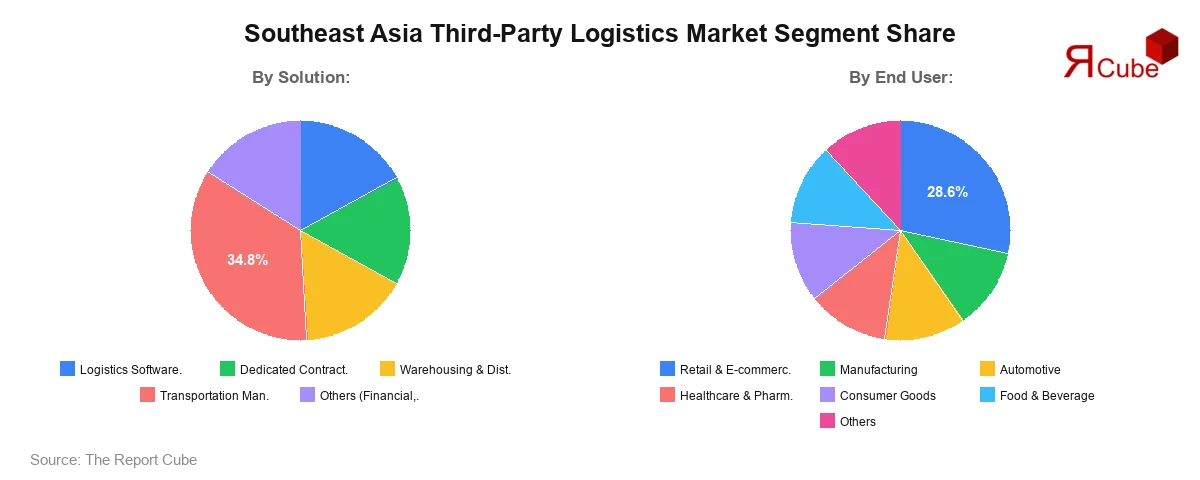
Transportation Management remains the largest solution segment within the Southeast Asia Third-Party Logistics Market, accounting for an estimated 34.8% market share in 2026. The segment's leadership is closely linked to the region's strong dependence on international trade and complex cross-border supply chains. Manufacturers, retailers, and distributors increasingly outsource transportation planning and freight management activities to specialized logistics providers to improve network efficiency and reduce operating costs. International transportation services generate a substantial portion of segment revenue due to growing exports of electronics, machinery, consumer products, and industrial goods.
Demand for transportation management solutions is further supported by ongoing investments in multimodal logistics infrastructure. Logistics providers are expanding capabilities across sea freight, air freight, road transportation, and rail connectivity to accommodate rising cargo volumes. Advanced route optimization systems, shipment visibility platforms, and carrier management technologies are helping organizations improve service reliability while controlling transportation expenses. These advantages continue to strengthen the segment's contribution to overall Southeast Asia 3PL sector revenue.
By End User:
- Retail & E-commerce
- Manufacturing
- Automotive
- Healthcare & Pharmaceuticals
- Consumer Goods
- Food & Beverage
- Others
Retail & E-commerce represents the leading end-user segment in the Southeast Asia Third-Party Logistics Market, contributing approximately 28.6% of total revenue. The segment's dominance reflects the rapid evolution of digital commerce platforms across major Southeast Asian economies. Online retailers require sophisticated logistics support to manage inventory, fulfillment, returns processing, and last-mile delivery operations. Third-party logistics providers help businesses scale efficiently while maintaining service quality across geographically diverse markets.
The continued expansion of omnichannel retail models is generating additional demand for flexible warehousing and distribution networks. Retailers increasingly require real-time inventory visibility, faster order processing, and seamless cross-border fulfillment capabilities. Logistics providers are responding through investments in regional fulfillment centers, automated distribution facilities, and advanced transportation systems. As digital commerce penetration continues to rise, the retail and e-commerce segment is expected to remain a primary growth engine for the Southeast Asia 3PL sector.
Regional Projection of Southeast Asia Third-Party Logistics Industry
- Malaysia
- Indonesia
- Singapore
- Cambodia
- Vietnam
- Thailand
- Philippines
- Others
Singapore maintains its position as the leading contributor to the Southeast Asia Third-Party Logistics Market, accounting for approximately 26.4% of regional revenue. The country serves as a critical logistics gateway for international trade due to its strategic location along major shipping routes, highly efficient customs processes, and world-class transportation infrastructure. Singapore's port and airport facilities handle significant cargo volumes annually, supporting regional distribution activities and global supply chain connectivity.
Government-led investments in logistics innovation, smart port development, and supply chain digitalization continue to reinforce Singapore's competitive advantage. The presence of multinational logistics providers, advanced warehousing facilities, and integrated free-trade ecosystems further strengthens its leadership position. Recent investments in bonded warehousing, e-commerce fulfillment centers, and technology-enabled logistics operations are expanding capacity while supporting rising trade flows throughout ASEAN. These factors collectively ensure Singapore remains the dominant logistics hub within the Southeast Asia 3PL sector through the forecast period.
Need insights for a specific region within this market?
Request Regional DataSoutheast Asia Third-Party Logistics Market Country Analysis
The Southeast Asia third-party logistics market is led by trade hubs and e-commerce growth.
| Country | Demand Level | Key Areas | System Dominance | Core Demand Logic | Growth Nature |
|---|---|---|---|---|---|
| Malaysia | High | Greater Klang Valley, Penang, Johor | Contract logistics, warehousing, linehaul | Manufacturing, e-commerce, port access | Steady expansion |
| Indonesia | Very High | Jakarta, Surabaya, Batam, Bekasi | Parcel, freight forwarding, cold chain | Large domestic demand, archipelago delivery | Fast volume growth |
| Singapore | Very High | CBD, Tuas, Changi, Jurong | 3PL control towers, air/sea forwarding | Regional HQs, transshipment, premium service | High-value growth |
| Cambodia | Medium | Phnom Penh, Sihanoukville, Poipet | Road freight, basic warehousing | Garments, trade corridors, import flows | Emerging growth |
| Vietnam | Very High | Ho Chi Minh City, Hanoi, Hai Phong | Contract logistics, distribution, 3PL | Export manufacturing, industrial relocation | Rapid scale-up |
| Thailand | High | Bangkok, Eastern Economic Corridor | Multimodal freight, warehousing, forwarding | Auto, industrial parks, port and rail links | Infrastructure-led growth |
| Philippines | High | Metro Manila, Cebu, Davao, Clark | CEP, domestic delivery, island logistics | E-commerce, archipelago complexity, congestion | Route-density growth |
Government Initiatives & Policies
- Singapore Logistics Industry Digital Plan (2025 Expansion): Singapore continues expanding its Logistics Industry Digital Plan to accelerate digital adoption, automation, supply chain visibility, and workforce transformation across logistics and transportation sectors.
- Malaysia National Transport Policy 2019-2030 Implementation Updates (2025): Malaysia continues strengthening multimodal transport connectivity, logistics infrastructure modernization, and trade facilitation programs to improve regional supply chain efficiency and logistics competitiveness.
Southeast Asia Third-Party Logistics Industry Recent Developments
- 2025: Maersk Logistics launched Asia Pacific's largest integrated distribution center in Malaysia. The facility strengthens warehousing, freight forwarding, and inland logistics operations while improving multimodal connectivity, cargo consolidation, and supply chain efficiency across Southeast Asia's manufacturing and consumer goods sectors.
- 2025: DP World opened its first Singapore warehouse at the Mapletree Benoi Logistics Hub, adding 13,000 square meters of bonded storage capacity. The investment enhances inventory management, freight consolidation, trade connectivity, and regional distribution capabilities throughout Asia-Pacific markets.
- 2025: SEKO Logistics established a new logistics hub within Singapore's Changi Free Trade Zone. The upgraded facility strengthens e-commerce fulfillment, freight forwarding, and value-added logistics services while improving cross-border trade connectivity and supply chain efficiency across ASEAN markets.
Why Choose This Report?
- Provides a comprehensive overview of the overall market analysis, encompassing key trends, consumer behavior analysis, and risk assessment to support strategic decision-making.
- Provides accurate, up-to-date insights into market size, segmentation, and emerging opportunities, helping to minimize risk & capitalizing on growth.
- Gives deep understanding of target audience preferences, investment habits, and communication channels for enhanced product development & marketing effectiveness.
- Delivers competitive analysis & benchmarking, uncovering the strengths & weaknesses of market competitors to guide strategies.
- Consolidate comprehensive market intelligence, reducing reasoning & streamlining research efforts.
- Facilitates customized market segmentation & risk mitigation strategies, fine-tuned to the business objectives.
- Aids in identifying both market challenges & untapped opportunities within the industry to drive long-term business growth.
- Provides valuable information based on actual customer data & search trends.
Table of Contents
- Introduction
- Objective of the Study
- Product and Category Definition
- Market Segmentation
- Study Variables
- Research Methodology
- Secondary Data Points
- Breakdown of Secondary Sources
- Primary Data Points
- Breakdown of Primary Interviews
- Secondary Data Points
- Executive Summary
- Market Dynamics
- Emerging Opportunities
- Adoption Trends
- Demand Drivers
- Disruption Analysis (Challenges)
- Industry Analysis & Strategic Insights
- Supply/Value Chain Analysis
- Pricing Analysis
- Go-To-Market (GTM) Strategy
- BCG Matrix
- Recent Trends and Developments
- Import and Export Analysis
- Regulatory and Policy Landscape
- Region-wise policies
- Government Initiatives
- Southeast Asia Third-Party Logistics Market Overview and Forecast Analysis (2021-2034)
- Market Size, by Value, by Growth Rate (CAGR / USD Billion)
- Market Share, by Solution
- Logistics software
- Dedicated Contract Carriage (DCC)
- Warehousing & Distribution
- Transportation Management
- International
- Domestic
- Others (Financial, Information, etc)
- Market Share, by Transportation Mode
- Sea
- Air
- Road
- Rail
- Market Share, by End User
- Retail & E-commerce
- Manufacturing
- Automotive
- Healthcare & Pharmaceuticals
- Consumer Goods
- Food & Beverage
- Others
- Market Share, by Region
- Malaysia
- Indonesia
- Singapore
- Cambodia
- Vietnam
- Thailand
- Philippines
- Others
- Market Share, by Company
- Revenue Shares & Analysis
- Competitive Landscape
- Malaysia Third-Party Logistics Market Overview and Forecast Analysis (2021-2034)
- Market Size, by Value, by Growth Rate (CAGR / USD Billion / Million)
- Market Share, by Solution
- Market Share, by Transportation Mode
- Market Share, by End User
- Market Share, by Region
- Indonesia Third-Party Logistics Market Overview and Forecast Analysis (2021-2034)
- Market Size, by Value, by Growth Rate (CAGR / USD Billion / Million)
- Market Share, by Solution
- Market Share, by Transportation Mode
- Market Share, by End User
- Market Share, by Region
- Singapore Third-Party Logistics Market Overview and Forecast Analysis (2021-2034)
- Market Size, by Value, by Growth Rate (CAGR / USD Billion / Million)
- Market Share, by Solution
- Market Share, by Transportation Mode
- Market Share, by End User
- Market Share, by Region
- Cambodia Third-Party Logistics Market Overview and Forecast Analysis (2021-2034)
- Market Size, by Value, by Growth Rate (CAGR / USD Billion / Million)
- Market Share, by Solution
- Market Share, by Transportation Mode
- Market Share, by End User
- Market Share, by Region
- Vietnam Third-Party Logistics Market Overview and Forecast Analysis (2021-2034)
- Market Size, by Value, by Growth Rate (CAGR / USD Billion / Million)
- Market Share, by Solution
- Market Share, by Transportation Mode
- Market Share, by End User
- Market Share, by Region
- Thailand Third-Party Logistics Market Overview and Forecast Analysis (2021-2034)
- Market Size, by Value, by Growth Rate (CAGR / USD Billion / Million)
- Market Share, by Solution
- Market Share, by Transportation Mode
- Market Share, by End User
- Market Share, by Region
- Philippines Third-Party Logistics Market Overview and Forecast Analysis (2021-2034)
- Market Size, by Value, by Growth Rate (CAGR / USD Billion / Million)
- Market Share, by Solution
- Market Share, by Transportation Mode
- Market Share, by End User
- Market Share, by Region
- Competitive Analysis, 2026
- Market Share of Key Players
- Competitive Mapping for Each Solution, Transportation Mode, End User and Companies Operating Regionally
- Malaysia Third-Party Logistics Companies Share & Competitive Analysis, 2026
- Indonesia Third-Party Logistics Companies Share & Competitive Analysis, 2026
- Singapore Third-Party Logistics Companies Share & Competitive Analysis, 2026
- Cambodia Third-Party Logistics Companies Share & Competitive Analysis, 2026
- Vietnam Third-Party Logistics Companies Share & Competitive Analysis, 2026
- Thailand Third-Party Logistics Companies Share & Competitive Analysis, 2026
- Philippines Third-Party Logistics Companies Share & Competitive Analysis, 2026
- Company Profile (Partial List)
- Kerry Logistics
- Company Overview
- Product Portfolio
- Strategic Alliances/Partnerships
- Recent Developments
- DSV
- Company Overview
- Product Portfolio
- Strategic Alliances/Partnerships
- Recent Developments
- Nippon Express
- Company Overview
- Product Portfolio
- Strategic Alliances/Partnerships
- Recent Developments
- DHL Supply Chain & Global Forwarding
- Company Overview
- Product Portfolio
- Strategic Alliances/Partnerships
- Recent Developments
- CJ Logistics
- Company Overview
- Product Portfolio
- Strategic Alliances/Partnerships
- Recent Developments
- Sinotrans
- Company Overview
- Product Portfolio
- Strategic Alliances/Partnerships
- Recent Developments
- DB Schenker
- Company Overview
- Product Portfolio
- Strategic Alliances/Partnerships
- Recent Developments
- CEVA Logistics
- Company Overview
- Product Portfolio
- Strategic Alliances/Partnerships
- Recent Developments
- Kuehne+Nagel International
- Company Overview
- Product Portfolio
- Strategic Alliances/Partnerships
- Recent Developments
- Maersk Logistics
- Company Overview
- Product Portfolio
- Strategic Alliances/Partnerships
- Recent Developments
- Others (Partial List)
- Kerry Logistics
- Contact Us and Disclaimer
Top Key Players & Market Share Outlook
- Kerry Logistics
- DSV
- Nippon Express
- DHL Supply Chain & Global Forwarding
- CJ Logistics
- Sinotrans
- DB Schenker
- CEVA Logistics
- Kuehne+Nagel International
- Maersk Logistics
- Others
Frequently Asked Questions






