


Build Your Custom Market Intelligence Report
Customize Your ReportKey Takeaways
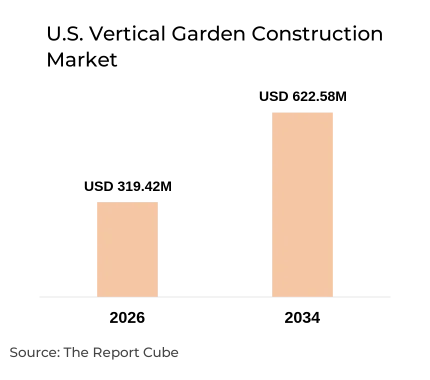
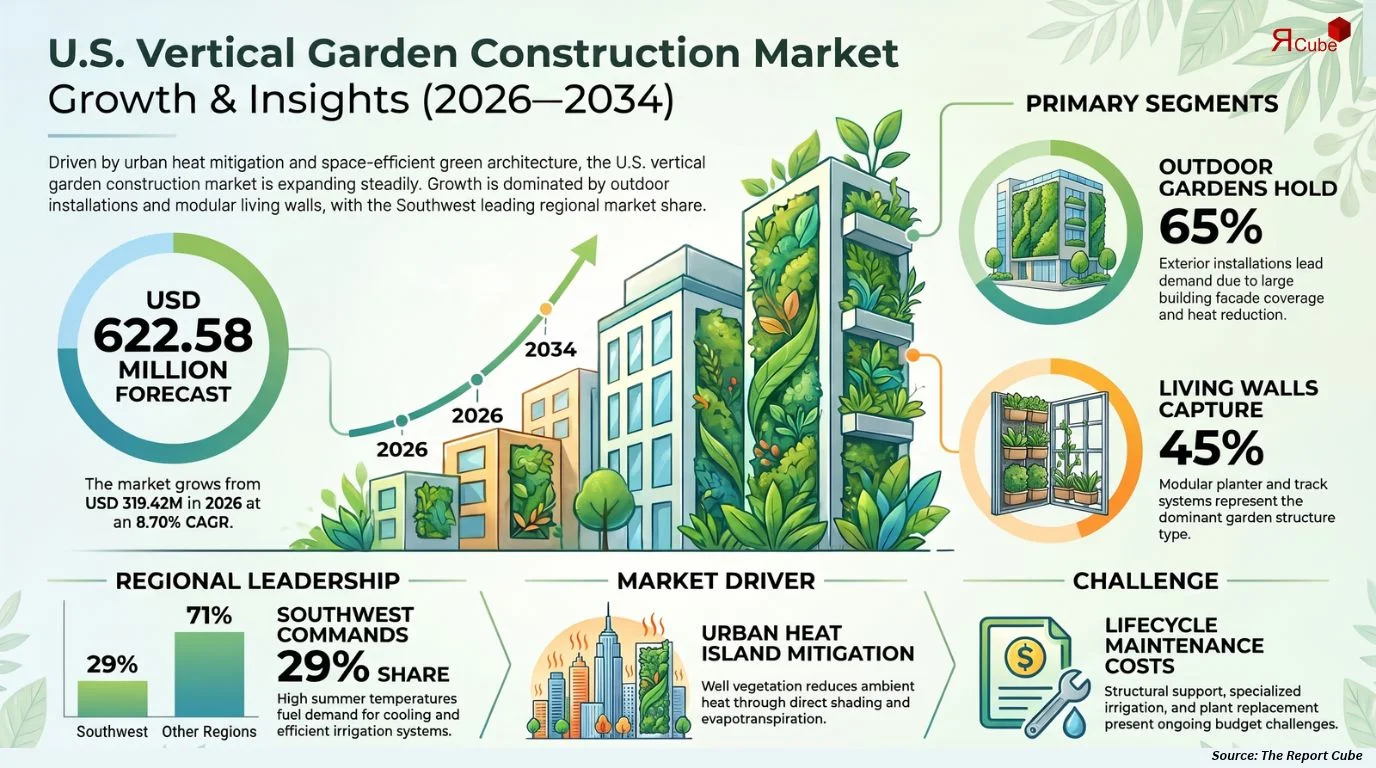
- The U.S. Vertical Garden Construction Market is valued at USD 319.42 million in 2026.
- The market is projected to reach USD 622.58 million by 2034, expanding at a CAGR of 8.70%.
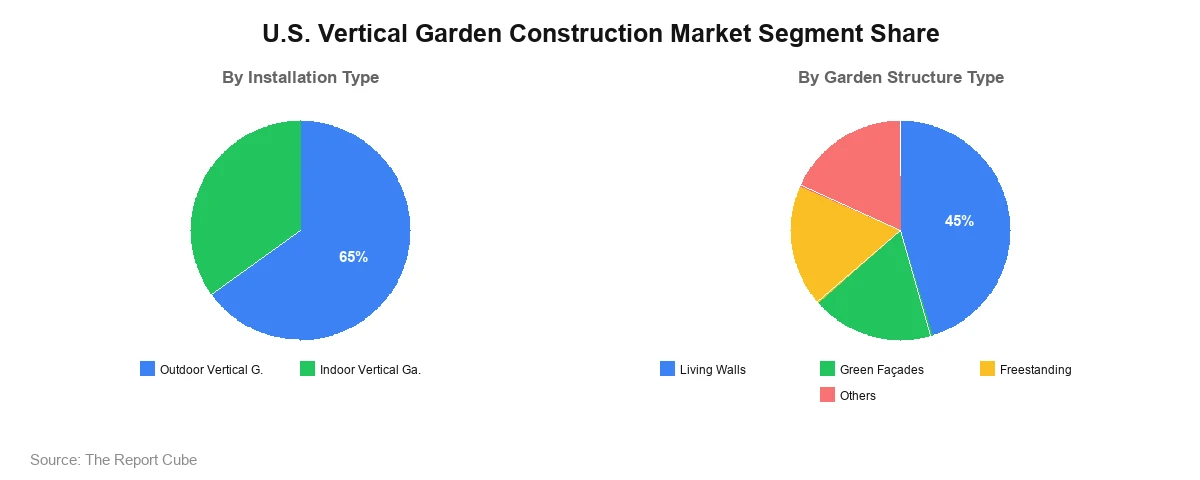
- Outdoor vertical gardens lead the installation type segment with an estimated 65% share in 2026.
- Living walls lead the garden structure type segment with an estimated 45% share in 2026.
- The Southwest is the leading region with an estimated 29% share in 2026.
- End-use shares and the fastest-growing end user were not supplied, so none are estimated.
- LiveWall, GSky, Sempergreen, Greenrise, Green Roof Outfitters and Sage are the supplied key players.
- Climate-appropriate planting and maintenance planning are important themes for project delivery.
Market Overview
Vertical garden construction covers the design, structural mounting, irrigation, drainage and planting of vegetation on walls, façades and freestanding frames. Systems include living walls, green façades and freestanding structures, and are installed on residential and commercial properties, indoors and outdoors, to add greenery where conventional ground-level planting space is limited.
The U.S. Vertical Garden Construction Market Analysis shows demand shaped by building-integrated greenery, urban heat mitigation and efficient use of limited planting space. The U.S. Environmental Protection Agency notes that vegetation reduces heat-island effects through shading and evapotranspiration, and recognizes green walls where planting space is limited, although it does not quantify vertical garden revenue.
Project economics, building compatibility, irrigation design, climate-appropriate plant selection and maintenance capacity influence adoption among property owners and developers. Modular living walls, integrated installation-and-maintenance services and lifecycle planning are shaping supplier offerings. The market is projected to grow at a CAGR of 8.70% during 2026–2034, from USD 319.42 million to USD 622.58 million.
U.S. Vertical Garden Construction Market Dynamics
U.S. Vertical Garden Construction Market Growth depends on building-integrated greenery demand, project economics, structural and irrigation requirements, plant suitability and maintenance capacity. Supplier competition centers on system design, installation quality and long-term service, while government guidance supports urban vegetation benefits without directly quantifying vertical garden construction revenue.
|
Factor |
Type |
Specific Impact on Market |
Magnitude |
|---|---|---|---|
|
Urban heat mitigation and green infrastructure |
Driver |
Vegetation on walls and façades adds shading and evapotranspiration where ground-level space is limited |
Medium–High (qualitative) |
|
Integrated installation and maintenance services |
Opportunity |
Combined design, installation, irrigation and plant replacement contracts differentiate providers |
Medium–High (qualitative) |
|
Installation and lifecycle maintenance costs |
Challenge |
Structural support, irrigation, drainage and specialist upkeep can limit project feasibility |
Medium–High (qualitative) |
|
Integration with building design |
Trend |
Vertical greenery is included in façades, interiors and renovation projects |
Medium (qualitative) |
U.S. Vertical Garden Construction Market Growth Drivers
Urban heat mitigation supports interest in vertical greenery. According to the U.S. Environmental Protection Agency, vegetation reduces heat-island effects through shading and evapotranspiration. Vertical systems add plants to walls and façades in dense sites lacking ground-level space, although actual cooling benefits depend on the installation, climate and maintenance quality at each site.
Space-efficient building greenery is a second driver. The EPA’s green-wall guidance recognizes green walls as an alternative where planting space is limited, creating potential applications in dense residential and commercial environments. Modular living walls, green façades and freestanding structures allow developers and property owners to fit planting into existing vertical surfaces and renovation projects.
U.S. Vertical Garden Construction Market Opportunities
Integrated installation and maintenance services represent a visible supplier opportunity. Providers can combine site assessment, system design, installation, irrigation planning, plant replacement and ongoing maintenance into single contracts. EPA guidance on maintenance planning supports the importance of these considerations, although it does not establish the commercial size of this opportunity.
Modular and space-efficient systems address sites with different structural and space constraints. Living walls, green façades and freestanding structures can serve urban projects where conventional planting is impractical. The EPA identifies green walls as one approach for adding vegetation where planting space is limited, providing a basis for evaluating such systems in residential and commercial projects.
U.S. Vertical Garden Construction Industry Challenges
Installation and lifecycle costs affect project feasibility. Vertical gardens may require structural support, irrigation, drainage, plant replacement and specialist maintenance. The EPA advises designing green-infrastructure projects around maintenance needs, access, labor and locally suitable vegetation, and these requirements can raise ongoing operating costs for smaller property owners and cost-sensitive residential projects.
Site and climate suitability also constrain adoption. Plant performance depends on light, moisture, temperature and local growing conditions, and the EPA recommends selecting vegetation suited to a project’s geographic climate and design purpose. Poor plant selection or inadequate maintenance planning can increase replacement needs and weaken system performance in outdoor installations.
Need Specific Data, Let’s Customize the Report for You
Request CustomizationU.S. Vertical Garden Construction Market Trends
U.S. Vertical Garden Construction Market Trends show vertical greenery moving from ground-level landscaping toward integration with building design. Façades, interiors and renovation projects can incorporate planted walls, and the EPA identifies green walls as a way to introduce vegetation where conventional planting space is limited, supporting design-led adoption in urban settings.
Climate-appropriate planting and maintenance planning are gaining emphasis in green-infrastructure guidance, covering plant selection, access for upkeep and the resources needed to keep systems functioning. For U.S. vertical garden providers, lifecycle planning and ongoing service capability have become important parts of project delivery alongside system design, installation and plant replacement.
U.S. Vertical Garden Construction Market Segment Analysis
U.S. Vertical Garden Construction Market Share is distributed across installation types, garden structure types and end-use applications, each shaped by site conditions, structural requirements and maintenance capacity. Estimated 2026 shares are shown only for the leading segment in each category.
By Installation Type
- Outdoor Vertical Gardens
- Indoor Vertical Gardens
Outdoor vertical gardens lead the installation type segment with an estimated 65% share in 2026, supported by façade projects, urban heat mitigation objectives and the large exterior wall surfaces available for planting. Outdoor systems depend on climate-suited plant selection, irrigation, drainage and maintenance access, which favors suppliers offering design, installation and service together; Sempergreen, for example, supplies a modular outdoor system built from pre-cultivated panels. Indoor vertical gardens follow, serving commercial interiors, offices and public spaces where owners want planted features within limited floor area, and where integrated irrigation supports more predictable plant performance. Indoor demand is linked to interior design and renovation activity, while outdoor demand responds more directly to climate, exposure and structural conditions.
By Garden Structure Type
- Living Walls
- Green Façades
- Freestanding
- Others
Living walls lead the garden structure type segment with an estimated 45% share in 2026, driven by modular planter and panel systems that integrate irrigation and allow plants to be replaced in sections. LiveWall supplies planter modules that slide into mounting tracks with built-in mist irrigation, while Sempergreen supplies pre-cultivated Flexipanels for indoor and outdoor walls. Green façades follow, using vegetation on or near building envelopes to add greenery to exterior surfaces. Freestanding structures serve sites where a suitable wall is unavailable, such as boundaries and screens, while other structures cover specialized designs. Demand across these types is shaped by structural capacity, available space, maintenance resources and plant climate suitability, making project-level design capability a key supplier differentiator.
Regional Analysis
The U.S. Vertical Garden Construction Market is assessed across the West, Southwest, North and Midwest. Only the Southwest share was supplied, and the remaining allocations require validation before publication.
|
Region |
Estimated Market Share |
Key Growth Factors |
Industry Trends |
|---|---|---|---|
|
West |
- |
Dense metropolitan areas and green-building activity (qualitative) |
Compact, modular systems for space-limited sites |
|
Southwest |
29% |
Heat-island mitigation interest and irrigation-efficiency requirements (qualitative) |
Climate-suited plant selection and maintenance planning |
|
North |
- |
Frost and freeze-thaw conditions shape outdoor system design (qualitative) |
Seasonal planning and indoor installations |
|
Midwest |
- |
Established green roof and planted wall suppliers (qualitative) |
Modular planter systems and local installation partners |
The Southwest leads the regional landscape with an estimated 29% share in 2026. Elevated summer temperatures raise interest in shading and heat-island mitigation, while arid conditions make irrigation efficiency, plant selection and maintenance planning central to project design. Climate suitability, which the EPA stresses for vegetation choices, strongly influences outdoor system specifications in the region.
The West, North and Midwest hold the remaining share, and the supplied inputs do not provide individual percentages for them. The West combines dense metropolitan areas with green-building activity, the North faces freeze-thaw and frost conditions that affect outdoor plant selection and irrigation design, and the Midwest includes Michigan-based supplier LiveWall.
Market Share & Competitive Landscape
The U.S. Vertical Garden Construction Market includes living wall system suppliers, green roof and vertical greening specialists, and installation and maintenance providers. The table summarizes the supplied companies by general capability. It does not represent numerical market share, and U.S. sales and project data should be validated.
|
Company |
Competitive Strength |
Primary Segment Served |
|---|---|---|
|
LiveWall LLC |
Planter-module living wall system with mounting tracks and integrated mist irrigation |
Living walls |
|
GSky Plant Systems Inc. |
Vertical garden systems (supplied key player; product details to be confirmed) |
Vertical garden systems |
|
Sempergreen Vertical Systems BV |
Pre-cultivated modular panels for indoor and outdoor walls with installation and maintenance support |
Living walls and green façades |
|
Greenrise Technologies |
Vertical greening solutions (supplied key player; product details to be confirmed) |
Vertical garden systems |
|
Green Roof Outfitters Inc. |
Green roof and vertical greening offerings (supplied key player; product details to be confirmed) |
Green roofs and vertical gardens |
|
Sage Vertical Garden Systems LLC |
Vertical garden systems (supplied key player; product details to be confirmed) |
Vertical garden systems |
Key Companies in the U.S. Vertical Garden Construction Market
LiveWall LLC: LiveWall LLC is a Michigan-based living wall supplier within the Hortech group, alongside the LiveRoof green roof brand. Its system uses planter modules that slide into mounting tracks with integrated mist irrigation. A 2025 hotel installation in Michigan was reported by a secondary source; company confirmation is recommended before publication.
Sempergreen Vertical Systems BV: Sempergreen is headquartered in the Netherlands and develops vertical greening and façade solutions, supporting projects from design through long-term maintenance. Its SemperGreenwall modular system, built from pre-cultivated Flexipanels, serves indoor and outdoor applications. Sempergreen Services renewed the Memorial Park living wall in Manhattan for the Port Authority.
Recent Developments
|
Year / Month |
Company |
Development |
|---|---|---|
|
May 2026 |
Sempergreen |
Outdoor SemperGreenwall system carries an environmental product declaration dated 19 May 2026, valid until 2031 (scope: Europe, Netherlands). |
|
June 2026 |
Sempergreen |
EPEA listing dated 24 June 2026 describes SemperGreenwall as a Cradle to Cradle Certified modular greening system. |
|
Date not stated |
Sempergreen |
Sempergreen Services was commissioned by the Port Authority of New York and New Jersey to renew the 2016 Memorial Park living wall after a pilot phase. |
|
2025 (reported October) |
LiveWall |
A hotel living wall installation in Michigan with a landscape management partner was reported by a secondary source; confirmation recommended. |
U.S. Vertical Garden Construction Market Future Outlook
The U.S. Vertical Garden Construction Market Forecast indicates expansion from USD 319.42 million in 2026 to USD 622.58 million by 2034 at a CAGR of 8.70%, based on supplied estimates. Growth is expected to depend on building-integrated greenery demand, urban heat mitigation objectives, renovation activity and the availability of qualified installation and maintenance providers across the four major U.S. regions.
Modular living walls, climate-appropriate plant selection, efficient irrigation and lifecycle service contracts are likely to shape supplier competition. Risks include installation and maintenance costs, site and climate limitations, plant replacement needs and project-level budget constraints. The projected values remain supplied assumptions rather than guaranteed outcomes, and the actual results will depend on construction activity, supplier execution and customer capital spending.
U.S. Vertical Garden Construction Market Report Coverage
This U.S. Vertical Garden Construction Market Report summarizes the supplied valuation, forecast assumptions, segmentation, regional framework and competitive ecosystem.
|
Parameter |
Details |
|---|---|
|
Market Name |
U.S. Vertical Garden Construction Market |
|
Market Size 2026 |
USD 319.42 million |
|
Market Size 2034 |
USD 622.58 million |
|
Forecast Period |
2026–2034 |
|
CAGR |
8.70% |
|
Base Year |
2026 |
|
Historical Years |
2021-2025 |
|
Forecast Years |
2026–2034 |
|
Segments Covered |
By Installation Type; By Garden Structure Type; By End-Use Application |
|
Regions Covered |
West, Southwest, North, Midwest |
|
Key Companies |
LiveWall LLC, GSky Plant Systems Inc., Sempergreen Vertical Systems BV, Greenrise Technologies, Green Roof Outfitters Inc., Sage Vertical Garden Systems LLC |
|
Customization |
Available as per client requirements |
Why Choose This U.S. Vertical Garden Construction Market Report?
- Market coverage of outdoor and indoor vertical garden construction across residential and commercial applications.
- Clear presentation of the supplied 2026 valuation, 2034 forecast and 8.70% CAGR.
- Segmentation across installation type, garden structure type and end-use application.
- Regional framework covering the West, Southwest, North and Midwest.
- Competitive profiling of supplied living wall and vertical greening suppliers.
- Trend and forecast insights to support product planning, procurement strategy and market-entry evaluation.
- Context on urban heat mitigation, climate suitability and maintenance planning relevant to project decisions.
Table of Contents
- Introduction
- Objective of the Study
- Product Definition
- Market Segmentation
- Study Variables
- Research Methodology
- Secondary Data Points
- Companies Interviewed
- Primary Data Points
- Breakdown of Primary Interviews
- Secondary Data Points
- Executive Summary
- Market Dynamics
- Drivers
- Challenges
- Opportunity Assessment
- Recent Trends and Developments
- Policy and Regulatory Landscape
- U.S. Vertical Garden Construction Market Overview and Forecast Analysis (2021-2034)
- Market Size, By Value, By Growth Rate (CAGR/USD Millions)
- Demand – Supply Trends
- Market Share, By Installation Type
- Outdoor Vertical Gardens
- Indoor Vertical Gardens
- Market Share, By Garden Structure Type
- Living Walls
- Green Façades
- Freestanding
- Others
- Market Share, By End-Use Application
- Residential
- Commercial
- Market Share, By Region
- West
- Southwest
- North
- Midwest
- Market Share, By Competitors
- Competition Characteristics
- Revenue Shares
- Outdoor Vertical Gardens U.S. Vertical Garden Construction Market Overview, 2021-2034F
- By Value (USD Million)
- By Garden Structure Type – Market Size & Forecast 2021-2034, USD Million
- Living Walls
- Green Façades
- Freestanding
- Others
- Indoor Vertical Gardens U.S. Vertical Garden Construction Market Overview, 2021-2034F
- By Value (USD Million)
- By Garden Structure Type – Market Size & Forecast 2021-2034, USD Million
- Living Walls
- Green Façades
- Freestanding
- Others
- Competitive Outlook (Company Profile – Partial List)
- LiveWall LLC
- Company Overview
- Business Segments
- Strategic Alliances/Partnerships
- Recent Developments
- GSky Plant Systems Inc.
- Company Overview
- Business Segments
- Strategic Alliances/Partnerships
- Recent Developments
- Sempergreen Vertical Systems BV
- Company Overview
- Business Segments
- Strategic Alliances/Partnerships
- Recent Developments
- Greenrise Technologies
- Company Overview
- Business Segments
- Strategic Alliances/Partnerships
- Recent Developments
- Green Roof Outfitters Inc.
- Company Overview
- Business Segments
- Strategic Alliances/Partnerships
- Recent Developments
- Sage Vertical Garden Systems LLC
- Company Overview
- Business Segments
- Strategic Alliances/Partnerships
- Recent Developments
- LiveWall LLC
- Contact Us & Disclaimer
Top Key Players & Market Share Outlook
- LiveWall LLC
- GSky Plant Systems Inc.
- Sempergreen Vertical Systems BV
- Greenrise Technologies
- Green Roof Outfitters Inc.
- Sage Vertical Garden Systems LLC
Frequently Asked Questions