



Build Your Custom Market Intelligence Report
Customize Your ReportAsia-Pacific Automotive Parts and Components Market Key Highlights
By Components:
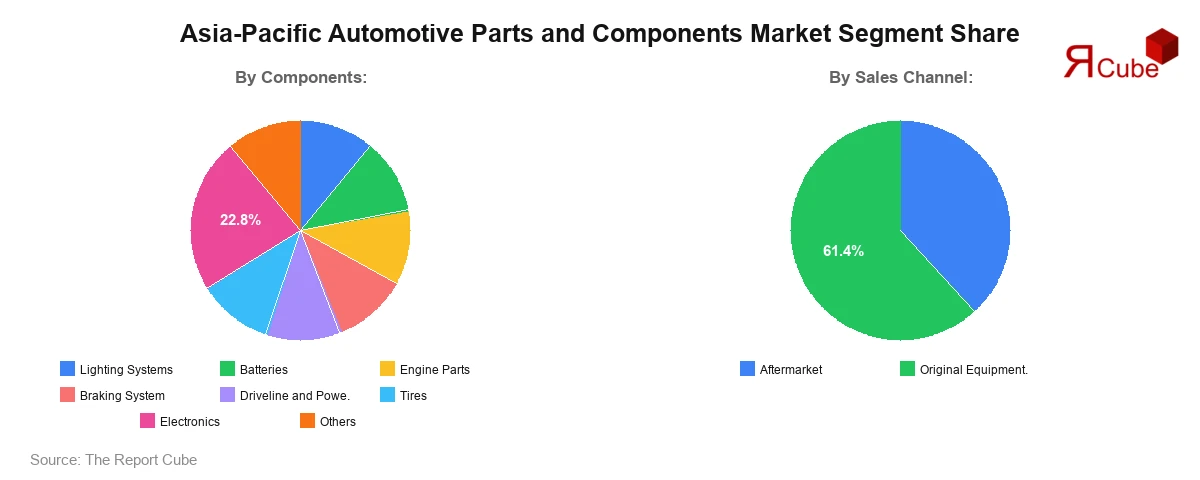
Electronics segment leads the market with nearly 22.8% share.
By Sales Channel:
Original Equipment Manufacturers (OEMs) segment dominates the market with approximately 61.4% of revenue.
Countries Outlook:
China dominates the Asia-Pacific Automotive Parts and Components market with around 43.7% share.
Asia-Pacific Automotive Parts and Components Market Insights & Analysis
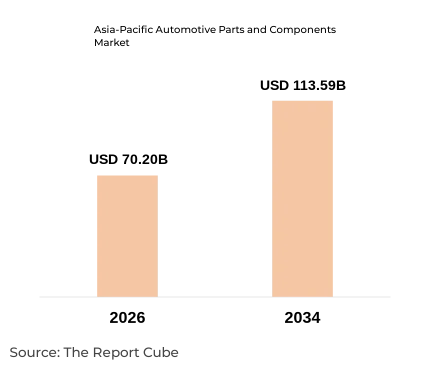
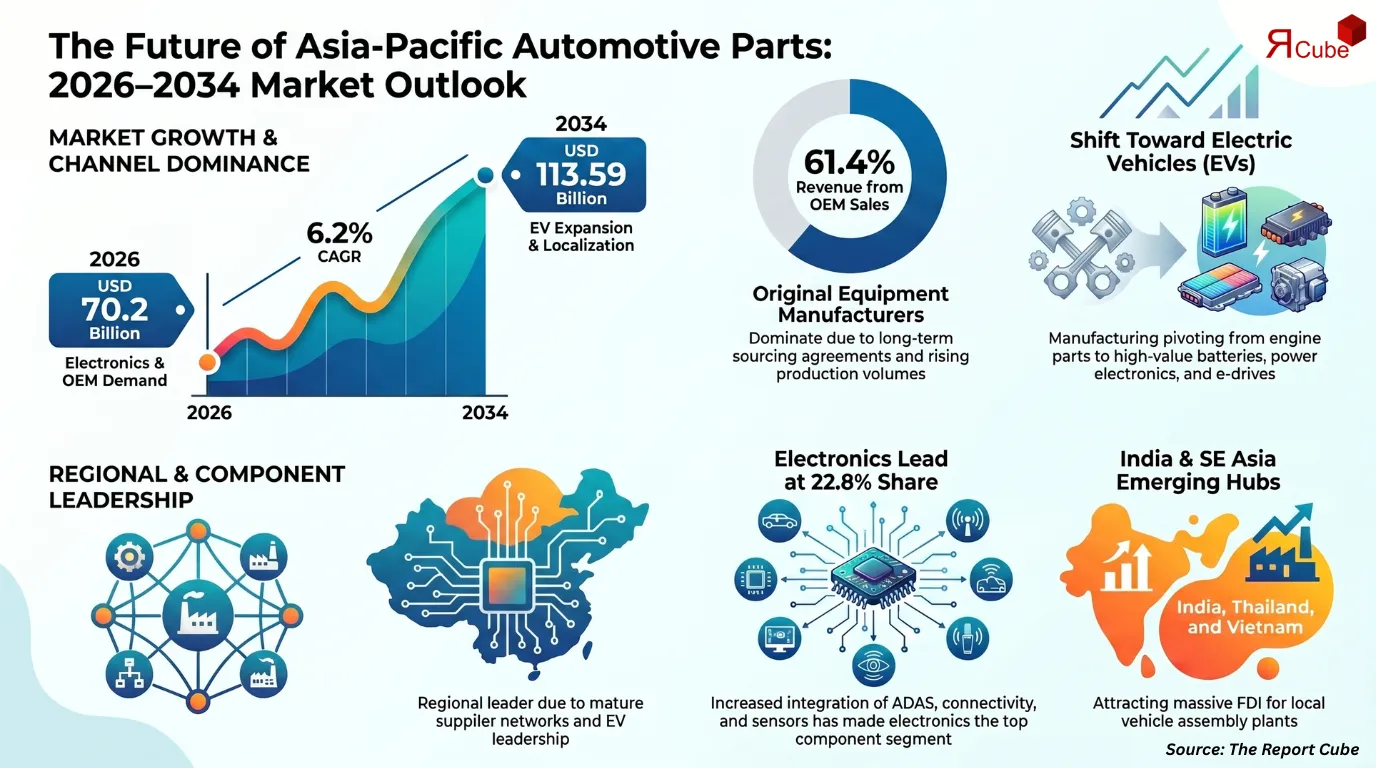
The Asia-Pacific Automotive Parts and Components Market is anticipated to register a CAGR of around 6.2% during the forecast period 2026-2034. The market size is valued at USD 70.2 billion in 2026 and is projected to reach USD 113.59 billion by 2034. Growth is being supported by the region's position as the world's largest vehicle production hub, accounting for a substantial share of global passenger car, commercial vehicle, and two-wheeler manufacturing. Countries such as China, India, Japan, South Korea, and Thailand continue to strengthen their automotive supply chains through capacity expansion, localization initiatives, and investments in advanced manufacturing technologies. Rising vehicle production volumes are creating sustained demand for critical components including electronics, braking systems, batteries, driveline systems, chassis structures, and engine parts.
The Asia-Pacific Automotive Parts and Components manufacturing industry is also benefiting from the rapid shift toward vehicle electrification and connected mobility technologies. Automotive manufacturers are increasingly sourcing high-value components locally to reduce supply chain risks and improve operational efficiency. Significant investments in EV assembly plants, battery production facilities, semiconductor integration, and lightweight material manufacturing are reshaping regional supply networks. In addition, governments across Asia-Pacific continue to support domestic automotive manufacturing through industrial incentives, infrastructure development, and EV-focused policies. These developments are strengthening supplier capabilities, improving export competitiveness, and creating long-term opportunities across both OEM and aftermarket channels.
Asia-Pacific Automotive Parts and Components Market Impact Analysis
| Factor | Type | Specific Impact on Market | Magnitude | Business Implication |
|---|---|---|---|---|
| Vehicle Production Growth | Market | Rising light and heavy vehicle output lifts parts demand | High | Supports scale expansion for core components suppliers |
| Shift Toward Electric Vehicles | Technological | Increases need for batteries, power electronics and e-drives | High | Requires portfolio shift from engine parts to EV subsystems |
| Regional Supply Chain Localization | Environmental | OEMs diversify sourcing away from distant foreign vendors | Medium | Opens sourcing and partnership options for local producers |
| Trade Policies and Tariff Changes | Regulatory | Tariffs alter cost competitiveness of imported components | Medium | Necessitates pricing, sourcing and footprint adjustments |
| Rising Aftermarket and Vehicle Parc | Consumer | Growing vehicle base boosts demand for replacement parts | High | Supports recurring revenue via aftermarket distribution |
| Technology Adoption in Manufacturing | Technological | Automation and digitalization enhance plant productivity | Medium | Improves cost position for firms investing in smart plants |
| Environmental and Emission Standards | Regulatory | Stricter norms drive demand for advanced emission systems | High | Encourages R&D in cleaner exhaust and lightweight parts |
Asia-Pacific Automotive Parts and Components Market Dynamics
Key Driver: Rising Vehicle Manufacturing and Supplier Localization Across Asia-Pacific
The primary growth catalyst for the Asia-Pacific Automotive Parts and Components Market is the continuous expansion of vehicle manufacturing activities across major automotive economies. China remains the largest automotive producer globally, while India, Thailand, Indonesia, and Vietnam are emerging as important manufacturing destinations for global automakers. Rising production of passenger vehicles, commercial vehicles, electric vehicles, and two-wheelers is generating strong demand for automotive systems such as powertrains, electronics, lighting systems, chassis components, and braking technologies. As production volumes increase, component suppliers are expanding regional manufacturing facilities to meet OEM requirements and reduce lead times.
Localization strategies adopted by both governments and automotive manufacturers are further accelerating market growth. Global vehicle manufacturers are increasingly sourcing components from domestic suppliers to strengthen supply chain resilience and comply with local content requirements. This approach is encouraging investments in precision manufacturing, component engineering, and advanced production technologies throughout the Asia-Pacific Automotive Parts and Components manufacturing industry. As a result, local suppliers are gaining larger shares of vehicle platforms and strengthening their position within regional and global automotive value chains.
Industry Trend: Expansion of Automotive Electronics and Electrification Components
One of the most significant developments within the Asia-Pacific Automotive Parts and Components Market is the growing integration of electronics into modern vehicles. Advanced driver assistance systems, vehicle connectivity platforms, digital instrument clusters, intelligent lighting systems, and electronic control units are becoming standard features across multiple vehicle categories. This transition is increasing the value contribution of electronic components per vehicle and encouraging suppliers to invest in research, development, and high-precision manufacturing capabilities.
The expansion of electric vehicle production is creating additional opportunities across the regional manufacturing ecosystem. Battery packs, power electronics, electric motors, thermal management systems, and wiring harnesses are experiencing robust demand growth. Automotive manufacturers across China, South Korea, Japan, Thailand, and India are establishing dedicated EV production facilities, creating new sourcing requirements for component suppliers. These trends are transforming the Asia-Pacific Automotive Parts and Components manufacturing industry from a traditional mechanical-focused sector into a technology-driven ecosystem with greater emphasis on innovation, efficiency, and product integration.
Book your FREE 30-minute expert consultation today
Contact UsMajor Challenge: Cost Pressures and Supply Chain Complexity
The Asia-Pacific Automotive Parts and Components Market continues to face challenges associated with fluctuating raw material costs and increasingly complex supply chains. Essential manufacturing inputs such as steel, aluminum, copper, specialty alloys, and semiconductor materials have experienced periodic price volatility, creating cost management challenges for component manufacturers. Since many suppliers operate under long-term contracts with vehicle manufacturers, sudden increases in material costs can place pressure on operating margins and profitability.
In addition, the growing technological complexity of modern vehicles requires suppliers to maintain strict quality standards, advanced production processes, and continuous investment in innovation. Semiconductor availability, logistics disruptions, and geopolitical uncertainties can affect production schedules and inventory planning throughout the supply chain. These factors increase operational risks for manufacturers and require greater investments in supplier diversification, inventory management, and production flexibility across the Asia-Pacific Automotive Parts and Components manufacturing industry.
Opportunity: Growth of EV Supply Chains and Advanced Material Manufacturing
Rapid expansion of electric mobility presents a substantial opportunity for participants operating within the Asia-Pacific Automotive Parts and Components Market. Governments and automotive manufacturers are investing heavily in battery production, charging infrastructure, and EV assembly facilities. This investment environment is creating strong demand for specialized components including battery management systems, power modules, electric drivetrains, lightweight structures, and thermal management technologies.
Another major opportunity lies in the growing adoption of advanced materials. Automotive manufacturers are increasingly utilizing aluminum, composites, and engineered polymers to reduce vehicle weight and improve energy efficiency. Suppliers capable of producing lightweight, durable, and high-performance materials are expected to benefit from rising procurement requirements across both conventional and electric vehicle platforms. As sustainability goals become more important throughout the automotive sector, the Asia-Pacific Automotive Parts and Components manufacturing industry is expected to witness greater investment in next-generation materials and environmentally responsible manufacturing processes.
Asia-Pacific Automotive Parts and Components Market Segment-wise Analysis
By Components:
- Lighting Systems
- Batteries
- Engine Parts
- Braking System
- Driveline and Powertrain
- Tires
- Bodies and Chassis
- Electronics
- Others
The electronics segment holds the leading position in the Asia-Pacific Automotive Parts and Components Market, accounting for approximately 22.8% of total revenue in 2026. The segment's leadership reflects the growing electronic content integrated into modern vehicles, including sensors, infotainment systems, connectivity modules, advanced safety systems, and vehicle control units. Automotive manufacturers are increasingly incorporating intelligent technologies to improve safety, efficiency, and driving experience, which continues to elevate demand for sophisticated electronic components.
China, Japan, and South Korea serve as major production centers for automotive electronics, supported by strong semiconductor ecosystems and advanced manufacturing infrastructure. Industry assessments indicate that the value of electronic systems per vehicle has increased significantly over recent years due to electrification and connectivity trends. As software-defined vehicles become more prevalent, electronics suppliers are expected to capture an even larger share of the Asia-Pacific Automotive Parts and Components manufacturing industry throughout the forecast period.
By Sales Channel:
- Aftermarket
- Original Equipment Manufacturers (OEMs)
The Original Equipment Manufacturers (OEMs) segment accounts for the largest share of market revenue, representing approximately 61.4% of the Asia-Pacific Automotive Parts and Components Market. The segment benefits directly from rising vehicle production volumes and long-term sourcing agreements between automakers and component suppliers. OEM procurement remains particularly strong in China, India, Japan, South Korea, and Thailand, where automotive manufacturing facilities continue to expand production capacity.
Automakers increasingly prioritize supplier partnerships capable of delivering advanced technologies, consistent quality standards, and localized production support. This trend has strengthened demand for OEM-supplied batteries, electronics, chassis systems, driveline components, and lightweight structural parts. While aftermarket demand continues to grow due to an expanding vehicle fleet, OEM sales remain the primary revenue contributor because of ongoing investments in vehicle platform development and new model launches across the region.
Regional Projection of Asia-Pacific Automotive Parts and Components Industry
- Japan
- Malaysia
- India
- South Korea
- Thailand
- China
- Philippines
- Indonesia
- Vietnam
- Rest of Asia-Pacific
China maintains its position as the largest contributor to the Asia-Pacific Automotive Parts and Components Market, representing approximately 43.7% of regional revenue. The country's dominance is supported by its extensive vehicle production capacity, mature supplier network, advanced manufacturing infrastructure, and leadership in electric vehicle production. China hosts thousands of automotive component manufacturers serving both domestic and international markets, creating one of the world's most comprehensive automotive supply ecosystems.
Continued investments in EV manufacturing, battery production, semiconductor development, and intelligent vehicle technologies are strengthening China's competitive position within the regional automotive industry. Furthermore, strong government support for industrial modernization and new-energy vehicles continues to encourage technological advancement throughout the supply chain. While China remains the regional leader, India and Southeast Asian countries are increasingly attracting automotive investments, contributing to the long-term expansion of the Asia-Pacific Automotive Parts and Components manufacturing industry.
Need insights for a specific region within this market?
Request Regional DataAsia-Pacific Automotive Parts & Components Market - Country Clusters
The Asia-Pacific auto parts market differs by country in scale, role, and growth focus, shaped by OEM output, export intensity, and electrification pace [web:2039][web:2047].
| Cluster | Demand Level | Key Areas | System Dominance | Core Demand Logic | Growth Nature |
|---|---|---|---|---|---|
| Japan | High | Toyota City, Aichi belt | OEM-grade, high-precision parts | Mature OEM base, tech-intensive | Steady, EV-hybrid shift led |
| Malaysia | Medium | Klang Valley, Penang | Aftermarket, CKD kit parts | Rising parc, strong aftermarket | Aftermarket-led, ASEAN linked |
| India | Very High | Pune, Chennai, NCR | Export-grade and OEM parts | Cost edge and export focus | Fast, broad-based value growth |
| South Korea | High | Ulsan, Gyeonggi clusters | High-value OEM and EV parts | Global OEMs, EV platform push | Tech-driven, premium growth |
| Thailand | High | Eastern Economic Corridor | ICE drivetrain and body parts | Regional production hub role | OEM-led, EV pivot beginning |
| China | Extremely High | Guangdong, Yangtze Delta | Full-range, EV and ICE parts | World’s largest vehicle base | Scale-driven, export offensive |
| Philippines | Low to Medium | CALABARZON belt | Aftermarket and niche parts | Import-heavy, aging vehicle parc | Gradual, aftermarket centered |
| Indonesia | High | Jakarta, West Java | OEM assembly and spares | Large MPV/SUV domestic base | Volume-led, ASEAN focused |
| Vietnam | Medium | Hai Phong, Hanoi belt | Tier-2 parts and assemblies | New OEM plants and FDI inflow | Fast, FDI-supply chain led |
Government Initiatives & Policies
- India PM E-DRIVE Program: The Government of India continues implementation of the PM E-DRIVE scheme to accelerate EV adoption, charging infrastructure development, and domestic automotive manufacturing ecosystem growth through 2026.
- Thailand EV 3.5 Incentive Program: Thailand continues expanding EV manufacturing through subsidies, tax incentives, and localization requirements that support regional production of electric vehicles and automotive components.
Asia-Pacific Automotive Parts and Components Industry Recent Developments
- 2026: Renault expanded local production of its new Duster SUV at the Chennai manufacturing facility in India. The development strengthens localization efforts, increases sourcing opportunities for domestic suppliers, and supports higher demand for chassis systems, electronics, interiors, body structures, and powertrain components across regional supply chains.
- 2025: Mazda Motor Corporation announced an investment of approximately USD 148 million in Thailand to support electric compact SUV production. The initiative is expected to increase demand for batteries, electric drivetrains, power electronics, wiring harnesses, and thermal management solutions while strengthening Southeast Asia's EV component ecosystem.
Why Choose This Report?
- Provides a comprehensive overview of the overall market analysis, encompassing key trends, consumer behavior analysis, and risk assessment to support strategic decision-making.
- Provides accurate, up-to-date insights into market size, segmentation, and emerging opportunities, helping to minimize risk & capitalizing on growth.
- Gives deep understanding of target audience preferences, investment habits, and communication channels for enhanced product development & marketing effectiveness.
- Delivers competitive analysis & benchmarking, uncovering the strengths & weaknesses of market competitors to guide strategies.
- Consolidate comprehensive market intelligence, reducing reasoning & streamlining research efforts.
- Facilitates customized market segmentation & risk mitigation strategies, fine-tuned to the business objectives.
- Aids in identifying both market challenges & untapped opportunities within the industry to drive long-term business growth.
- Provides valuable information based on actual customer data & search trends.
Table of Contents
- Introduction
- Objective of the Study
- Product and Category Definition
- Market Segmentation
- Study Variables
- Research Methodology
- Secondary Data Points
- Breakdown of Secondary Sources
- Primary Data Points
- Breakdown of Primary Interviews
- Secondary Data Points
- Executive Summary
- Market Dynamics
- Emerging Opportunities
- Adoption Trends
- Demand Drivers
- Disruption Analysis (Challenges)
- Industry Analysis and Strategic Insights
- Supply and Value Chain Analysis
- Pricing Analysis
- Go-to-Market Strategy
- BCG Matrix
- Recent Trends and Developments
- Import and Export Analysis
- Regulatory and Policy Landscape
- Region-wise Policies
- Government Initiatives
- Asia-Pacific Automotive Parts and Components Market Overview and Forecast Analysis (2021-2034)
- Market Size, By Value, By Growth Rate (CAGR/ USD Billion)
- Market Share, By Components
- Lighting Systems
- Batteries
- Engine Parts (Pistons, Gaskets, Belts, Timing Chains)
- Braking System
- Driveline and Powertrain
- Tires
- Bodies and Chassis
- Electronics
- Others (Seating, Transmission Components, and Others)
- Market Share, By Material
- Composites
- Steel
- Plastic and Polymers
- Aluminum
- Others
- Market Share, By Sales Channel
- Aftermarket
- Original Equipment Manufacturers (OEMs)
- Market Share, By Vehicle Type
- Passenger Cars
- Aftermarket
- Original Equipment Manufacturers (OEMs)
- Off-the-Road
- Aftermarket
- Original Equipment Manufacturers (OEMs)
- Three-wheelers
- Aftermarket
- Original Equipment Manufacturers (OEMs)
- Commercial Vehicles
- Medium and Heavy Commercial Vehicles (MHCVs)
- Aftermarket
- Original Equipment Manufacturers (OEMs)
- Light Commercial Vehicles (LCVs)
- Aftermarket
- Original Equipment Manufacturers (OEMs)
- Medium and Heavy Commercial Vehicles (MHCVs)
- Two-wheelers
- Aftermarket
- Original Equipment Manufacturers (OEMs)
- Passenger Cars
- Market Share, by Country
- Japan
- Malaysia
- India
- South Korea
- Thailand
- China
- Philippines
- Indonesia
- Vietnam
- Rest of Asia-Pacific
- Market Share, By Company
- Revenue Shares and Analysis
- Competitive Landscape
- Japan Automotive Parts and Components Market Overview and Forecast Analysis (2021-2034)
- Market Size, By Value, By Growth Rate (CAGR/ USD Billion/ Million)
- Market Share, By Components
- Market Share, By Material
- Market Share, By Sales Channel
- Market Share, By Vehicle Type
- Malaysia Automotive Parts and Components Market Overview and Forecast Analysis (2021-2034)
- Market Size, By Value, By Growth Rate (CAGR/ USD Billion/ Million)
- Market Share, By Components
- Market Share, By Material
- Market Share, By Sales Channel
- Market Share, By Vehicle Type
- India Automotive Parts and Components Market Overview and Forecast Analysis (2021-2034)
- Market Size, By Value, By Growth Rate (CAGR/ USD Billion/ Million)
- Market Share, By Components
- Market Share, By Material
- Market Share, By Sales Channel
- Market Share, By Vehicle Type
- South Korea Automotive Parts and Components Market Overview and Forecast Analysis (2021-2034)
- Market Size, By Value, By Growth Rate (CAGR/ USD Billion/ Million)
- Market Share, By Components
- Market Share, By Material
- Market Share, By Sales Channel
- Market Share, By Vehicle Type
- Thailand Automotive Parts and Components Market Overview and Forecast Analysis (2021-2034)
- Market Size, By Value, By Growth Rate (CAGR/ USD Billion/ Million)
- Market Share, By Components
- Market Share, By Material
- Market Share, By Sales Channel
- Market Share, By Vehicle Type
- China Automotive Parts and Components Market Overview and Forecast Analysis (2021-2034)
- Market Size, By Value, By Growth Rate (CAGR/ USD Billion/ Million)
- Market Share, By Components
- Market Share, By Material
- Market Share, By Sales Channel
- Market Share, By Vehicle Type
- Philippines Automotive Parts and Components Market Overview and Forecast Analysis (2021-2034)
- Market Size, By Value, By Growth Rate (CAGR/ USD Billion/ Million)
- Market Share, By Components
- Market Share, By Material
- Market Share, By Sales Channel
- Market Share, By Vehicle Type
- Indonesia Automotive Parts and Components Market Overview and Forecast Analysis (2021-2034)
- Market Size, By Value, By Growth Rate (CAGR/ USD Billion/ Million)
- Market Share, By Components
- Market Share, By Material
- Market Share, By Sales Channel
- Market Share, By Vehicle Type
- Vietnam Automotive Parts and Components Market Overview and Forecast Analysis (2021-2034)
- Market Size, By Value, By Growth Rate (CAGR/ USD Billion/ Million)
- Market Share, By Components
- Market Share, By Material
- Market Share, By Sales Channel
- Market Share, By Vehicle Type
- Competitive Analysis, 2026
- Market Share of Key Players
- Competitive Mapping for Each Segment and Companies Operating Regionally
- Japan Automotive Parts and Components Companies Share and Competitive Analysis, 2026
- Malaysia Automotive Parts and Components Companies Share and Competitive Analysis, 2026
- India Automotive Parts and Components Companies Share and Competitive Analysis, 2026
- South Korea Automotive Parts and Components Companies Share and Competitive Analysis, 2026
- Thailand Automotive Parts and Components Companies Share and Competitive Analysis, 2026
- China Automotive Parts and Components Companies Share and Competitive Analysis, 2026
- Philippines Automotive Parts and Components Companies Share and Competitive Analysis, 2026
- Indonesia Automotive Parts and Components Companies Share and Competitive Analysis, 2026
- Vietnam Automotive Parts and Components Companies Share and Competitive Analysis, 2026
- Company Profile (Partial List)
- Mando
- Company Overview
- Product Portfolio
- Strategic Alliances/Partnerships
- Recent Developments
- Tata AutoComp Systems
- Company Overview
- Product Portfolio
- Strategic Alliances/Partnerships
- Recent Developments
- Denso
- Company Overview
- Product Portfolio
- Strategic Alliances/Partnerships
- Recent Developments
- JTEKT
- Company Overview
- Product Portfolio
- Strategic Alliances/Partnerships
- Recent Developments
- Hyundai Mobis
- Company Overview
- Product Portfolio
- Strategic Alliances/Partnerships
- Recent Developments
- Bosch
- Company Overview
- Product Portfolio
- Strategic Alliances/Partnerships
- Recent Developments
- ZF Friedrichshafen
- Company Overview
- Product Portfolio
- Strategic Alliances/Partnerships
- Recent Developments
- Aisin
- Company Overview
- Product Portfolio
- Strategic Alliances/Partnerships
- Recent Developments
- Samvardhana Motherson
- Company Overview
- Product Portfolio
- Strategic Alliances/Partnerships
- Recent Developments
- Sumitomo Electric
- Company Overview
- Product Portfolio
- Strategic Alliances/Partnerships
- Recent Developments
- Others (Partial List)
- Mando
- Contact Us and Disclaimer
Top Key Players & Market Share Outlook
- Mando
- Tata AutoComp Systems
- Denso
- JTEKT
- Hyundai Mobis
- Bosch
- ZF Friedrichshafen
- Aisin
- Samvardhana Motherson
- Sumitomo Electric
Frequently Asked Questions






