



Build Your Custom Market Intelligence Report
Customize Your ReportUnited States AI Protein Design Market Key Highlights
By Technology:
Generative AI Models segment leads the market with around 31% share.
By Application:
Therapeutic Protein Design segment dominates the market with nearly 34% of revenue.
Regional Outlook:
West region dominates the United States AI Protein Design market with approximately 39% share.
United States AI Protein Design Market Insights & Analysis
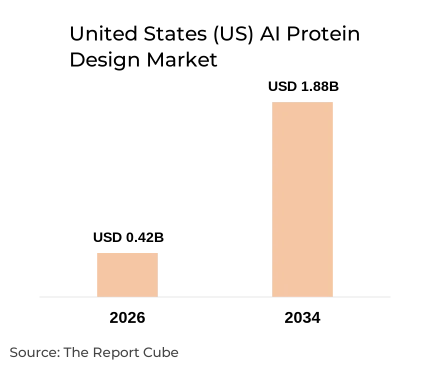
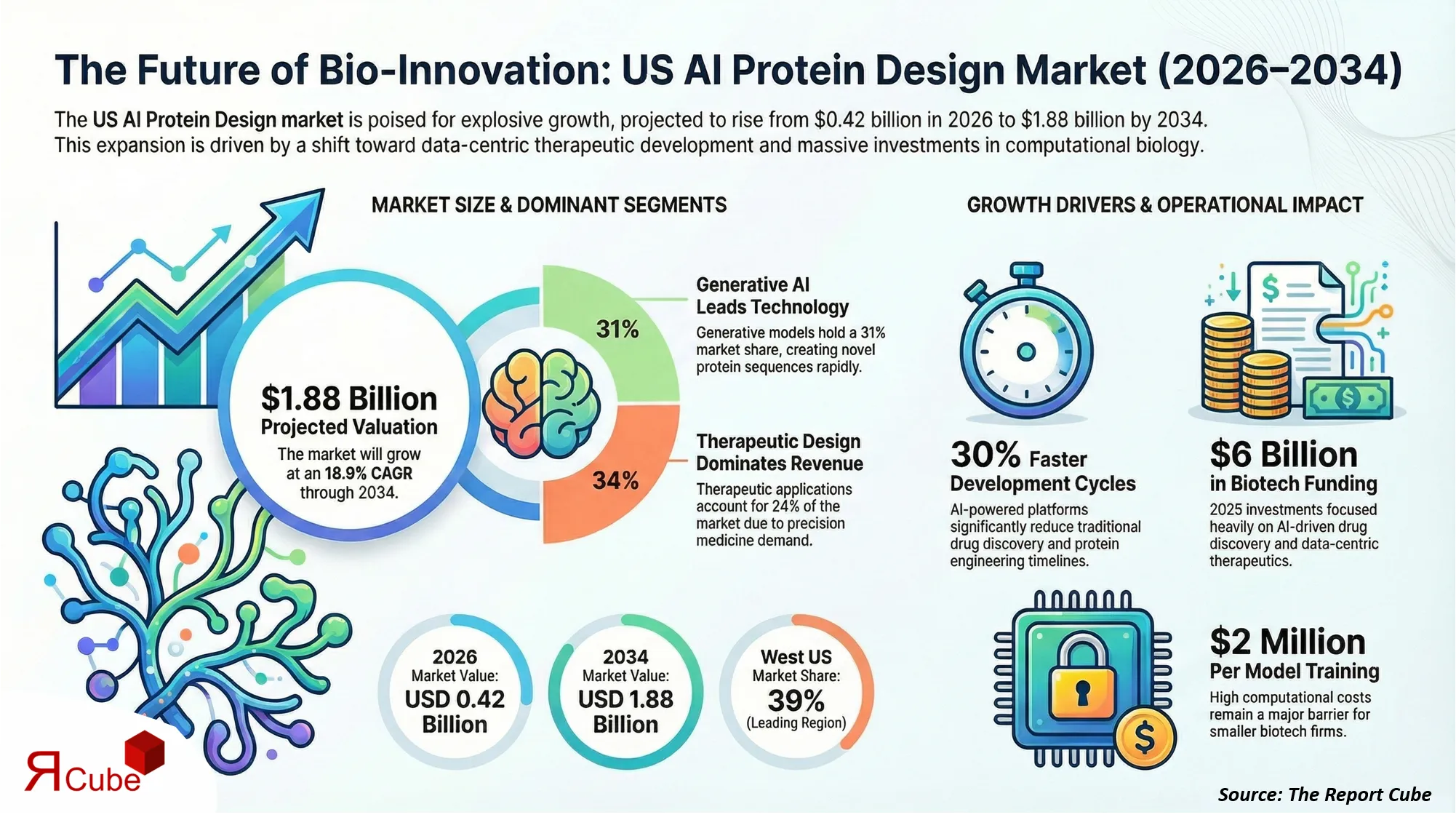
The United States AI Protein Design Market is anticipated to register a CAGR of around 18.9% during the forecast period 2026-2034. The market size is valued at USD 0.42 billion in 2026 and is projected to reach USD 1.88 billion by 2034. The rapid expansion of the AI protein design market is strongly linked to rising investments in computational biology and precision medicine. In 2025, U.S. biotech funding for AI-driven drug discovery surpassed USD 6 billion, reflecting a major shift toward data-centric therapeutic development. Companies are integrating high-performance computing with biological datasets, enabling faster identification of protein structures and functions. This transformation is reshaping traditional drug discovery timelines, reducing development cycles by nearly 30%.
In addition, advancements in foundation models and protein-folding algorithms are strengthening the market value and innovation pipeline. The integration of generative AI models with wet-lab automation has significantly improved success rates in therapeutic protein engineering. Government-backed research initiatives and collaborations with academic institutions continue to support innovation, particularly in areas such as vaccine antigen design and enzyme optimization. As a result, the US AI Protein Design market growth is increasingly driven by cross-disciplinary innovation, combining bioinformatics, machine learning, and molecular biology to deliver scalable and efficient protein engineering solutions.
United States AI Protein Design Market Dynamics
Key Driver: Rising Demand for Accelerated Drug Discovery and Precision Medicine
The primary driver of the United States AI Protein Design market is the growing need to accelerate drug discovery processes while improving precision. Traditional drug development can take over a decade, but AI-powered protein design platforms are reducing this timeline significantly. In 2025, nearly 45% of U.S. biopharmaceutical companies adopted AI-driven modeling tools to streamline protein engineering workflows. This shift is fueled by the increasing demand for targeted therapies, especially for oncology and rare diseases. AI enables researchers to design proteins with higher specificity, reducing off-target effects and improving treatment outcomes.
Moreover, the integration of AI in therapeutic development enhances cost efficiency and scalability. Pharmaceutical firms are leveraging deep learning models to predict protein folding and interactions with remarkable accuracy. This allows early-stage validation of drug candidates, reducing failure rates in clinical trials. As healthcare systems focus more on personalized medicine, the demand for AI-designed proteins continues to rise, strengthening the overall market size and revenue potential.
Book your FREE 30-minute expert consultation today
Contact UsIndustry Trends: Emergence of Foundation Models and End-to-End AI Platforms
The United States AI Protein Design market trends indicate a strong shift toward foundation models capable of handling complex biological datasets. These models are trained on millions of protein sequences and structures, enabling them to generate highly accurate predictions. In 2025, several biotech firms launched end-to-end AI platforms that integrate sequence design, structure prediction, and validation within a single workflow. This trend is improving efficiency and reducing dependency on fragmented tools.
Another notable trend is the rise of cloud-based platforms that enable collaborative research across institutions. These platforms allow real-time data sharing and model training, accelerating innovation cycles. Additionally, the use of generative AI in enzyme engineering and antibody optimization is expanding rapidly. The growing adoption of hybrid AI-physics models further enhances predictive accuracy, ensuring better alignment with real-world biological behavior. These trends are shaping a more integrated and scalable ecosystem within the AI protein design market.
Major Challenge: High Computational Costs and Data Complexity
One of the key challenges affecting the United States AI Protein Design market growth is the high computational cost associated with advanced AI models. Training large-scale protein models requires significant computational infrastructure, often involving specialized hardware such as GPUs and high-performance clusters. In 2025, the average cost of training a complex biomolecular model exceeded USD 2 million, limiting accessibility for smaller organizations.
Additionally, the complexity and variability of biological data pose challenges in model accuracy and reproducibility. Protein behavior is influenced by multiple environmental and genetic factors, making it difficult to create universally reliable models. Data fragmentation across institutions further complicates integration and standardization efforts. These factors collectively hinder widespread adoption, particularly among early-stage biotech startups.
Opportunity: Expansion into Gene Editing and Industrial Applications
The United States AI Protein Design market presents significant opportunities in expanding beyond therapeutics into gene editing and industrial biotechnology. AI-designed enzymes are increasingly being used in sustainable manufacturing processes, including biofuels and biodegradable materials. In 2025, industrial applications accounted for nearly 18% of emerging AI protein design use cases, highlighting a growing diversification of the market.
Furthermore, advancements in gene editing technologies such as CRISPR are creating new avenues for AI-designed proteins. These innovations enable precise modifications at the genetic level, opening possibilities for one-time curative treatments. Collaboration between biotech firms and industrial players is expected to accelerate innovation, driving new revenue streams and strengthening the overall market outlook.
United States AI Protein Design Market Segment-wise Analysis
By Technology:
- Deep Learning Models
- Generative AI Models
- Reinforcement Learning Systems
- Bayesian Optimization Platforms
- Hybrid AI-Physics Models
- High-Throughput Screening Platforms
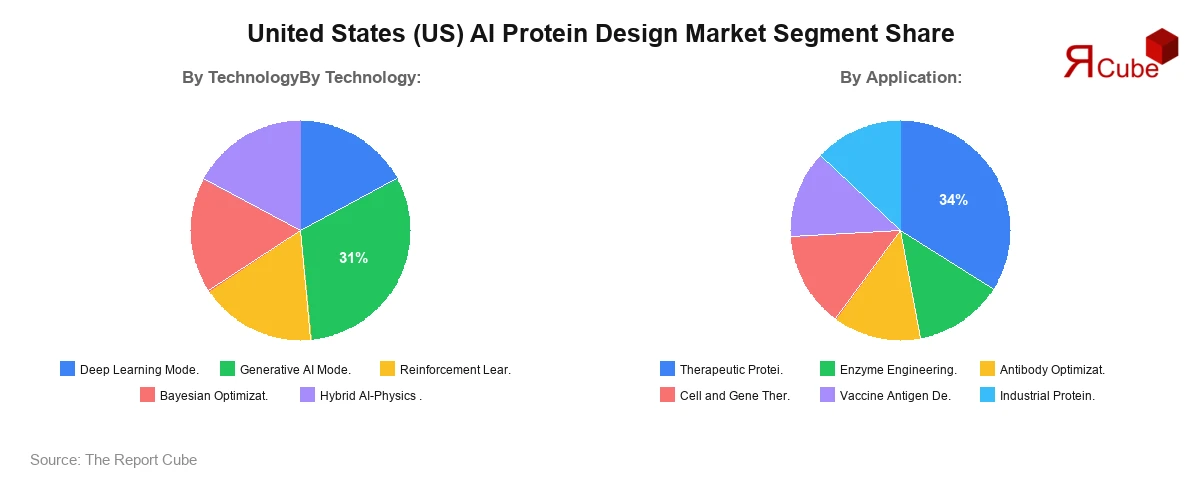
Generative AI Models dominate the United States AI Protein Design market share, accounting for approximately 31% in 2026. These models excel in creating novel protein sequences by learning from vast biological datasets. Their ability to simulate millions of potential protein configurations in a short time significantly accelerates discovery processes. In 2025, over 50% of newly designed therapeutic proteins in the U.S. utilized generative AI frameworks. The flexibility and scalability of these models make them highly preferred among biotechnology startups and research institutions.
By Application:
- Therapeutic Protein Design
- Enzyme Engineering
- Antibody Optimization
- Cell and Gene Therapy Design
- Vaccine Antigen Design
- Industrial Protein Design
Therapeutic Protein Design holds the leading position with nearly 34% revenue share in the United States AI Protein Design market. The segment’s growth is driven by increasing demand for targeted biologics and personalized treatments. AI tools enable precise protein modifications, improving drug efficacy and reducing adverse effects. In 2025, therapeutic applications saw a 28% increase in clinical pipeline activity, reflecting strong adoption. This segment continues to attract major investments, reinforcing its dominance in the market.
Regional Projection of United States AI Protein Design Industry
- West
- East
- South
- Midwest
- Others
The West region leads the United States AI Protein Design market with an estimated 39% share, driven by a strong concentration of biotechnology firms and research institutions. States like California host major biotech hubs, supported by advanced infrastructure and access to venture capital. In 2025, nearly 60% of AI-driven biotech funding in the U.S. was directed toward companies in the West region. The presence of leading technology companies also facilitates integration of AI capabilities with biological research, enhancing innovation and market growth.
Government Initiatives & Policies
- National Biotechnology and Biomanufacturing Initiative (2025): Supports AI-driven bioinnovation, funding protein engineering and synthetic biology projects.
- NIH AI for Biomedical Research Program (2026): Promotes AI integration in drug discovery and protein design through federal research grants.
United States AI Protein Design Industry Recent Developments
- 2025: Recursion released Boltz-2 with MIT, enabling high-accuracy protein structure and binding prediction, accelerating AI-driven drug discovery workflows across the United States.
- 2025: Profluent Bio partnered with Ensoma to develop AI-designed base editors for gene therapies, expanding applications into advanced cell and gene treatment solutions.
Need insights for a specific region within this market?
Request Regional DataWhy Choose This Report?
- Provides a comprehensive overview of the overall market analysis, encompassing key trends, consumer behavior analysis, and risk assessment to support strategic decision-making.
- Provides accurate, up-to-date insights into market size, segmentation, and emerging opportunities, helping to minimize risk & capitalizing on growth.
- Gives deep understanding of target audience preferences, investment habits, and communication channels for enhanced product development & marketing effectiveness.
- Delivers competitive analysis & benchmarking, uncovering the strengths & weaknesses of market competitors to guide strategies.
- Consolidate comprehensive market intelligence, reducing reasoning & streamlining research efforts.
- Facilitates customized market segmentation & risk mitigation strategies, fine-tuned to the business objectives.
- Aids in identifying both market challenges & untapped opportunities within the industry to drive long-term business growth.
- Provides valuable information based on actual customer data & search trends.
Table of Contents
- Introduction
- Objective of the Study
- Product and Category Definition
- Market Segmentation
- Study Variables
- Research Methodology
- Secondary Data Points
- Breakdown of Secondary Sources
- Primary Data Points
- Breakdown of Primary Interviews
- Secondary Data Points
- Executive Summary
- Market Dynamics
- Drivers
- Challenges
- Opportunity Assessment
- Recent Trends and Developments
- Regulatory and Policy Landscape
- United States (US) AI Protein Design Market Overview (2021-2034)
- Market Size, By Value (USD Billion)
- Market Share, By Technology
- Deep Learning Models
- Generative AI Models
- Reinforcement Learning Systems
- Bayesian Optimization Platforms
- Hybrid AI-Physics Models
- High‑Throughput Screening Platforms
- Market Share, By Application
- Therapeutic Protein Design
- Enzyme Engineering
- Antibody Optimization
- Cell and Gene Therapy Design
- Vaccine Antigen Design
- Industrial Protein Design
- Market Share, By End User
- Biopharmaceutical Companies
- Biotechnology Startups
- Contract Research Organizations
- Academic Research Institutes
- Government and Nonprofit Laboratories
- Market Share, By Deployment Type
- Cloud‑Based Platforms
- On‑Premise Solutions
- Hybrid Deployment Models
- Platform‑as‑a‑Service
- Market Share, By Protein Type
- Monoclonal Antibodies
- Enzymes
- Cytokines and Growth Factors
- Peptides
- Scaffold Proteins
- Chimeric Antigen Receptors
- Market Share, By Workflow Stage
- Target Identification
- Sequence Design
- Structure Prediction
- In Silico Screening
- Optimization and Validation
- Preclinical Translation
- Market Share, By Region
- West
- East
- South
- Midwest
- Others
- Market Share, By Company
- Revenue Shares and Analysis
- Competitive Landscape
- West United States AI Protein Design Market
- Market Size, By Value (USD Billion)
- Market Share, By Technology
- Market Share, By Application
- Market Share, By End User
- Market Share, By Deployment Type
- Market Share, By Protein Type
- Market Share, By Workflow Stage
- East United States AI Protein Design Market
- Market Size, By Value (USD Billion)
- Market Share, By Technology
- Market Share, By Application
- Market Share, By End User
- Market Share, By Deployment Type
- Market Share, By Protein Type
- Market Share, By Workflow Stage
- South United States AI Protein Design Market
- Market Size, By Value (USD Billion)
- Market Share, By Technology
- Market Share, By Application
- Market Share, By End User
- Market Share, By Deployment Type
- Market Share, By Protein Type
- Market Share, By Workflow Stage
- Midwest United States AI Protein Design Market
- Market Size, By Value (USD Billion)
- Market Share, By Technology
- Market Share, By Application
- Market Share, By End User
- Market Share, By Deployment Type
- Market Share, By Protein Type
- Market Share, By Workflow Stage
- Competitive Outlook and Company Profiles
- Arzeda
- Company Overview
- Product Portfolio
- Strategic Alliances/Partnerships
- Recent Developments
- LabGenius
- Company Overview
- Product Portfolio
- Strategic Alliances/Partnerships
- Recent Developments
- Absci
- Company Overview
- Product Portfolio
- Strategic Alliances/Partnerships
- Recent Developments
- Evozyne
- Company Overview
- Product Portfolio
- Strategic Alliances/Partnerships
- Recent Developments
- Recursion
- Company Overview
- Product Portfolio
- Strategic Alliances/Partnerships
- Recent Developments
- Fable Therapeutics
- Company Overview
- Product Portfolio
- Strategic Alliances/Partnerships
- Recent Developments
- BigHat Biosciences
- Company Overview
- Product Portfolio
- Strategic Alliances/Partnerships
- Recent Developments
- Cradle
- Company Overview
- Product Portfolio
- Strategic Alliances/Partnerships
- Recent Developments
- Insilico Medicine
- Company Overview
- Product Portfolio
- Strategic Alliances/Partnerships
- Recent Developments
- Outpace Bio
- Company Overview
- Product Portfolio
- Strategic Alliances/Partnerships
- Recent Developments
- Profluent Bio
- Company Overview
- Product Portfolio
- Strategic Alliances/Partnerships
- Recent Developments
- A-Alpha Bio
- Company Overview
- Product Portfolio
- Strategic Alliances/Partnerships
- Recent Developments
- Asimov
- Company Overview
- Product Portfolio
- Strategic Alliances/Partnerships
- Recent Developments
- Atomwise
- Company Overview
- Product Portfolio
- Strategic Alliances/Partnerships
- Recent Developments
- Nabla Bio
- Company Overview
- Product Portfolio
- Strategic Alliances/Partnerships
- Recent Developments
- Avenue Biosciences
- Company Overview
- Product Portfolio
- Strategic Alliances/Partnerships
- Recent Developments
- Others
- Arzeda
- Contact Us and Disclaimer
Top Key Players & Market Share Outlook
- Arzeda
- LabGenius
- Absci
- Evozyne
- Recursion
- Fable Therapeutics
- BigHat Biosciences
- Cradle
- Insilico Medicine
- Outpace Bio
- Profluent Bio
- A-Alpha Bio
- Asimov
- Atomwise
- Nabla Bio
- Avenue Biosciences
- Others
Frequently Asked Questions






