



Build Your Custom Market Intelligence Report
Customize Your ReportJapan Cruise Missiles Market Key Highlights
By Type:
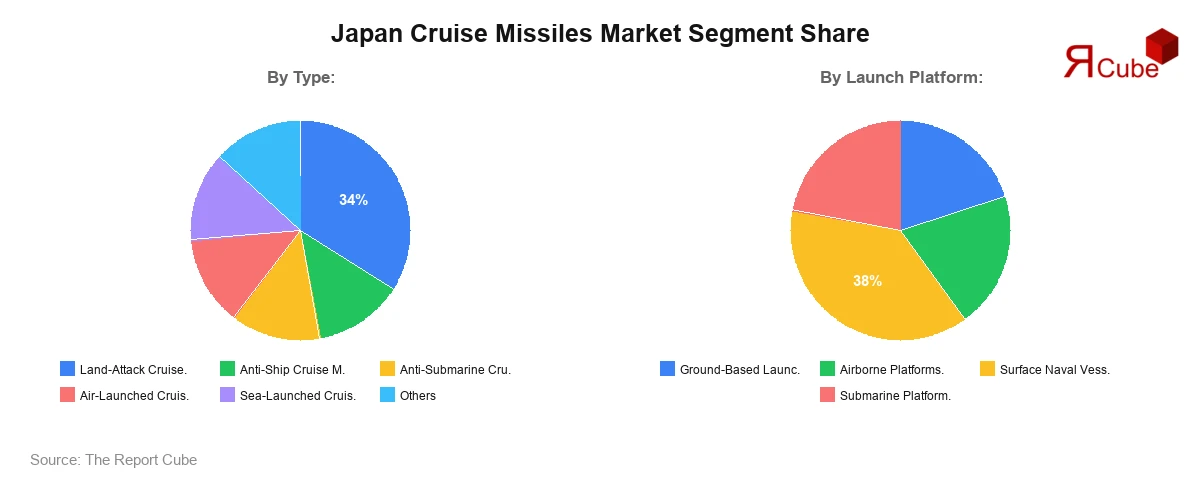
Land-Attack Cruise Missiles segment leads the market with nearly 34% market share.
By Launch Platform:
Surface Naval Vessels segment dominates the market with around 38% of revenue.
Regional Outlook:
Honshu region dominates the Japan Cruise Missiles market with approximately 52% share.
Japan Cruise Missiles Market Insights & Analysis
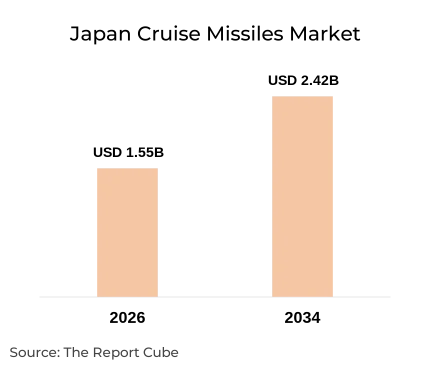
The Japan Cruise Missiles Market is anticipated to register a CAGR of around 5.6% during the forecast period 2026-2034. The market size is valued at USD 1.55 billion in 2026 and is projected to reach USD 2.42 billion by 2034. The Japan cruise missiles market size is steadily expanding as the country accelerates its defense modernization strategy in response to rising geopolitical tensions in the Indo-Pacific region. Increasing investments in long-range precision strike capabilities, including the deployment of advanced stand-off missiles, are significantly shaping market growth and overall market revenue.
Japan’s defense policy transformation, including its shift toward counterstrike capabilities, has driven procurement of advanced cruise missile systems such as the Tomahawk and upgraded Type-12 missiles. Government-backed initiatives and defense budget increases exceeding 15% year-on-year in recent cycles have enhanced domestic manufacturing and international collaboration. Additionally, partnerships with global defense contractors are improving propulsion, guidance systems, and stealth technologies, which directly influence Japan cruise missiles market trends and long-term market value.
Japan Cruise Missiles Market Dynamics
Key Driver: Rising Defense Modernization and Counterstrike Capability Development
Japan’s evolving national security strategy has emerged as a primary growth driver for the Japan cruise missiles market. The government has prioritized enhancing counterstrike capabilities, leading to increased acquisition of long-range cruise missile systems. Defense spending is projected to exceed 2% of GDP by the end of the decade, reflecting a structural shift toward advanced military preparedness. This strategic move supports procurement of systems capable of targeting distant threats with high precision, boosting Japan cruise missiles market growth.
Additionally, regional security concerns, particularly in the Indo-Pacific, have intensified demand for multi-platform missile deployment. Japan is investing in land, air, and sea-based launch systems to ensure operational flexibility. These developments are strengthening the market size and reinforcing Japan’s focus on deterrence through technological superiority.
Book your FREE 30-minute expert consultation today
Contact UsIndustry Trends: Integration of Advanced Guidance, AI-Based Targeting, and Extended Range Capabilities
The Japan cruise missiles market trends indicate a strong focus on technological advancement, particularly in guidance and propulsion systems. Modern cruise missiles are increasingly equipped with advanced navigation technologies such as terrain contour matching and satellite-based guidance, improving accuracy and mission success rates. Integration of AI-supported targeting systems is also enhancing real-time decision-making and threat response efficiency.
Another notable trend is the development of extended-range missiles exceeding 1,000 km, enabling Japan to strengthen its strategic reach. Defense manufacturers are focusing on lightweight materials and fuel-efficient propulsion systems, which improve endurance and reduce operational costs. These innovations are reshaping the competitive landscape and driving sustained growth in the Japan cruise missiles market revenue.
Major Challenge: High Development Costs and Technological Complexity
The development and deployment of cruise missile systems involve substantial financial and technical challenges. Advanced missile systems require high-precision components, sophisticated propulsion technologies, and extensive testing procedures. These factors significantly increase production costs, limiting scalability and slowing adoption across certain defense segments.
In addition, reliance on imported technologies and components can create supply chain vulnerabilities. Integration of advanced systems across multiple platforms requires continuous upgrades and interoperability testing, which adds to operational complexity. These challenges may restrict the overall expansion of the Japan cruise missiles market share during the forecast period.
Opportunity: Expansion of Indigenous Defense Manufacturing and Strategic Partnerships
Japan is actively promoting domestic defense production, creating new opportunities within the Japan cruise missiles market. Government initiatives supporting local manufacturing capabilities are encouraging companies to develop indigenous missile technologies. This shift reduces dependency on imports while strengthening national security infrastructure.
Collaborations with global defense firms are also opening new avenues for technology transfer and innovation. Joint development programs are enabling Japan to access advanced propulsion and guidance technologies while boosting local expertise. These opportunities are expected to enhance the Japan cruise missiles market value and create long-term growth potential.
Japan Cruise Missiles Market Segment-wise Analysis
By Type:
- Land-Attack Cruise Missiles
- Anti-Ship Cruise Missiles
- Anti-Submarine Cruise Missiles
- Air-Launched Cruise Missiles
- Sea-Launched Cruise Missiles
- Others
The land-attack cruise missiles segment holds the leading position with around 34% share in the Japan cruise missiles market. This dominance is driven by Japan’s increasing focus on counterstrike capabilities and long-range precision targeting. These missiles are designed to strike strategic land-based targets with high accuracy, making them essential for modern defense strategies.
Recent procurement programs, including the adoption of long-range systems, have strengthened this segment’s growth. Continuous upgrades in guidance systems and payload efficiency further enhance their operational effectiveness, contributing significantly to overall market revenue.
By Launch Platform:
- Ground-Based Launchers
- Airborne Platforms
- Surface Naval Vessels
- Submarine Platforms
Surface naval vessels dominate this segment with approximately 38% market share, supported by Japan’s strong naval capabilities. The deployment of cruise missiles on Aegis destroyers and advanced naval platforms enhances maritime defense and long-range strike capabilities. Increasing investments in naval modernization programs and fleet expansion are key factors driving this segment. Additionally, integration of advanced missile systems into naval platforms ensures operational flexibility, boosting the Japan cruise missiles market growth.
Regional Projection of Japan Cruise Missiles Industry
- Hokkaido
- Honshu
- Shikoku
- Kyushu
Honshu dominates the Japan cruise missiles market with a share of approximately 52%, driven by its concentration of defense infrastructure and military bases. The region hosts major defense installations and industrial hubs, enabling efficient deployment and maintenance of missile systems. High government spending and the presence of leading defense contractors further support regional growth. Additionally, Honshu’s strategic location enhances its role in national defense planning, contributing significantly to overall market size and revenue generation.
Government Initiatives & Policies
- Japan National Security Strategy (2025 Update): Focuses on counterstrike capabilities and long-range missile deployment to strengthen national defense.
- Defense Buildup Program 2026: Allocates increased budget for advanced missile systems and indigenous defense manufacturing expansion.
Japan Cruise Missiles Industry Recent Developments
- 2025: Raytheon Technologies secured a USD 401 million contract to supply 131 Block V Tomahawk missiles, including 78 units for Japan, strengthening long-range strike capabilities.
Need insights for a specific region within this market?
Request Regional DataWhy Choose This Report?
- Provides a comprehensive overview of the overall market analysis, encompassing key trends, consumer behavior analysis, and risk assessment to support strategic decision-making.
- Provides accurate, up-to-date insights into market size, segmentation, and emerging opportunities, helping to minimize risk & capitalizing on growth.
- Gives deep understanding of target audience preferences, investment habits, and communication channels for enhanced product development & marketing effectiveness.
- Delivers competitive analysis & benchmarking, uncovering the strengths & weaknesses of market competitors to guide strategies.
- Consolidate comprehensive market intelligence, reducing reasoning & streamlining research efforts.
- Facilitates customized market segmentation & risk mitigation strategies, fine-tuned to the business objectives.
- Aids in identifying both market challenges & untapped opportunities within the industry to drive long-term business growth.
- Provides valuable information based on actual customer data & search trends.
<
Table of Contents
- Introduction
- Objective of the Study
- Product and Category Definition
- Market Segmentation
- Study Variables
- Research Methodology
- Secondary Data Points
- Breakdown of Secondary Sources
- Primary Data Points
- Breakdown of Primary Interviews
- Secondary Data Points
- Executive Summary
- Market Dynamics
- Drivers
- Challenges
- Opportunity Assessment
- Recent Trends and Developments
- Regulatory and Policy Landscape
- Japan Cruise Missiles Market Overview (2021-2034)
- Market Size, By Value (USD Billion)
- Market Share, By Type
- Land-Attack Cruise Missiles
- Anti-Ship Cruise Missiles
- Anti-Submarine Cruise Missiles
- Air-Launched Cruise Missiles
- Sea-Launched Cruise Missiles
- Others
- Market Share, By Launch Platform
- Ground-Based Launchers
- Airborne Platforms
- Surface Naval Vessels
- Submarine Platforms
- Market Share, By Range
- Short-Range (Up to 300 km)
- Medium-Range (301-1,000 km)
- Long-Range (1,001-3,000 km)
- Extended-Range (Above 3,000 km)
- Market Share, By Warhead Type
- Conventional Warhead
- Nuclear-Capable Warhead
- Submunition Warhead
- Penetration Warhead
- Others
- Market Share, By Propulsion System
- Turbojet Propulsion
- Turbofan Propulsion
- Ramjet Propulsion
- Rocket-Boosted Propulsion
- Hybrid Propulsion Systems
- Market Share, By Region
- Hokkaido
- Honshu
- Shikoku
- Kyushu
- Market Share, By Company
- Revenue Shares & Analysis
- Competitive Landscape
- Hokkaido Cruise Missiles Market
- Market Size, By Value (USD Billion/Million)
- Market Share, By Type
- Market Share, By Launch Platform
- Market Share, By Range
- Market Share, By Warhead Type
- Market Share, By Propulsion System
- Honshu Cruise Missiles Market
- Market Size, By Value (USD Billion/Million)
- Market Share, By Type
- Market Share, By Launch Platform
- Market Share, By Range
- Market Share, By Warhead Type
- Market Share, By Propulsion System
- Shikoku Cruise Missiles Market
- Market Size, By Value (USD Billion/Million)
- Market Share, By Type
- Market Share, By Launch Platform
- Market Share, By Range
- Market Share, By Warhead Type
- Market Share, By Propulsion System
- Kyushu Cruise Missiles Market
- Market Size, By Value (USD Billion/Million)
- Market Share, By Type
- Market Share, By Launch Platform
- Market Share, By Range
- Market Share, By Warhead Type
- Market Share, By Propulsion System
- Competitive Outlook and Company Profiles
- Northrop Grumman
- Company Overview
- Product Portfolio
- Strategic Alliances/Partnerships
- Recent Developments
- MBDA
- Company Overview
- Product Portfolio
- Strategic Alliances/Partnerships
- Recent Developments
- General Dynamics
- Company Overview
- Product Portfolio
- Strategic Alliances/Partnerships
- Recent Developments
- Thales Group
- Company Overview
- Product Portfolio
- Strategic Alliances/Partnerships
- Recent Developments
- Raytheon Technologies
- Company Overview
- Product Portfolio
- Strategic Alliances/Partnerships
- Recent Developments
- Boeing
- Company Overview
- Product Portfolio
- Strategic Alliances/Partnerships
- Recent Developments
- BAE Systems plc
- Company Overview
- Product Portfolio
- Strategic Alliances/Partnerships
- Recent Developments
- Aerojet Rocketdyne
- Company Overview
- Product Portfolio
- Strategic Alliances/Partnerships
- Recent Developments
- Lockheed Martin
- Company Overview
- Product Portfolio
- Strategic Alliances/Partnerships
- Recent Developments
- Israel Aerospace Industries
- Company Overview
- Product Portfolio
- Strategic Alliances/Partnerships
- Recent Developments
- Others
- Northrop Grumman
- Contact Us and Disclaimer
Top Key Players & Market Share Outlook
- Northrop Grumman
- MBDA
- General Dynamics
- Thales Group
- Raytheon Technologies
- Boeing
- BAE Systems plc
- Aerojet Rocketdyne
- Lockheed Martin
- Israel Aerospace Industries
Frequently Asked Questions






