



Build Your Custom Market Intelligence Report
Customize Your ReportAsia Pacific Electric Commercial Vehicles Market Insights & Analysis
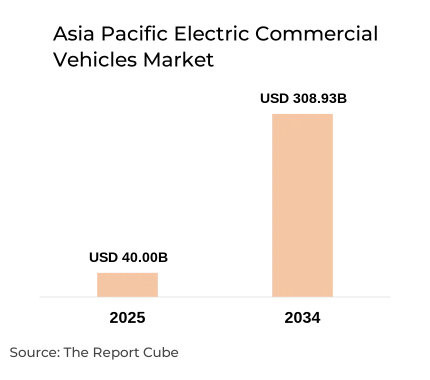
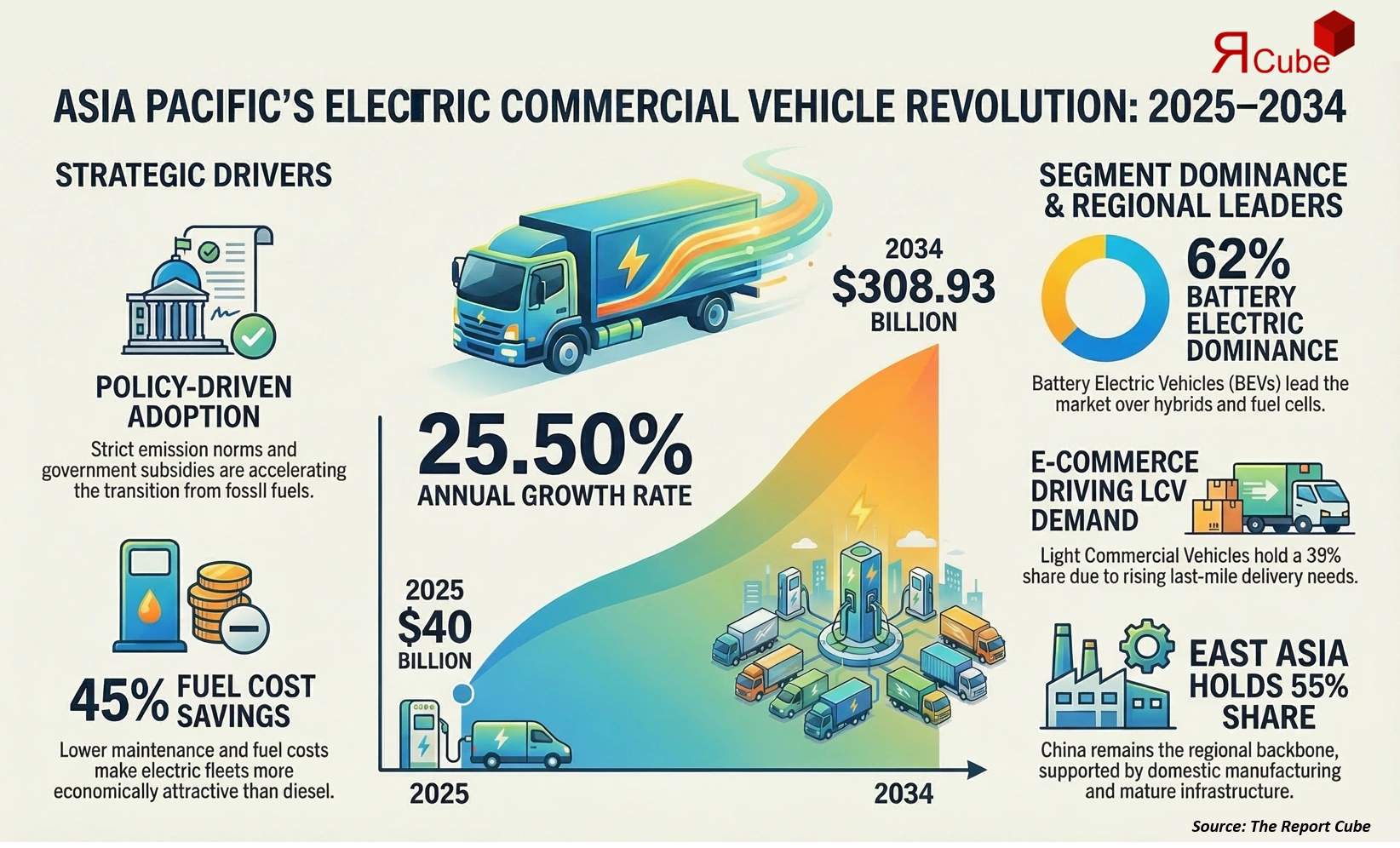
The Asia Pacific Electric Commercial Vehicles Market is anticipated to register a robust CAGR of 25.50% during the 2026-2034 forecast period. The market size was valued at USD 40 billion in 2025 and is projected to reach a substantial USD 308.93 billion by 2034. This exceptional growth trajectory is driven by aggressive decarbonization targets, rapid electrification of public transport systems, and rising demand for sustainable logistics solutions across the Asia Pacific region.
Governments across East Asia and South Asia are prioritizing electric commercial vehicle (ECV) adoption to curb urban air pollution and reduce dependence on fossil fuels. Electric buses and light commercial vehicles are witnessing accelerated deployment in metropolitan areas due to favorable total cost of ownership, lower maintenance requirements, and expanding charging ecosystems. China remains the backbone of the regional market, supported by large-scale subsidies, domestic manufacturing dominance, and mature battery supply chains.
Additionally, growth in e-commerce, urban freight movement, and municipal services is driving demand for electric vans, trucks, and buses. Technological advancements in battery energy density, fast-charging solutions, and fleet telematics are further enhancing operational efficiency. With commercial fleet operators increasingly aligning sustainability goals with cost optimization, the Asia Pacific Electric Commercial Vehicles Market is expected to witness exponential growth throughout the forecast period.
Asia Pacific Electric Commercial Vehicles Market Recent Developments
- 2025: BYD Company expanded its next-generation electric bus production capacity to meet rising municipal demand across Asia.
- 2025: Tata Motors launched an advanced electric light commercial vehicle platform targeting last-mile delivery fleets.
Government Initiatives & Policies
- China New Energy Commercial Vehicle Policy: Supports electric bus and truck adoption through subsidies and procurement mandates.
- India National Electric Bus Program: Promotes large-scale deployment of electric buses under public-private partnerships.
Asia Pacific Electric Commercial Vehicles Market Dynamics
Key Driver: Strong Government Mandates and Public Transport Electrification
Government mandates aimed at reducing greenhouse gas emissions are a key driver for the Asia Pacific Electric Commercial Vehicles Market. Countries such as China, India, and South Korea have introduced strict emission norms and zero-emission public transport targets, accelerating the adoption of electric buses and trucks. Public transportation agencies are transitioning fleets to electric models due to long-term fuel savings of nearly 45% and significantly lower maintenance costs. Additionally, financial incentives including upfront subsidies, reduced toll charges, and tax exemptions are making electric commercial vehicles economically attractive for fleet operators.
Book your FREE 30-minute expert consultation today
Contact UsIndustry Trends: Rapid Adoption of Battery Electric and Smart Fleet Technologies
Battery electric vehicles (BEVs) dominate current market deployments, accounting for more than 62% of electric commercial vehicle sales in 2025. The declining cost of lithium-ion batteries and advancements in fast-charging infrastructure have made BEVs viable for urban logistics and city transport. Another key trend is the integration of smart fleet management systems using telematics, AI-based route optimization, and predictive maintenance. These technologies enhance vehicle uptime and reduce operational inefficiencies, making electric commercial fleets increasingly competitive with conventional diesel counterparts.
Major Challenge: High Initial Capital Investment and Infrastructure Gaps
Despite strong growth potential, high upfront costs remain a significant challenge for market expansion. Electric commercial vehicles are priced 20-35% higher than diesel alternatives, which can deter small and medium fleet operators. Additionally, uneven charging infrastructure availability across emerging Asia Pacific economies limits long-haul and intercity electric truck adoption. Grid capacity constraints and slow permitting processes further delay infrastructure deployment, posing challenges to widespread electrification beyond urban centers.
Opportunity: Electrification of Urban Freight and Municipal Fleets
The electrification of urban freight transport and municipal service fleets presents a major growth opportunity. E-commerce expansion and rising demand for sustainable last-mile delivery solutions are driving adoption of electric vans and light commercial vehicles. Municipal applications such as waste collection, sanitation, and utility services are increasingly transitioning to electric fleets to meet sustainability mandates. Strategic collaborations between OEMs, energy providers, and city authorities are expected to accelerate large-scale deployments, unlocking significant market opportunities through 2034.
Asia Pacific Electric Commercial Vehicles Market Segment-wise Analysis
By Vehicle Type:
- Light Commercial
- Medium Trucks
- Heavy Trucks
- City Buses
- Vans & Pickups
Light commercial vehicles lead the market, accounting for approximately 38% of total market share in 2025. Their dominance is driven by rising demand from e-commerce, retail distribution, and urban logistics. City buses follow closely, supported by large-scale government procurement programs. Heavy electric trucks remain in early adoption stages but are gaining momentum as battery ranges improve and charging infrastructure expands along freight corridors.
By Propulsion:
- Battery Electric
- Plug-in Hybrid
- Hybrid Electric
- Fuel Cell Electric
Battery electric propulsion dominates the market with an estimated 62% share in 2025, owing to simplicity, lower operating costs, and extensive government support. Plug-in hybrid and hybrid electric vehicles serve transitional roles in regions with limited charging infrastructure. Fuel cell electric vehicles remain niche but are gaining strategic interest for long-haul and heavy-duty applications, particularly in Japan and South Korea.
Regional Projection of Asia Pacific Electric Commercial Vehicles Industry
- East Asia
- South Asia
- Southeast Asia
- Oceania
East Asia leads the Asia Pacific Electric Commercial Vehicles Market, holding approximately 55% of regional market share in 2025. China dominates due to its extensive manufacturing capacity, mature supply chains, and strong policy backing. South Asia, led by India, is the fastest-growing region, driven by public bus electrification and urban logistics demand. Southeast Asia is emerging as a high-potential market, while Oceania focuses on pilot projects and fleet trials for electric buses and trucks.
Need insights for a specific region within this market?
Request Regional DataWhy Choose This Report?
- Provides a comprehensive overview of the overall market analysis, encompassing key trends, consumer behavior analysis, and risk assessment to support strategic decision-making.
- Provides accurate, up-to-date insights into market size, segmentation, and emerging opportunities, helping to minimize risk & capitalizing on growth.
- Gives deep understanding of target audience preferences, investment habits, and communication channels for enhanced product development & marketing effectiveness.
- Delivers competitive analysis & benchmarking, uncovering the strengths & weaknesses of market competitors to guide strategies.
- Consolidate comprehensive market intelligence, reducing reasoning & streamlining research efforts.
- Facilitates customized market segmentation & risk mitigation strategies, fine-tuned to the business objectives.
- Aids in identifying both market challenges & untapped opportunities within the industry to drive long-term business growth.
- Provides valuable information based on actual customer data & search trends.
Table of Contents
- Introduction
- Objective of the Study
- Product and Category Definition
- Market Segmentation
- Study Variables
- Research Methodology
- Secondary Data Points
- Breakdown of Secondary Sources
- Primary Data Points
- Breakdown of Primary Interviews
- Secondary Data Points
- Executive Summary
- Market Dynamics
- Drivers
- Challenges
- Opportunity Assessment
- Recent Trends and Developments
- Regulatory and Policy Landscape
- Asia Pacific Electric Commercial Vehicles Market Overview (2020-2034)
- Market Size, By Value (USD Billion)
- Market Share, By Vehicle Type
- Light Commercial
- Medium Trucks
- Heavy Trucks
- City Buses
- Vans & Pickups
- Market Share, By Propulsion
- Battery Electric
- Plug-in Hybrid
- Hybrid Electric
- Fuel Cell Electric
- Market Share, By End Use
- Last‑Mile Delivery
- Public Transport
- Logistics & Freight
- Construction & Mining
- Market Share, By Battery Type
- Li‑ion
- LFP
- Nickel‑Metal Hydride
- Other Chemistries
- Market Share, By Region
- East Asia
- South Asia
- Southeast Asia
- Oceania
- Market Share, By Company
- Revenue Shares
- Competitive Landscape
- East Asia Electric Commercial Vehicles Market
- Market Size, By Value (USD Billion)
- Market Share, By Vehicle Type
- Market Share, By Propulsion
- Market Share, By End Use
- Market Share, By Battery Type
- Market Share, By Country Group
- Market Share, By Country
- China Electric Commercial Vehicles Market
- Japan Electric Commercial Vehicles Market
- South Korea Electric Commercial Vehicles Market
- Rest of East Asia
- South Asia Electric Commercial Vehicles Market
- Market Size, By Value (USD Billion)
- Market Share, By Vehicle Type
- Market Share, By Propulsion
- Market Share, By End Use
- Market Share, By Battery Type
- Market Share, By Country Group
- Market Share, By Country
- India Electric Commercial Vehicles Market
- Pakistan Electric Commercial Vehicles Market
- Bangladesh Electric Commercial Vehicles Market
- Rest of South Asia
- Southeast Asia Electric Commercial Vehicles Market
- Market Size, By Value (USD Billion)
- Market Share, By Vehicle Type
- Market Share, By Propulsion
- Market Share, By End Use
- Market Share, By Battery Type
- Market Share, By Country Group
- Market Share, By Country
- Indonesia Electric Commercial Vehicles Market
- Thailand Electric Commercial Vehicles Market
- Vietnam Electric Commercial Vehicles Market
- Philippines Electric Commercial Vehicles Market
- Rest of Southeast Asia
- Oceania Electric Commercial Vehicles Market
- Market Size, By Value (USD Billion)
- Market Share, By Vehicle Type
- Market Share, By Propulsion
- Market Share, By End Use
- Market Share, By Battery Type
- Market Share, By Country Group
- Market Share, By Country
- Australia Electric Commercial Vehicles Market
- New Zealand Electric Commercial Vehicles Market
- Rest of Oceania
- Competitive Outlook and Company Profiles
- BYD Company
- Company Overview
- Product Portfolio
- Strategic Alliances/Partnerships
- Recent Developments
- Yutong Bus
- Company Overview
- Product Portfolio
- Strategic Alliances/Partnerships
- Recent Developments
- Dongfeng Motor
- Company Overview
- Product Portfolio
- Strategic Alliances/Partnerships
- Recent Developments
- Tata Motors
- Company Overview
- Product Portfolio
- Strategic Alliances/Partnerships
- Recent Developments
- Ashok Leyland
- Company Overview
- Product Portfolio
- Strategic Alliances/Partnerships
- Recent Developments
- Hyundai Motor
- Company Overview
- Product Portfolio
- Strategic Alliances/Partnerships
- Recent Developments
- Mitsubishi Fuso
- Company Overview
- Product Portfolio
- Strategic Alliances/Partnerships
- Recent Developments
- Hino Motors
- Company Overview
- Product Portfolio
- Strategic Alliances/Partnerships
- Recent Developments
- SAIC Motor
- Company Overview
- Product Portfolio
- Strategic Alliances/Partnerships
- Recent Developments
- Foton Motor
- Company Overview
- Product Portfolio
- Strategic Alliances/Partnerships
- Recent Developments
- Others
- BYD Company
- Contact Us and Disclaimer
Top Key Players & Market Share Outlook
- BYD Company
- Yutong Bus
- Dongfeng Motor
- Tata Motors
- Ashok Leyland
- Hyundai Motor
- Mitsubishi Fuso
- Hino Motors
- SAIC Motor
- Foton Motor
- Others
Frequently Asked Questions






