




Build Your Custom Market Intelligence Report
Customize Your ReportAsia Pacific Full-Service Carrier Market Insights & Analysis
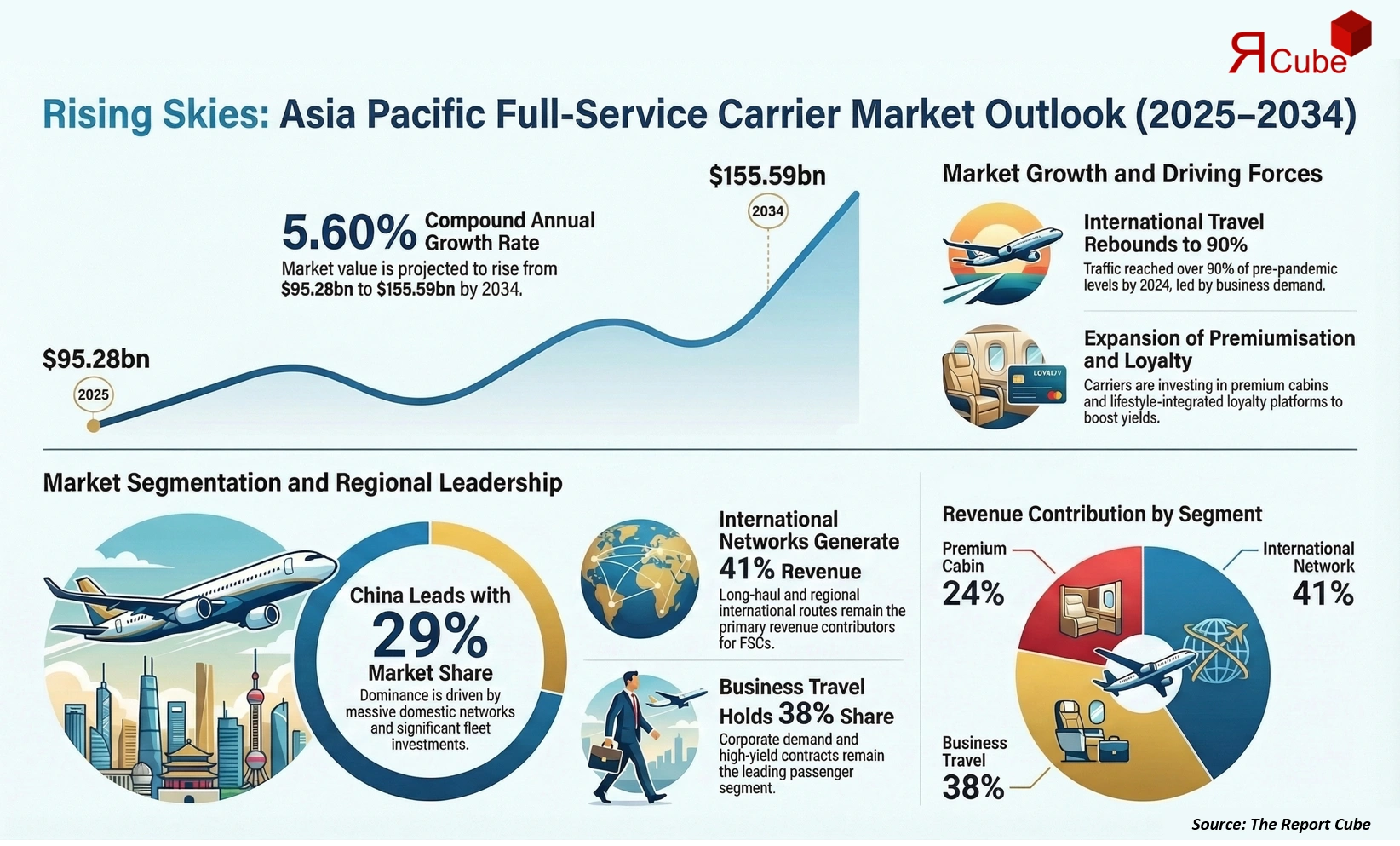
The Asia Pacific Full-Service Carrier Market is anticipated to register a CAGR of 5.60% during the forecast period 2026-2034. The market size was valued at USD 95.28 billion and is projected to reach USD 155.59 billion by 2034. This robust expansion is supported by the strong rebound of international aviation, rising middle-class income levels, and sustained demand for premium air travel across major Asia Pacific economies.
Full-service carriers (FSCs) continue to play a pivotal role in the region’s aviation ecosystem by offering extensive domestic and international connectivity, premium onboard services, and integrated loyalty ecosystems. As business travel resumes and long-haul leisure demand strengthens, Asia Pacific airlines are witnessing higher load factors, improved yields, and increased premium cabin occupancy. Countries such as China, Japan, India, and Australia are driving regional growth, supported by large populations, strong corporate travel demand, and expanding tourism infrastructure.
Additionally, strategic capacity deployment, fleet modernization, and digital service enhancements are enabling FSCs to improve operational efficiency while maintaining service differentiation. The growing emphasis on customer experience, sustainability initiatives, and personalized offerings positions the Asia Pacific Full-Service Carrier Market for steady and resilient growth throughout the forecast period.
Asia Pacific Full-Service Carrier Market Recent Developments
- 2025: Singapore Airlines expanded premium cabin capacity on long-haul routes to meet rising business travel demand.
- 2025: ANA Holdings introduced upgraded loyalty benefits across Asia-Pacific routes to enhance customer retention.
Government Initiatives & Policies
- Asia-Pacific Air Connectivity Initiative: Supports cross-border air travel and regional aviation infrastructure upgrades.
- India UDAN & International Aviation Expansion: Enhances regional and international air connectivity.
Asia Pacific Full-Service Carrier Market Dynamics
Key Driver: Recovery of International and Business Air Travel
The primary driver of the Asia Pacific Full-Service Carrier Market is the strong recovery of international and business travel. Multinational corporations are reinstating in-person meetings, regional headquarters operations, and long-haul travel, significantly benefiting full-service airlines. In 2024, international passenger traffic across Asia Pacific recovered to over 90% of pre-pandemic levels, with premium cabin demand growing faster than economy class. FSCs are uniquely positioned to capture this demand due to their extensive route networks, alliance partnerships, and superior service offerings. Additionally, government-led tourism promotion and relaxed visa policies are further stimulating cross-border travel, reinforcing sustained demand for full-service airline operations.
Book your FREE 30-minute expert consultation today
Contact UsIndustry Trends: Premiumization and Loyalty Ecosystem Expansion
A key trend shaping the market is the growing focus on premiumization and loyalty program expansion. Full-service carriers are investing heavily in premium cabins, airport lounges, and personalized digital services to attract high-yield passengers. Loyalty programs are evolving into comprehensive lifestyle platforms, offering partnerships with hotels, financial institutions, and retail brands. This strategy enhances customer lifetime value and stabilizes revenue streams amid competitive pressures. Moreover, airlines are leveraging data analytics to tailor offerings, optimize pricing, and improve customer satisfaction. The integration of premium services with digital engagement is emerging as a defining trend across leading Asia Pacific FSCs.
Major Challenge: Rising Operating Costs and Price Sensitivity
Rising operating costs remain a significant challenge for the Asia Pacific Full-Service Carrier Market. Volatile fuel prices, higher labor costs, and increased airport charges are compressing margins, particularly on competitive regional routes. At the same time, passengers remain price-sensitive, especially in emerging markets where low-cost carriers offer aggressive pricing. Full-service airlines must balance cost management with maintaining service quality, which can strain profitability. Currency fluctuations and geopolitical uncertainties further add to financial risk, making cost control and revenue diversification critical for long-term sustainability.
Opportunity: Growth in Emerging Asia Pacific Travel Markets
The expansion of air travel in emerging Asia Pacific markets presents a substantial opportunity for full-service carriers. Rapid urbanization, rising disposable incomes, and expanding middle-class populations in countries such as India, Indonesia, Vietnam, and Thailand are driving first-time international travel. FSCs can leverage their brand strength and network reach to capture premium leisure and corporate demand in these markets. Additionally, strategic partnerships and secondary hub development enable airlines to tap underserved routes, enhancing market penetration. This structural demand growth offers long-term upside potential beyond mature markets.
Asia Pacific Full-Service Carrier Market Segment-wise Analysis
By Service Type:
- Domestic Network
- International Network
- Premium Cabin
- Loyalty Programs
- Ancillary Services
The International Network segment leads the market, accounting for approximately 41% of total revenue share. This dominance is driven by long-haul and regional international routes operated by major carriers such as Singapore Airlines, ANA, and Cathay Pacific. Premium Cabin services contribute nearly 24% of market revenue, reflecting strong demand from business and high-net-worth leisure travelers. Loyalty Programs are increasingly strategic, supporting repeat travel and cross-selling opportunities, while Ancillary Services continue to grow as airlines monetize value-added offerings. The integrated service portfolio strengthens FSC competitiveness across diverse customer segments.
By Passenger Type:
- Business Travel
- Leisure Travel
- VFR Travel
- Corporate Contracts
Business Travel remains the leading passenger segment, representing close to 38% of market share due to higher fares and premium service uptake. Corporate Contracts further reinforce revenue stability through long-term agreements with multinational firms. Leisure Travel follows closely, supported by tourism growth and improved international connectivity. VFR Travel contributes a steady share, particularly in migrant-heavy corridors across Southeast Asia and Oceania. The balanced passenger mix enables full-service carriers to optimize yields while mitigating demand volatility.
Regional Projection of Asia Pacific Full-Service Carrier Industry
- China
- India
- Japan
- South Korea
- Australia
- Indonesia
- Thailand
- Singapore
- Malaysia
- Rest of Asia Pacific
China leads the Asia Pacific Full-Service Carrier Market with an estimated 29% regional market share, driven by its vast domestic network and growing international capacity. Japan and India follow, supported by strong business travel and expanding outbound tourism. Singapore and Australia serve as premium long-haul hubs, reinforcing regional connectivity. China’s leadership is underpinned by large-scale fleet investments, airport infrastructure development, and strong state-backed airline operations. As regional travel demand continues to diversify, secondary markets are expected to contribute incrementally to overall growth.
Need insights for a specific region within this market?
Request Regional DataWhy Choose This Report?
- Provides a comprehensive overview of the overall market analysis, encompassing key trends, consumer behavior analysis, and risk assessment to support strategic decision-making.
- Provides accurate, up-to-date insights into market size, segmentation, and emerging opportunities, helping to minimize risk & capitalizing on growth.
- Gives deep understanding of target audience preferences, investment habits, and communication channels for enhanced product development & marketing effectiveness.
- Delivers competitive analysis & benchmarking, uncovering the strengths & weaknesses of market competitors to guide strategies.
- Consolidate comprehensive market intelligence, reducing reasoning & streamlining research efforts.
- Facilitates customized market segmentation & risk mitigation strategies, fine-tuned to the business objectives.
- Aids in identifying both market challenges & untapped opportunities within the industry to drive long-term business growth.
- Provides valuable information based on actual customer data & search trends.
Table of Contents
- Introduction
- Objective of the Study
- Market and Carrier Definition
- Market Segmentation
- Study Variables
- Research Methodology
- Secondary Data Points
- Breakdown of Secondary Sources
- Primary Data Points
- Breakdown of Primary Interviews
- Secondary Data Points
- Executive Summary
- Market Dynamics
- Drivers
- Challenges
- Opportunity Assessment
- Recent Trends and Developments
- Regulatory and Policy Landscape
- Asia Pacific Full-Service Carrier Market Overview (2020-2034)
- Market Size, By Value (USD Billion)
- Market Share, By Service Type
- Domestic Network
- International Network
- Premium Cabin
- Loyalty Programs
- Ancillary Services
- Market Share, By Passenger Type
- Business Travel
- Leisure Travel
- VFR Travel
- Corporate Contracts
- Market Share, By Class Type
- Economy Class
- Premium Economy
- Business Class
- First Class
- Market Share, By Route Type
- Short-Haul
- Medium-Haul
- Long-Haul
- Market Share, By Country
- China
- India
- Japan
- South Korea
- Australia
- Indonesia
- Thailand
- Singapore
- Malaysia
- Rest of Asia Pacific
- Market Share, By Company
- Revenue Shares
- Competition Characteristics
- Revenue Shares & Analysis
- China Full-Service Carrier Market
- Market Size, By Value (USD Billion)
- Market Share, By Service Type
- Market Share, By Passenger Type
- Market Share, By Class Type
- Market Share, By Route Type
- Market Share, By Region/City Tier
- India Full-Service Carrier Market
- Market Size, By Value (USD Billion)
- Market Share, By Service Type
- Market Share, By Passenger Type
- Market Share, By Class Type
- Market Share, By Route Type
- Market Share, By Region/City Tier
- Japan Full-Service Carrier Market
- Market Size, By Value (USD Billion)
- Market Share, By Service Type
- Market Share, By Passenger Type
- Market Share, By Class Type
- Market Share, By Route Type
- Market Share, By Region/City Group
- South Korea Full-Service Carrier Market
- Market Size, By Value (USD Billion)
- Market Share, By Service Type
- Market Share, By Passenger Type
- Market Share, By Class Type
- Market Share, By Route Type
- Market Share, By Region/City Group
- Australia Full-Service Carrier Market
- Market Size, By Value (USD Billion)
- Market Share, By Service Type
- Market Share, By Passenger Type
- Market Share, By Class Type
- Market Share, By Route Type
- Market Share, By Region/City Group
- South East Asia Full-Service Carrier Market
- Market Size, By Value (USD Billion)
- Market Share, By Service Type
- Market Share, By Passenger Type
- Market Share, By Class Type
- Market Share, By Route Type
- Market Share, By Country
- Indonesia
- Thailand
- Singapore
- Philippines
- Vietnam
- Malaysia
- Others
- Competitive Outlook and Company Profiles
- Singapore Airlines
- Company Overview
- Service Portfolio
- Strategic Alliances/Partnerships
- Recent Developments
- Cathay Pacific
- Company Overview
- Service Portfolio
- Strategic Alliances/Partnerships
- Recent Developments
- ANA Holdings
- Company Overview
- Service Portfolio
- Strategic Alliances/Partnerships
- Recent Developments
- Japan Airlines
- Company Overview
- Service Portfolio
- Strategic Alliances/Partnerships
- Recent Developments
- Korean Air
- Company Overview
- Service Portfolio
- Strategic Alliances/Partnerships
- Recent Developments
- China Southern Airlines
- Company Overview
- Service Portfolio
- Strategic Alliances/Partnerships
- Recent Developments
- China Eastern Airlines
- Company Overview
- Service Portfolio
- Strategic Alliances/Partnerships
- Recent Developments
- Air China
- Company Overview
- Service Portfolio
- Strategic Alliances/Partnerships
- Recent Developments
- Qantas Airways
- Company Overview
- Service Portfolio
- Strategic Alliances/Partnerships
- Recent Developments
- Garuda Indonesia
- Company Overview
- Service Portfolio
- Strategic Alliances/Partnerships
- Recent Developments
- Others
- Singapore Airlines
- Contact Us and Disclaimer
Top Key Players & Market Share Outlook
- Singapore Airlines
- Cathay Pacific
- ANA Holdings
- Japan Airlines
- Korean Air
- China Southern Airlines
- China Eastern Airlines
- Air China
- Qantas Airways
- Garuda Indonesia
- Others
Frequently Asked Questions






