




Build Your Custom Market Intelligence Report
Customize Your ReportGCC Refrigerated Truck Market Key Highlights
By Vehicle Type:
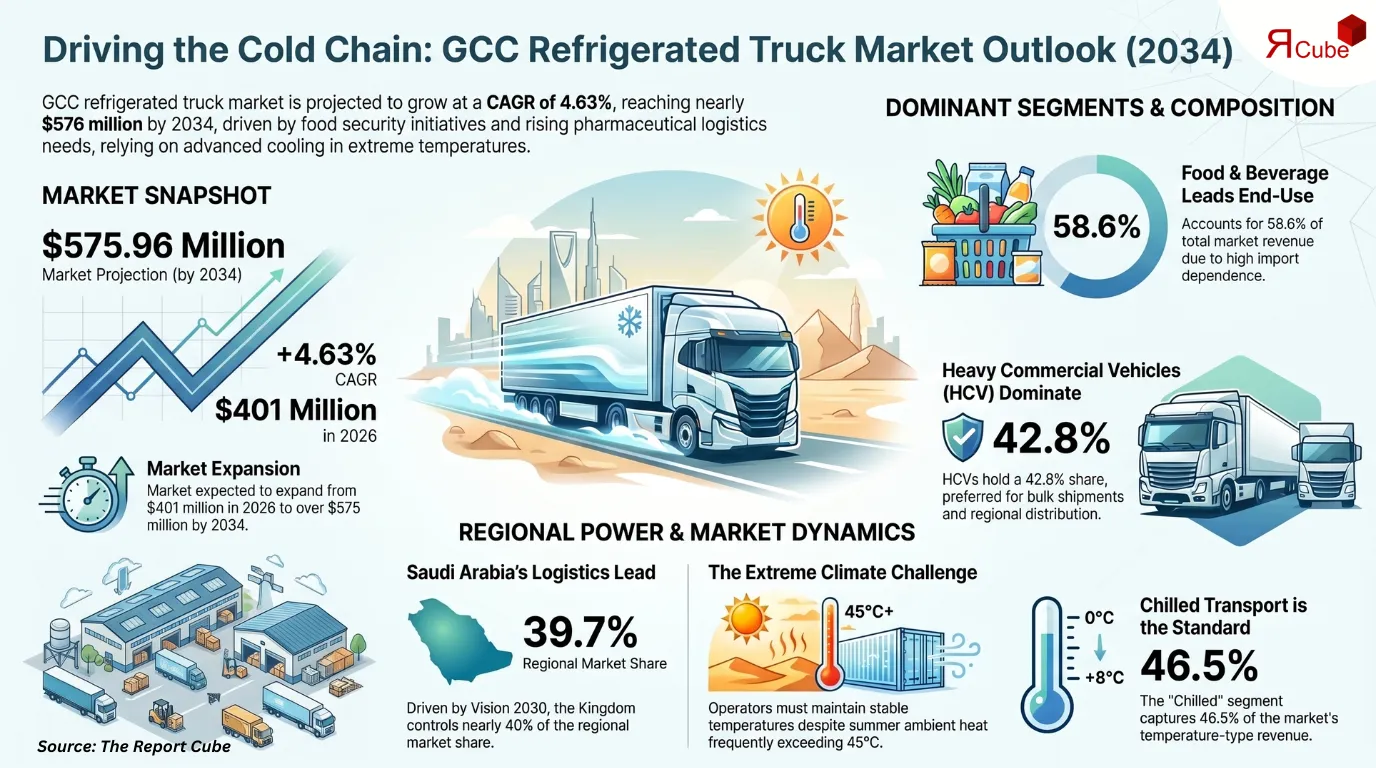
Heavy Commercial Vehicles (HCV) segment leads the market with nearly 42.8% share.
By Temperature Type:
Chilled (0°C to +8°C) segment dominates the market with approximately 46.5% of revenue.
Regional Outlook:
Saudi Arabia dominates the GCC Refrigerated Truck market with around 39.7% share.
GCC Refrigerated Truck Market Insights & Analysis
The GCC Refrigerated Truck Market is anticipated to register a CAGR of around 4.63% during the forecast period 2026-2034. The market size is valued at USD 401 million in 2026 and is projected to reach USD 575.96 million by 2034. The market is witnessing steady expansion due to the Gulf region's increasing dependence on efficient cold-chain transportation for imported and locally produced food products. GCC countries import a substantial portion of their food requirements, making temperature-controlled logistics a critical component of supply chain continuity. The continuous expansion of modern retail formats, food processing facilities, hospitality establishments, and distribution centers has elevated the need for refrigerated transportation capable of preserving product quality across long distances and harsh climatic conditions.
Beyond food logistics, healthcare investments are reshaping refrigerated transportation requirements throughout the region. Pharmaceutical distributors increasingly require validated cold-chain vehicles to transport vaccines, biologics, and specialty medicines under strict temperature conditions. Government-backed logistics diversification programs in Saudi Arabia, the UAE, and Qatar are encouraging infrastructure modernization through investments in logistics zones, warehousing facilities, and transportation corridors. These developments are strengthening regional trade connectivity while creating sustained demand for advanced refrigerated trucks equipped with monitoring systems, efficient cooling technologies, and fleet management solutions.
GCC Refrigerated Truck Market Impact Analysis
| Factor | Type | Specific Impact on Market | Magnitude | Business Implication |
|---|---|---|---|---|
| Growth in Perishable Goods Trade | Market | Higher movement of food and pharma boosts cold transport need | High | Supports fleet expansion focused on regional cold chain routes |
| Expansion of GCC Logistics Infrastructure | Market | New roads and hubs increase demand for long haul reefers | High | Enables wider coverage of cross border refrigerated corridors |
| Stringent Food Safety and Quality Rules | Regulatory | Stricter standards require reliable temperature control in transit | High | Drives uptake of modern units with certified compliance features |
| Rising Consumer Demand for Fresh Produce | Consumer | Preference for fresh and frozen items lifts delivery volumes | Medium | Strengthens need for city distribution focused reefer fleets |
| High Operating and Fuel Costs | Environmental | Energy use of cooling units raises total trip expenses | Medium | Encourages shift to efficient systems and route optimization |
| Technological Shift to Efficient Units | Technological | New refrigeration and telematics improve load monitoring | Medium | Creates edge for fleets investing early in advanced systems |
| Competitive Presence of Global Players | Competitive | International brands intensify pricing and service expectations | Medium | Requires differentiation through reliability and service depth |
GCC Refrigerated Truck Market Dynamics
Key Driver: Expansion of Food Security and Cold-Chain Infrastructure
Food security remains a strategic priority across GCC economies, creating strong demand for refrigerated transportation assets. Governments continue investing in agricultural supply chains, food storage facilities, logistics parks, and distribution networks to reduce supply disruptions and improve food availability. Since perishable products require uninterrupted temperature control from origin to destination, refrigerated trucks have become an essential component of regional logistics operations. Rising consumption of dairy products, frozen foods, poultry, seafood, and fresh produce further reinforces transportation requirements across urban and rural markets.
The growing presence of multinational food retailers and restaurant chains has also contributed to fleet expansion. These organizations maintain strict quality standards and require reliable cold transportation systems to protect product integrity. As distribution networks become more sophisticated, logistics providers are increasing investments in specialized refrigerated vehicles capable of handling diverse temperature-sensitive cargo categories. This structural shift continues to support long-term GCC refrigerated truck market growth.
Industry Trends: Technology-Driven Fleet Modernization
Fleet operators across the GCC are increasingly modernizing refrigerated transportation assets to improve operational efficiency and cargo protection. Advanced refrigeration units integrated with temperature sensors, telematics platforms, and GPS-based tracking systems are becoming standard features in newly deployed vehicles. These technologies allow logistics companies to monitor cargo conditions continuously, helping reduce spoilage risks and strengthen compliance with food safety and pharmaceutical transportation requirements.
Another notable trend is the gradual adoption of energy-efficient refrigeration systems designed to reduce fuel consumption and operating expenses. Fleet owners are evaluating hybrid-powered and electrically assisted refrigeration technologies as part of broader sustainability initiatives. The shift toward connected fleet ecosystems is also improving route planning, maintenance scheduling, and asset utilization. These developments are expected to enhance service reliability while improving profitability across the refrigerated transportation sector.
Book your FREE 30-minute expert consultation today
Contact UsMajor Challenge: Operational Complexity in Extreme Climate Conditions
Operating refrigerated trucks within GCC markets presents unique technical and financial challenges. Ambient temperatures frequently exceed 45°C during peak summer months, increasing the workload on refrigeration units and placing additional pressure on vehicle cooling systems. Maintaining stable cargo temperatures under such conditions requires specialized equipment, rigorous maintenance schedules, and higher energy consumption compared to many international markets.
Fleet operators must also manage rising ownership costs associated with refrigeration equipment, insulated vehicle bodies, compliance requirements, and skilled maintenance personnel. Any failure in temperature management can lead to product losses, regulatory penalties, and reputational risks. These operational realities create barriers for smaller transportation providers and can limit fleet expansion, particularly in highly competitive logistics environments.
Opportunity: Rising Demand for Pharmaceutical Transportation
The healthcare sector represents one of the most promising growth avenues for refrigerated transportation providers in the GCC. Governments are investing heavily in healthcare infrastructure, pharmaceutical manufacturing capabilities, and medical distribution networks to improve healthcare accessibility and strengthen supply resilience. Many pharmaceutical products require strict temperature management throughout transportation, creating demand for specialized refrigerated vehicles equipped with validated monitoring systems.
The expansion of vaccine distribution programs, biotechnology products, and specialty therapeutics is expected to generate new transportation requirements over the forecast period. Logistics providers that develop expertise in pharmaceutical cold-chain operations are likely to benefit from higher-value contracts and long-term partnerships with healthcare institutions. This transition is gradually diversifying the customer base of refrigerated fleet operators beyond traditional food distribution activities.
GCC Refrigerated Truck Market Segment-wise Analysis
By Vehicle Type:
- Medium Commercial Vehicles (MCV)
- Heavy Commercial Vehicles (HCV)
- Light Commercial Vehicles (LCV)
Heavy Commercial Vehicles (HCV) hold the largest share of the GCC Refrigerated Truck Market, accounting for approximately 42.8% of industry revenue. Their leadership position stems from their suitability for regional distribution networks, cross-border transportation routes, and large-volume food supply operations. These vehicles are widely used by logistics companies transporting frozen and chilled products between ports, distribution centers, processing facilities, and retail outlets. Their larger payload capacity improves transportation economics by reducing the number of trips required for bulk shipments.
The segment continues to benefit from growing trade activity and infrastructure expansion across GCC countries. As food imports, pharmaceutical distribution volumes, and industrial logistics requirements increase, operators are prioritizing high-capacity refrigerated vehicles that can deliver consistent performance under demanding operating conditions. Continued investment in transportation corridors and logistics hubs is expected to sustain demand for HCV refrigerated trucks throughout the forecast period.
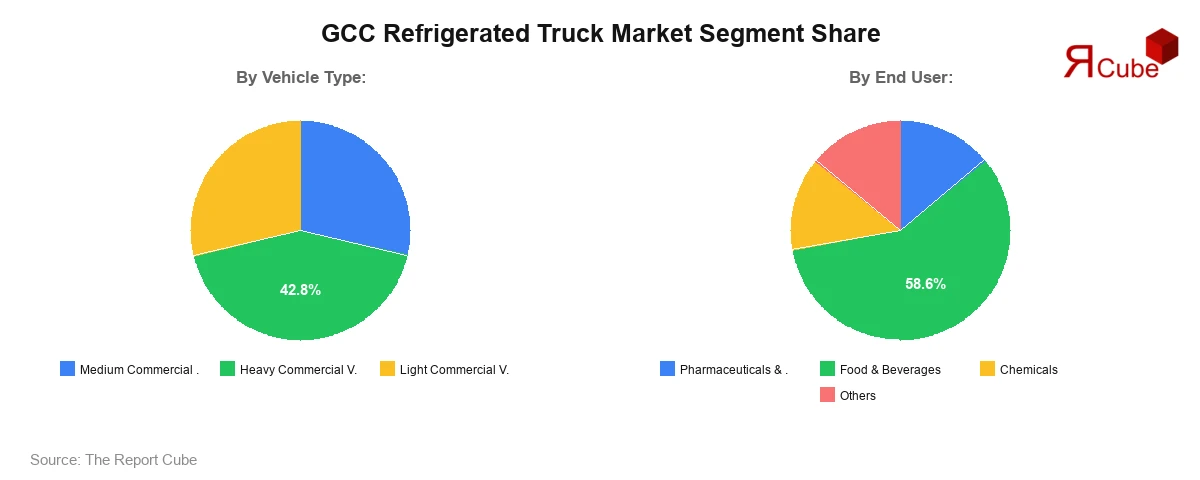
By End User:
- Pharmaceuticals & Healthcare
- Food & Beverages
- Chemicals
- Others
The Food & Beverages segment remains the dominant end-user category, contributing nearly 58.6% of total market revenue. The GCC's dependence on imported food products and expanding domestic food processing sector have significantly increased the requirement for temperature-controlled transportation. Refrigerated trucks play a vital role in preserving food quality during movement from ports and manufacturing facilities to distribution centers, supermarkets, hotels, and restaurants.
Consumer preferences are increasingly shifting toward premium frozen foods, fresh produce, dairy products, and convenience meals, creating additional pressure on cold-chain networks. Food manufacturers and distributors are therefore expanding refrigerated transportation capacity to ensure product freshness and regulatory compliance. The segment's strong market position is expected to remain intact as food demand continues to rise alongside population growth and urban development across the region.
Regional Projection of GCC Refrigerated Truck Industry
- Saudi Arabia
- United Arab Emirates
- Kuwait
- Oman
- Qatar
- Bahrain
Saudi Arabia represents the largest market for refrigerated trucks within the GCC, accounting for approximately 39.7% of regional revenue. The country's extensive geographic area, expanding population, and strategic focus on logistics development have created substantial demand for temperature-controlled transportation solutions. Large-scale investments under Vision 2030 continue to strengthen transportation infrastructure, logistics facilities, warehousing networks, and supply chain efficiency.
The Kingdom's food processing, pharmaceutical, and retail sectors are major contributors to refrigerated transportation demand. Growing import volumes, increasing healthcare investments, and the expansion of modern distribution networks have accelerated fleet deployment across key economic regions. Saudi Arabia's position as the largest economy in the GCC, combined with ongoing infrastructure modernization, is expected to support continued market leadership throughout the forecast period.
Need insights for a specific region within this market?
Request Regional DataGCC Refrigerated Truck Market - Country Analysis
The GCC refrigerated truck market differs by country based on food imports, pharma logistics, retail expansion, and regulatory focus on cold chain reliability.
| Country | Demand Level | Key Areas | System Dominance | Core Demand Logic | Growth Nature |
|---|---|---|---|---|---|
| Saudi Arabia | Very High | Riyadh, Jeddah, Dammam | Multi‑axle reefer trucks | Food imports and Vision 2030 logistics push [web:1824][web:1826] | Network expansion and fleet upgrades [web:1824][web:1826] |
| United Arab Emirates | Very High | Dubai, Abu Dhabi, Sharjah | Urban distribution reefers | Re‑export hub for food and pharma [web:1821][web:1824] | Tech‑driven, higher‑spec fleets [web:1821][web:1824] |
| Kuwait | Medium | Kuwait City, Shuwaikh port | Medium‑duty reefer trucks | Retail chains and high food import share [web:1824] | Steady, replacement‑led growth [web:1824] |
| Oman | Medium | Muscat, Sohar, Salalah | Long‑haul reefers | Ports linking GCC and Indian Ocean trade [web:1824] | Corridor‑driven transport growth [web:1824] |
| Qatar | Medium to High | Doha, Hamad Port | Short‑haul city reefers | Food security and centralized warehousing [web:1824] | Policy‑backed capacity building [web:1824] |
| Bahrain | Low to Medium | Manama, Khalifa Bin Salman Port | Light‑duty refrigerated vans | Last‑mile links into Saudi corridors [web:1825] | Niche, cross‑border focused growth [web:1825] |
Government Initiatives & Policies
- Saudi Arabia National Transport and Logistics Strategy (2025-2026): The initiative focuses on expanding logistics infrastructure, strengthening cold-chain networks, and improving transportation efficiency to support food security and pharmaceutical distribution across the Kingdom.
- UAE National Food Security Strategy 2051 (2025-2026 Implementation Programs): The strategy continues supporting advanced cold-chain logistics investments, warehouse modernization, and temperature-controlled transportation systems to ensure reliable food supply management.
GCC Refrigerated Truck Industry Recent Developments
- 2024: Victory Saudi Arabia launched the K3 refrigerated truck and V3 refrigerated van to strengthen temperature-controlled transportation capabilities. The vehicles are designed for chilled and frozen product distribution, supporting food logistics operations and expanding the company's refrigerated vehicle portfolio within Saudi Arabia's growing cold-chain transportation market.
Why Choose This Report?
- Provides a comprehensive overview of the overall market analysis, encompassing key trends, consumer behavior analysis, and risk assessment to support strategic decision-making.
- Provides accurate, up-to-date insights into market size, segmentation, and emerging opportunities, helping to minimize risk & capitalizing on growth.
- Gives deep understanding of target audience preferences, investment habits, and communication channels for enhanced product development & marketing effectiveness.
- Delivers competitive analysis & benchmarking, uncovering the strengths & weaknesses of market competitors to guide strategies.
- Consolidate comprehensive market intelligence, reducing reasoning & streamlining research efforts.
- Facilitates customized market segmentation & risk mitigation strategies, fine-tuned to the business objectives.
- Aids in identifying both market challenges & untapped opportunities within the industry to drive long-term business growth.
- Provides valuable information based on actual customer data & search trends.
Table of Contents
- Introduction
- Objective of the Study
- Product and Category Definition
- Market Segmentation
- Study Variables
- Research Methodology
- Secondary Data Points
- Breakdown of Secondary Sources
- Primary Data Points
- Breakdown of Primary Interviews
- Secondary Data Points
- Executive Summary
- Market Dynamics
- Emerging Opportunities
- Adoption Trends
- Demand Drivers
- Disruption Analysis (Challenges)
- Industry Analysis & Strategic Insights
- Supply/Value Chain Analysis
- Pricing Analysis
- Go-To-Market (GTM) Strategy
- BCG Matrix
- Recent Trends and Developments
- Import and Export Analysis
- Regulatory and Policy Landscape
- Country-wise Policies
- Government Initiatives
- GCC Refrigerated Truck Market Overview and Forecast Analysis (2021-2034)
- Market Size, By Value, By Growth Rate (CAGR/USD Million)
- Market Share, By Vehicle Type
- Medium Commercial Vehicles (MCV)
- Heavy Commercial Vehicles (HCV)
- Light Commercial Vehicles (LCV)
- Market Share, By Temperature Type
- Frozen (Below 0°C)
- Chilled (0°C to +8°C)
- Multi-Temperature
- Market Share, By Capacity
- Below 7 Tons
- 7-12 Tons
- 12-18 Tons
- Above 18 Tons
- Market Share, By Propulsion Type
- Electric
- Hybrid
- Diesel
- Market Share, By End User
- Pharmaceuticals & Healthcare
- Food & Beverages
- Chemicals
- Others
- Market Share, By Country
- Saudi Arabia
- United Arab Emirates
- Kuwait
- Oman
- Qatar
- Bahrain
- Market Share, By Company
- Revenue Shares & Analysis
- Competitive Landscape
- Saudi Arabia Refrigerated Truck Market Overview and Forecast Analysis (2021-2034)
- Market Size, By Value, By Growth Rate (CAGR/USD Million)
- Market Share, By Vehicle Type
- Market Share, By Temperature Type
- Market Share, By Capacity
- Market Share, By Propulsion Type
- Market Share, By End User
- United Arab Emirates Refrigerated Truck Market Overview and Forecast Analysis (2021-2034)
- Market Size, By Value, By Growth Rate (CAGR/USD Million)
- Market Share, By Vehicle Type
- Market Share, By Temperature Type
- Market Share, By Capacity
- Market Share, By Propulsion Type
- Market Share, By End User
- Kuwait Refrigerated Truck Market Overview and Forecast Analysis (2021-2034)
- Market Size, By Value, By Growth Rate (CAGR/USD Million)
- Market Share, By Vehicle Type
- Market Share, By Temperature Type
- Market Share, By Capacity
- Market Share, By Propulsion Type
- Market Share, By End User
- Oman Refrigerated Truck Market Overview and Forecast Analysis (2021-2034)
- Market Size, By Value, By Growth Rate (CAGR/USD Million)
- Market Share, By Vehicle Type
- Market Share, By Temperature Type
- Market Share, By Capacity
- Market Share, By Propulsion Type
- Market Share, By End User
- Qatar Refrigerated Truck Market Overview and Forecast Analysis (2021-2034)
- Market Size, By Value, By Growth Rate (CAGR/USD Million)
- Market Share, By Vehicle Type
- Market Share, By Temperature Type
- Market Share, By Capacity
- Market Share, By Propulsion Type
- Market Share, By End User
- Bahrain Refrigerated Truck Market Overview and Forecast Analysis (2021-2034)
- Market Size, By Value, By Growth Rate (CAGR/USD Million)
- Market Share, By Vehicle Type
- Market Share, By Temperature Type
- Market Share, By Capacity
- Market Share, By Propulsion Type
- Market Share, By End User
- Competitive Analysis, 2026
- Market Share of Key Players
- Competitive Mapping for Each Segment and Companies Operating Regionally
- Saudi Arabia Refrigerated Truck Companies Share & Competitive Analysis, 2026
- United Arab Emirates Refrigerated Truck Companies Share & Competitive Analysis, 2026
- Kuwait Refrigerated Truck Companies Share & Competitive Analysis, 2026
- Oman Refrigerated Truck Companies Share & Competitive Analysis, 2026
- Qatar Refrigerated Truck Companies Share & Competitive Analysis, 2026
- Bahrain Refrigerated Truck Companies Share & Competitive Analysis, 2026
- Company Profile (Partial List)
- Carrier Transicold Corporation
- Company Overview
- Product Portfolio
- Strategic Alliances/Partnerships
- Recent Developments
- Scania CV AB
- Company Overview
- Product Portfolio
- Strategic Alliances/Partnerships
- Recent Developments
- AB Volvo
- Company Overview
- Product Portfolio
- Strategic Alliances/Partnerships
- Recent Developments
- Krone Commercial Vehicle Group GmbH & Co. KG
- Company Overview
- Product Portfolio
- Strategic Alliances/Partnerships
- Recent Developments
- Daimler Truck AG
- Company Overview
- Product Portfolio
- Strategic Alliances/Partnerships
- Recent Developments
- Thermo King Corporation
- Company Overview
- Product Portfolio
- Strategic Alliances/Partnerships
- Recent Developments
- MAN Truck & Bus SE
- Company Overview
- Product Portfolio
- Strategic Alliances/Partnerships
- Recent Developments
- DAF Trucks N.V.
- Company Overview
- Product Portfolio
- Strategic Alliances/Partnerships
- Recent Developments
- IVECO S.p.A.
- Company Overview
- Product Portfolio
- Strategic Alliances/Partnerships
- Recent Developments
- Mitsubishi Fuso Truck and Bus Corporation
- Company Overview
- Product Portfolio
- Strategic Alliances/Partnerships
- Recent Developments
- Schmitz Cargobull AG
- Company Overview
- Product Portfolio
- Strategic Alliances/Partnerships
- Recent Developments
- Hino Motors, Ltd.
- Company Overview
- Product Portfolio
- Strategic Alliances/Partnerships
- Recent Developments
- Isuzu Motors Limited
- Company Overview
- Product Portfolio
- Strategic Alliances/Partnerships
- Recent Developments
- Others (Partial List)
- Carrier Transicold Corporation
- Contact Us and Disclaimer
Top Key Players & Market Share Outlook
- Carrier Transicold Corporation
- Scania CV AB
- AB Volvo
- Krone Commercial Vehicle Group GmbH & Co. KG
- Daimler Truck AG
- Thermo King Corporation
- MAN Truck & Bus SE
- DAF Trucks N.V.
- IVECO S.p.A.
- Mitsubishi Fuso Truck and Bus Corporation
- Schmitz Cargobull AG
- Hino Motors, Ltd.
- Isuzu Motors Limited
- Others
Frequently Asked Questions






