



Build Your Custom Market Intelligence Report
Customize Your ReportGlobal AI Data Center Liquid Cooling Market Key Highlights
By Cooling Technology:
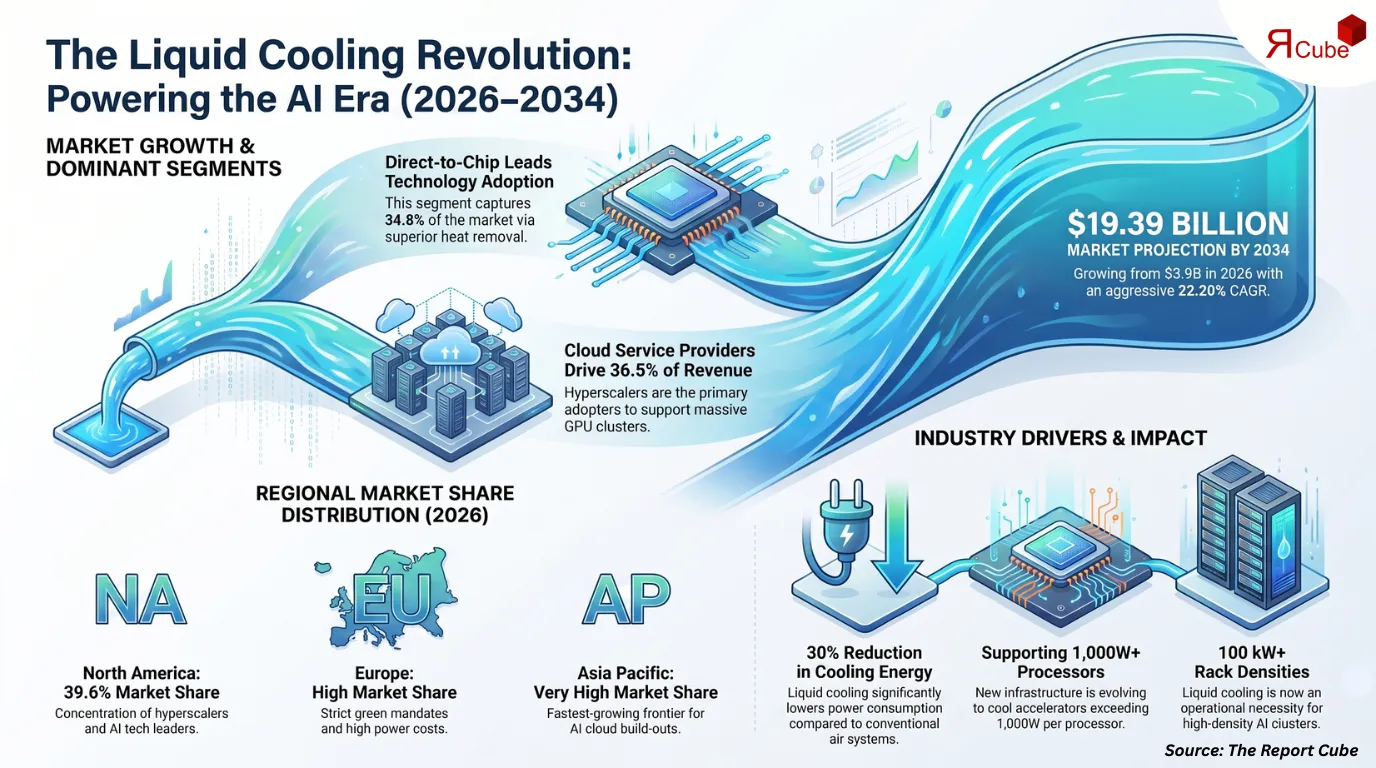
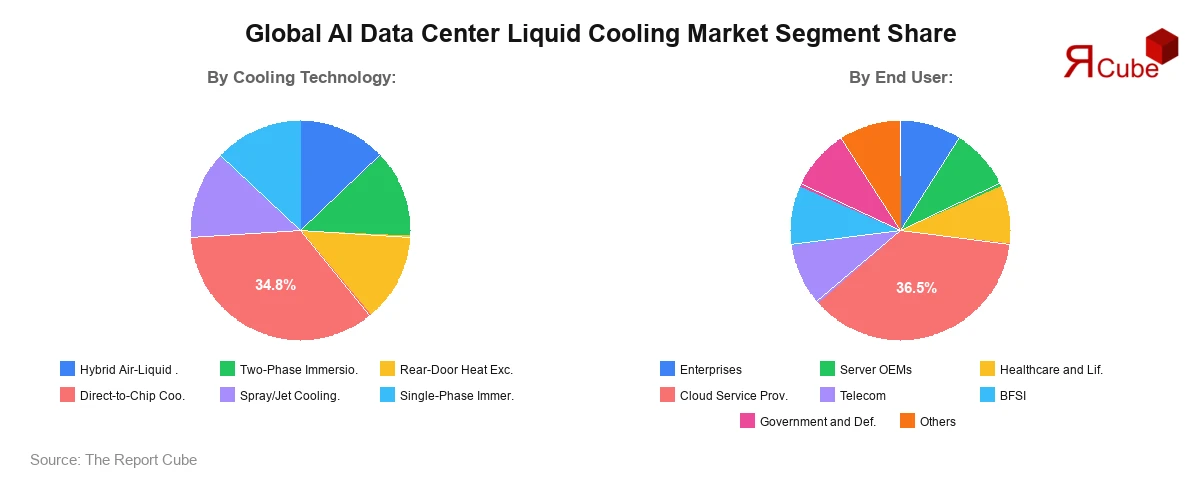
Direct-to-Chip Cooling segment leads the market with approximately 34.8% share.
By End User:
Cloud Service Providers segment dominates the market with around 36.5% of total revenue.
Regional Outlook:
North America dominates the Global AI Data Center Liquid Cooling Market with nearly 39.6% market share.
Global AI Data Center Liquid Cooling Market Insights & Analysis
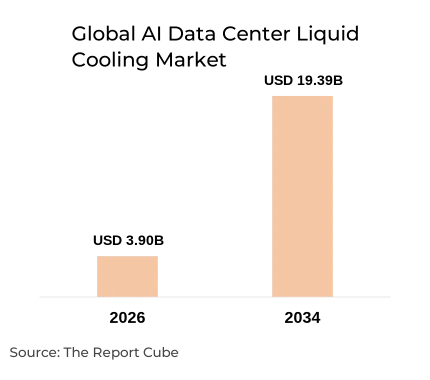
The Global AI Data Center Liquid Cooling Market is anticipated to register a CAGR of around 22.20% during the forecast period 2026-2034. The market size is valued at USD 3.9 Billion in 2026 and is projected to reach approximately USD 19.39 Billion by 2034. Market growth is accelerating as artificial intelligence infrastructure rapidly expands across hyperscale cloud providers, enterprise data centers, research organizations, and government computing facilities. The increasing deployment of high-density GPU clusters for generative AI, large language models, and scientific computing has significantly increased rack power densities, making conventional air cooling less efficient. Liquid cooling technologies deliver superior thermal performance while reducing energy consumption, supporting higher server utilization, and improving equipment reliability. Growing investments in AI factories, semiconductor design infrastructure, and advanced cloud computing continue to strengthen demand for efficient thermal management systems across modern data centers.
Industry participants are expanding innovation through advanced cold plates, immersion cooling systems, intelligent coolant distribution units, and integrated monitoring platforms capable of supporting future AI accelerators exceeding 1,000W per processor. Major technology companies are increasing capital expenditure to construct next-generation AI-ready facilities that prioritize sustainability alongside computing performance. Government initiatives supporting digital infrastructure, semiconductor manufacturing, and high-performance computing research are creating favorable conditions for market expansion across North America, Europe, and Asia Pacific. Strategic partnerships between cooling solution providers, server manufacturers, cloud service providers, and semiconductor companies are also accelerating commercialization of liquid cooling technologies. Continuous product innovation, acquisitions, and investments in modular cooling infrastructure are expected to strengthen the long-term outlook of the Global AI Data Center Liquid Cooling Market while supporting higher operational efficiency and lower total cost of ownership.
Global AI Data Center Liquid Cooling Market Impact Analysis
| Factor | Type | Specific Impact on Market | Magnitude | Business Implication |
|---|---|---|---|---|
| AI Rack Power Density Growth | Market | Dense AI servers exceed air cooling limits and need liquids | High | Drives rapid shift to direct and immersion cooling designs |
| Hyperscale Cloud Expansion | Market | Cloud and hyperscale operators deploy large AI facilities | High | Creates sustained multi year demand for liquid solutions |
| Energy Efficiency Regulations | Regulatory | Efficiency rules push data centers toward low PUE cooling | High | Favors vendors offering greener and high efficiency systems |
| Sustainability and ESG Pressure | Environmental | Operators seek cooling that cuts emissions and waste heat | High | Boosts adoption of heat reuse and low carbon coolants |
| High Upfront Infrastructure Cost | Competitive | Capital intensive systems slow adoption in small centers | Medium | Encourages retrofit friendly and modular liquid offerings |
| Technology Maturity and Standards | Technological | Multiple designs and limited standards raise integration risk | Medium | Rewards providers that support open standards and partners |
| AI Workload and Edge Growth | Market | Rising inference and edge AI need compact efficient cooling | Medium | Opens new niches for small form factor liquid solutions |
Global AI Data Center Liquid Cooling Market Dynamics
Key Driver: Escalating Rack Power Density Across AI Computing Infrastructure
AI infrastructure is advancing at a pace that places unprecedented pressure on data center cooling systems. Modern GPU platforms used for foundation models, scientific computing, digital engineering, and enterprise AI applications routinely generate thermal loads far beyond what traditional air-based systems can efficiently dissipate. Liquid cooling technologies enable direct heat transfer from processors, allowing facilities to operate dense computing environments without sacrificing system reliability or performance. As organizations continue scaling AI clusters, liquid cooling has become an operational necessity rather than a performance enhancement.
Large investments in AI factories, hyperscale cloud campuses, and research computing facilities are reinforcing demand for high-capacity thermal management solutions. Operators increasingly recognize that efficient cooling directly influences infrastructure utilization, energy costs, and hardware longevity. Direct-to-chip cooling and immersion technologies also support higher processor boost frequencies while reducing thermal throttling during prolonged AI training cycles. These technical advantages continue to strengthen demand across cloud service providers, semiconductor companies, financial institutions, healthcare organizations, and government research centers, supporting sustained market expansion through 2034.
Industry Trend: Integrated Liquid Cooling Platforms Becoming the Preferred Deployment Model
Technology vendors are moving beyond standalone cooling hardware by delivering integrated platforms that combine coolant distribution units, monitoring software, cold plates, pumps, sensors, and leak detection into unified infrastructure solutions. This integrated approach simplifies deployment for operators expanding AI capacity while improving operational visibility across increasingly complex computing environments. Modular architecture also enables phased infrastructure expansion without disrupting existing workloads, making liquid cooling more practical for both new facilities and retrofit projects.
Product development is increasingly focused on supporting processors with substantially higher thermal design power while maintaining energy efficiency targets. Manufacturers are introducing advanced dielectric fluids, intelligent flow management, predictive maintenance capabilities, and automated thermal optimization systems that reduce maintenance requirements and improve cooling consistency. Hybrid configurations combining air and liquid cooling are also becoming more common, allowing operators to optimize cooling strategies according to workload intensity. These innovations continue to reshape the competitive landscape and improve adoption across enterprise, hyperscale, and colocation data centers.
Book your FREE 30-minute expert consultation today
Contact UsMajor Challenge: Infrastructure Modernization Requires Significant Capital Commitment
Although liquid cooling delivers measurable operational benefits, implementation often involves extensive infrastructure upgrades that can affect project economics. Existing facilities may require modifications to piping systems, coolant distribution equipment, server racks, electrical layouts, and monitoring infrastructure before liquid cooling technologies can be fully integrated. These modernization requirements increase deployment costs, particularly for enterprise operators managing aging facilities designed around conventional air cooling architectures.
Operational readiness presents an additional consideration for organizations transitioning toward liquid cooling. Facility managers must establish maintenance procedures, technician training programs, coolant management protocols, and equipment compatibility standards before deployment at scale. Differences in cooling architectures across vendors may also influence procurement decisions and long-term service strategies. While standardization is improving across the industry, these implementation challenges continue to influence purchasing timelines for certain organizations, particularly those upgrading legacy infrastructure.
Opportunity: AI Infrastructure Expansion Creating Long-Term Demand for Advanced Thermal Management
Global investment in AI infrastructure continues to create substantial opportunities for liquid cooling providers. Cloud computing companies, semiconductor manufacturers, governments, and enterprise organizations are building next-generation AI facilities capable of supporting increasingly sophisticated machine learning workloads. These environments require cooling technologies that can maintain thermal stability under continuous high-density operation while minimizing electricity consumption. Liquid cooling systems have therefore become a foundational technology supporting the future growth of accelerated computing infrastructure.
Environmental sustainability is further expanding commercial opportunities across the market. Data center operators are under increasing pressure to reduce energy intensity and improve overall operational efficiency without limiting computing performance. Advanced liquid cooling enables lower cooling power consumption, improved heat recovery potential, and more efficient utilization of computing assets compared with conventional air cooling systems. As digital infrastructure investment continues across North America, Europe, Asia Pacific, and emerging AI markets, demand for scalable liquid cooling technologies is expected to strengthen steadily throughout the forecast period.
Global AI Data Center Liquid Cooling Market Segment-wise Analysis
By Cooling Technology:
- Hybrid Air-Liquid Cooling
- Two-Phase Immersion Cooling
- Rear-Door Heat Exchangers
- Direct-to-Chip Cooling
- Spray/Jet Cooling
- Single-Phase Immersion Cooling
Direct-to-chip cooling is the leading cooling technology in the Global AI Data Center Liquid Cooling Market, accounting for an estimated around 34.8% of the total market share in 2026. The segment continues to expand as AI servers equipped with advanced GPUs and AI accelerators generate significantly higher thermal loads than conventional computing systems. Direct-to-chip systems circulate coolant through cold plates attached directly to processors, delivering superior heat removal while lowering energy consumption and improving overall system reliability. Major cloud service providers and hyperscale operators increasingly deploy this technology to support high-density AI clusters exceeding 100 kW per rack. The growing adoption of generative AI, machine learning training, and large language model infrastructure is further strengthening demand for direct-to-chip cooling solutions across modern AI data centers.
The segment also benefits from continuous technological improvements introduced by cooling solution providers and server manufacturers. New cold plate designs, intelligent coolant distribution units, and advanced leak detection systems have improved cooling efficiency while reducing maintenance requirements. Strategic collaborations between liquid cooling companies, GPU manufacturers, and data center infrastructure providers are accelerating commercial deployment across hyperscale and enterprise facilities. Industry estimates indicate that direct-to-chip cooling can reduce cooling energy consumption by up to 30% compared with conventional air cooling in high-density AI environments. As organizations invest in next-generation AI infrastructure, direct-to-chip cooling is expected to remain the preferred solution due to its scalability, operational efficiency, and ability to support increasingly powerful processors.
By End User:
- Enterprises
- Server OEMs
- Healthcare and Life Sciences
- Cloud Service Providers
- Telecom
- BFSI
- Government and Defense
- Colocation Providers
- Manufacturing
- Others
Cloud Service Providers dominate the Global AI Data Center Liquid Cooling Market with an estimated around 36.5% revenue share in 2026. The segment leads because hyperscale cloud companies continue expanding AI infrastructure to support generative AI applications, cloud-based machine learning platforms, and enterprise AI services. These organizations operate massive GPU clusters that require highly efficient thermal management solutions to maintain performance and minimize operational costs. Liquid cooling technologies enable cloud operators to increase rack density, improve power usage effectiveness (PUE), and optimize data center space utilization. Rising investments in AI infrastructure across North America, Europe, and Asia Pacific continue driving large-scale adoption of advanced liquid cooling systems among leading cloud providers.
The growing demand for AI-as-a-Service and accelerated computing is encouraging cloud companies to modernize both existing and newly constructed data centers with hybrid and liquid cooling architectures. Many providers are integrating direct-to-chip cooling, rear-door heat exchangers, and advanced coolant distribution systems to accommodate next-generation AI hardware with thermal design power exceeding previous server generations. Sustainability commitments also play an important role, as liquid cooling helps reduce electricity consumption and lowers carbon emissions associated with traditional cooling methods. Continuous investments in hyperscale AI campuses and expanding cloud capacity are expected to reinforce the leadership of cloud service providers throughout the forecast period, creating sustained opportunities for liquid cooling equipment manufacturers and solution providers.
Regional Projection of Global AI Data Center Liquid Cooling Industry
- North America
- Europe
- Asia Pacific
- Middle East and Africa
- South America
North America holds the largest share of the Global AI Data Center Liquid Cooling Market, representing an estimated around 39.6% of global revenue in 2026. The region benefits from a strong concentration of hyperscale cloud operators, AI technology companies, semiconductor manufacturers, and advanced research institutions. Significant investments in AI infrastructure across the United States and Canada continue driving demand for high-performance liquid cooling technologies capable of supporting increasingly dense computing environments. The rapid expansion of generative AI, cloud computing, and large-scale AI model training has accelerated deployment of direct-to-chip cooling, immersion cooling, and advanced coolant distribution systems throughout hyperscale facilities. Strong private-sector investment combined with favorable digital infrastructure development further strengthens regional market growth.
North America also maintains leadership through continuous innovation and strategic partnerships among cooling technology providers, server OEMs, GPU manufacturers, and data center operators. Companies across the region are investing heavily in energy-efficient thermal management systems to reduce operating costs while meeting sustainability objectives and carbon reduction targets. Government support for advanced semiconductor manufacturing, AI research, and digital infrastructure modernization further contributes to increased deployment of next-generation cooling technologies. The presence of leading market participants, rapid commercialization of advanced AI hardware, and ongoing construction of hyperscale AI campuses position North America to retain its dominant market position throughout the 2026-2034 forecast period.
Need insights for a specific region within this market?
Request Regional DataGlobal AI Data Center Liquid Cooling Market – Regional Analysis
The AI data center liquid cooling market shows distinct regional patterns driven by AI workloads, hyperscale expansion, and sustainability rules.
| Region | Demand Level | Key Areas | System Dominance | Core Demand Logic | Growth Nature |
|---|---|---|---|---|---|
| North America | Very High | US, Canada hyperscale hubs | Direct-to-chip & rear-door | GPU dense AI clusters, strict PUE | Leader, tech upgrade driven |
| Europe | High | FLAP markets, Nordics | Immersion & hybrid liquid | EU green mandates, high power costs | Steady, regulation-led growth |
| Asia Pacific | Very High | China, India, Japan, SE Asia | Immersion & direct-to-chip | Rapid AI cloud build-out, 5G edge | Fastest-growing frontier |
| Middle East & Africa | Medium | UAE, Saudi, South Africa | Liquid–air hybrid systems | Smart city clouds, hot climates | Emerging, project-based growth |
| South America | Low to Medium | Brazil, Chile, Colombia | Selective liquid in hyperscale | Localized cloud, energy efficiency | Niche, early-stage expansion |
Government Initiatives & Policies
- United States AI Infrastructure and Data Center Expansion Initiatives (2025-2026): The U.S. government continues supporting advanced AI infrastructure, semiconductor manufacturing, and high-performance computing through programs under the CHIPS and Science Act, encouraging deployment of energy-efficient AI data centers and advanced cooling technologies.
- European High Performance Computing Joint Undertaking (EuroHPC) (2025-2026): The European Union continues investing in AI-ready supercomputing infrastructure through EuroHPC, promoting sustainable, high-performance computing facilities that increasingly adopt advanced liquid cooling technologies to improve energy efficiency.
Global AI Data Center Liquid Cooling Industry Recent Developments
- 2026: Vertiv Group Corporation introduced new configurations of its MegaMod HDX prefabricated infrastructure platform for AI clusters. The upgraded solution combines direct-to-chip liquid cooling with air-cooled architectures, enabling efficient deployment of high-density GPU environments while improving scalability, thermal efficiency, and infrastructure flexibility for next-generation AI data centers.
- 2026: Schneider Electric SE, through Motivair, launched the MCDU-70, a 2.5MW coolant distribution unit engineered for high-density AI data centers and AI factories. The company also announced that its coolant distribution unit portfolio is scalable to 10MW and beyond, supporting accelerated computing and future AI workloads.
- 2026: Trane Technologies completed the acquisition of LiquidStack Inc., strengthening its advanced thermal management portfolio for AI infrastructure. The acquisition expands Trane's capabilities across direct-to-chip and immersion liquid cooling technologies designed for increasingly dense AI computing environments.
- 2026: Ecolab Inc. announced an agreement to acquire CoolIT Systems Inc., aiming to establish a comprehensive fluid management and liquid cooling platform for next-generation AI data centers. The acquisition is expected to strengthen integrated cooling capabilities supporting high-performance computing and generative AI infrastructure.
- 2026: CoolIT Systems Inc. demonstrated a new 15kW single-phase direct liquid cooling cold plate capable of delivering nearly four times the cooling capacity of its previously demonstrated design. The innovation supports future ultra-high-density GPUs and AI accelerators with significantly higher thermal requirements.
Why Choose This Report?
- Provides a comprehensive overview of the overall market analysis, encompassing key trends, consumer behavior analysis, and risk assessment to support strategic decision-making.
- Provides accurate, up-to-date insights into market size, segmentation, and emerging opportunities, helping to minimize risk while capitalizing on growth opportunities.
- Gives deep understanding of target audience preferences, investment habits, and communication channels for enhanced product development and marketing effectiveness.
- Delivers competitive analysis and benchmarking, uncovering the strengths and weaknesses of market competitors to guide strategic business planning.
- Consolidates comprehensive market intelligence, reducing research efforts while improving operational efficiency.
- Facilitates customized market segmentation and risk mitigation strategies that align with specific business objectives.
- Aids in identifying both market challenges and untapped opportunities within the industry to drive sustainable long-term business growth.
- Provides valuable information based on actual customer data, technology developments, and industry search trends.
Table of Contents
- Introduction
- Objective of the Study
- Product and Category Definition
- Market Segmentation
- Study Variables
- Research Methodology
- Secondary Data Points
- Breakdown of Secondary Sources
- Primary Data Points
- Breakdown of Primary Interviews
- Secondary Data Points
- Executive Summary
- Market Dynamics
- Emerging Opportunities
- Adoption Trends
- Demand Drivers
- Disruption Analysis (Challenges)
- Industry Analysis & Strategic Insights
- Supply/Value Chain Analysis
- Pricing Analysis
- Go-To-Market (GTM) Strategy
- BCG Matrix
- Recent Trends and Developments
- Import and Export Analysis
- Regulatory and Policy Landscape
- Region-wise Policies
- Government Initiatives
- Global AI Data Center Liquid Cooling Market Overview and Forecast Analysis (2021-2034)
- Market Size, By Value, By Growth Rate (CAGR/USD Billion)
- Market Share, By Cooling Technology
- Hybrid Air-Liquid Cooling
- Two-Phase Immersion Cooling
- Rear-Door Heat Exchangers
- Direct-to-Chip Cooling
- Spray/Jet Cooling
- Single-Phase Immersion Cooling
- Market Share, By Component
- Heat Exchangers
- Coolants and Dielectric Fluids
- Cold Plates
- Solutions
- Pumps, Valves and Manifolds
- Sensors and Leak Detection Systems
- Coolant Distribution Units
- Services
- Market Share, By Data Center Type
- Edge AI Data Centers
- HPC and Research Facilities
- Enterprise AI Data Centers
- Hyperscale AI Data Centers
- Colocation AI Data Centers
- Market Share, By Workload
- High-Performance Computing
- AI Inference
- Cloud AI Infrastructure
- Enterprise Analytics
- Generative AI Training
- Semiconductor Design and Simulation
- Defense and Research Computing
- Market Share, By End User
- Enterprises
- Server OEMs
- Healthcare and Life Sciences
- Cloud Service Providers
- Telecom
- BFSI
- Government and Defense
- Colocation Providers
- Manufacturing
- Others
- Market Share, By Region
- North America
- Europe
- Asia Pacific
- Middle East and Africa
- South America
- Market Share, By Company
- Revenue Shares and Analysis
- Competitive Landscape
- North America AI Data Center Liquid Cooling Market Overview and Forecast Analysis (2021-2034)
- Market Size, By Value, By Growth Rate (CAGR/USD Billion/Million)
- Market Share, By Cooling Technology
- Market Share, By Component
- Market Share, By Data Center Type
- Market Share, By Workload
- Market Share, By End User
- Market Share, By Country
- United States
- Canada
- Mexico
- Rest of North America
- Europe AI Data Center Liquid Cooling Market Overview and Forecast Analysis (2021-2034)
- Market Size, By Value, By Growth Rate (CAGR/USD Billion/Million)
- Market Share, By Cooling Technology
- Market Share, By Component
- Market Share, By Data Center Type
- Market Share, By Workload
- Market Share, By End User
- Market Share, By Country
- Germany
- United Kingdom
- France
- Italy
- Spain
- Netherlands
- Russia
- Poland
- Belgium
- Sweden
- Rest of Europe
- Asia Pacific AI Data Center Liquid Cooling Market Overview and Forecast Analysis (2021-2034)
- Market Size, By Value, By Growth Rate (CAGR/USD Billion/Million)
- Market Share, By Cooling Technology
- Market Share, By Component
- Market Share, By Data Center Type
- Market Share, By Workload
- Market Share, By End User
- Market Share, By Country
- China
- India
- Japan
- South Korea
- Australia
- Indonesia
- Thailand
- Malaysia
- Vietnam
- Philippines
- Singapore
- New Zealand
- Rest of Asia Pacific
- Middle East and Africa AI Data Center Liquid Cooling Market Overview and Forecast Analysis (2021-2034)
- Market Size, By Value, By Growth Rate (CAGR/USD Billion/Million)
- Market Share, By Cooling Technology
- Market Share, By Component
- Market Share, By Data Center Type
- Market Share, By Workload
- Market Share, By End User
- Market Share, By Country
- Saudi Arabia
- United Arab Emirates
- South Africa
- Egypt
- Nigeria
- Morocco
- Turkey
- Rest of Middle East and Africa
- South America AI Data Center Liquid Cooling Market Overview and Forecast Analysis (2021-2034)
- Market Size, By Value, By Growth Rate (CAGR/USD Billion/Million)
- Market Share, By Cooling Technology
- Market Share, By Component
- Market Share, By Data Center Type
- Market Share, By Workload
- Market Share, By End User
- Market Share, By Country
- Brazil
- Argentina
- Chile
- Colombia
- Peru
- Rest of South America
- Competitive Analysis, 2026
- Market Share of Key Players
- Competitive Mapping for Each Segment and Companies Operating Regionally
- North America AI Data Center Liquid Cooling Companies Share and Competitive Analysis, 2026
- Europe AI Data Center Liquid Cooling Companies Share and Competitive Analysis, 2026
- Asia Pacific AI Data Center Liquid Cooling Companies Share and Competitive Analysis, 2026
- Middle East and Africa AI Data Center Liquid Cooling Companies Share and Competitive Analysis, 2026
- South America AI Data Center Liquid Cooling Companies Share and Competitive Analysis, 2026
- Company Profile (Partial List)
- CoolIT Systems Inc.
- Company Overview
- Product Portfolio
- Strategic Alliances/Partnerships
- Recent Developments
- Submer Technologies SL
- Company Overview
- Product Portfolio
- Strategic Alliances/Partnerships
- Recent Developments
- Asperitas BV
- Company Overview
- Product Portfolio
- Strategic Alliances/Partnerships
- Recent Developments
- LiquidStack Inc.
- Company Overview
- Product Portfolio
- Strategic Alliances/Partnerships
- Recent Developments
- Fujitsu Limited
- Company Overview
- Product Portfolio
- Strategic Alliances/Partnerships
- Recent Developments
- Green Revolution Cooling Inc.
- Company Overview
- Product Portfolio
- Strategic Alliances/Partnerships
- Recent Developments
- Super Micro Computer, Inc.
- Company Overview
- Product Portfolio
- Strategic Alliances/Partnerships
- Recent Developments
- Boyd Corporation
- Company Overview
- Product Portfolio
- Strategic Alliances/Partnerships
- Recent Developments
- Vertiv Group Corporation
- Company Overview
- Product Portfolio
- Strategic Alliances/Partnerships
- Recent Developments
- NVIDIA Corporation
- Company Overview
- Product Portfolio
- Strategic Alliances/Partnerships
- Recent Developments
- Iceotope Technologies Limited
- Company Overview
- Product Portfolio
- Strategic Alliances/Partnerships
- Recent Developments
- Schneider Electric SE
- Company Overview
- Product Portfolio
- Strategic Alliances/Partnerships
- Recent Developments
- Asetek A/S
- Company Overview
- Product Portfolio
- Strategic Alliances/Partnerships
- Recent Developments
- Chilldyne Inc.
- Company Overview
- Product Portfolio
- Strategic Alliances/Partnerships
- Recent Developments
- Midas Green Technologies LLC
- Company Overview
- Product Portfolio
- Strategic Alliances/Partnerships
- Recent Developments
- Others (Partial List)
- CoolIT Systems Inc.
- Contact Us and Disclaimer
Top Key Players & Market Share Outlook
- CoolIT Systems Inc.
- Submer Technologies SL
- Asperitas BV
- LiquidStack Inc.
- Fujitsu Limited
- Green Revolution Cooling Inc.
- Super Micro Computer, Inc.
- Boyd Corporation
- Vertiv Group Corporation
- NVIDIA Corporation
- Iceotope Technologies Limited
- Schneider Electric SE
- Asetek A/S
- Chilldyne Inc.
- Midas Green Technologies LLC
- Others
Frequently Asked Questions






