




Build Your Custom Market Intelligence Report
Customize Your ReportGlobal Graphene Based Silicon Photonics Market Key Highlights
By Offering:
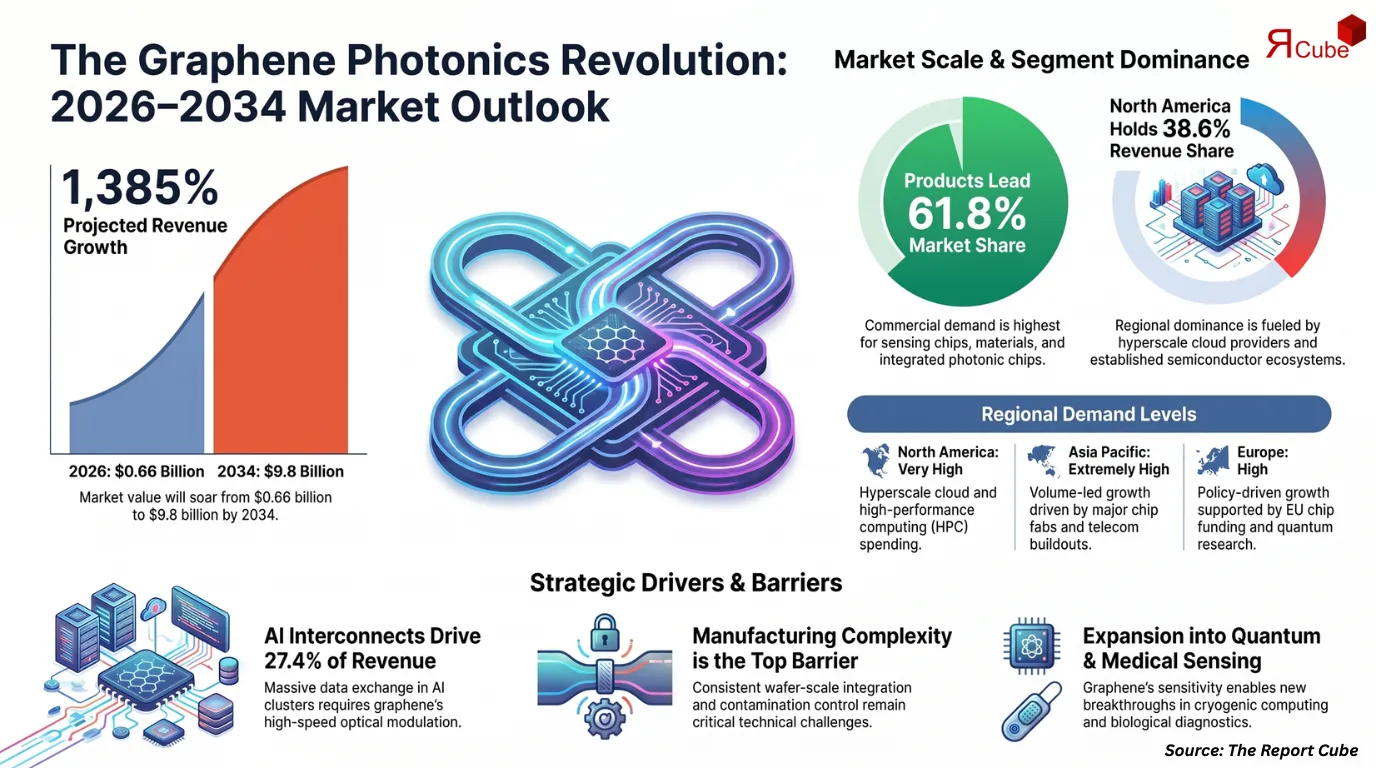
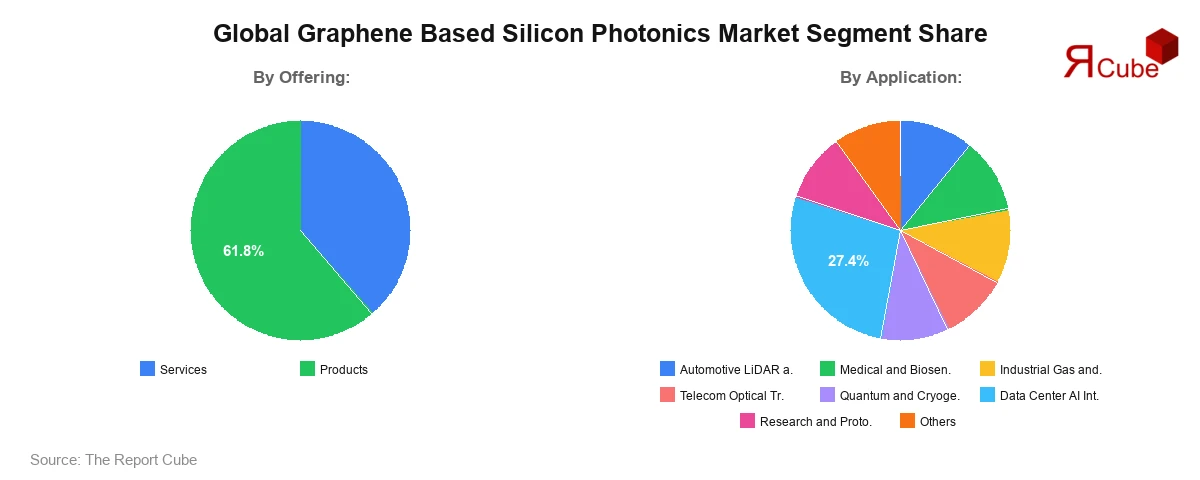
Products segment leads the market with approximately 61.8% share.
By Application:
Data Center AI Interconnects segment dominates the market with nearly 27.4% of total revenue.
Regional Outlook:
North America dominates the Global Graphene Based Silicon Photonics Market with around 38.6% market share.
Global Graphene Based Silicon Photonics Market Insights & Analysis
The Global Graphene Based Silicon Photonics Market is anticipated to register a CAGR of around 40.11% during the forecast period of 2026-2034. The market size is valued at USD 0.66 billion in 2026 and is projected to reach USD 9.8 billion by 2034. Commercial interest in graphene mixed silicon photonics has accelerated as semiconductor manufacturers seek materials capable of supporting faster optical modulation, lower power consumption, and greater bandwidth than conventional silicon-only photonic devices. Graphene's exceptional carrier mobility and broadband optical properties make it well suited for photonic integrated circuits used in AI infrastructure, optical communication networks, industrial sensing, medical diagnostics, and quantum technologies. Continued improvements in wafer-scale graphene integration and fabrication processes are enabling the transition from laboratory demonstrations to commercially deployable photonic components, strengthening long-term market prospects.
Investment activity across the semiconductor and photonics ecosystem continues to reinforce market development. Integrated device manufacturers, silicon foundries, advanced material suppliers, and research institutions are expanding collaborative programs focused on scalable graphene integration, process qualification, and high-volume manufacturing. Growing demand for co-packaged optics, optical input/output architectures, and energy-efficient networking hardware is encouraging companies to develop graphene-enabled modulators, detectors, and photonic chips capable of supporting next-generation computing platforms. At the same time, government funding for semiconductor innovation, quantum technologies, and advanced materials research is helping accelerate commercialization by supporting pilot production, technology validation, and industry-academia partnerships across North America, Europe, and Asia Pacific.
Global Graphene Based Silicon Photonics Market Impact Analysis
| Factor | Type | Specific Impact on Market | Magnitude | Business Implication |
|---|---|---|---|---|
| AI Data Center Interconnect Demand | Market | Accelerates need for ultra high bandwidth optical links | High | Drives adoption of graphene enhanced photonic transceivers |
| Energy Efficient Computing Requirements | Environmental | Pushes buyers toward low power photonic integration options | High | Strengthens value proposition of graphene optical devices |
| Advances in Wafer Scale Integration | Technological | Improves scalability of graphene silicon photonic platforms | Medium | Enables transition from lab prototypes to volume production |
| High Manufacturing Cost and Complexity | Market | Raises barriers for mass deployment and price sensitive use | High | Limits adoption to premium and performance critical segments |
| Regional Concentration in Asia Pacific | Competitive | Market share led by strong Asian semiconductor ecosystems | High | Encourages partnerships with foundries and fabs in the region |
| Standardization and PDK Ecosystem Growth | Technological | Facilitates design of graphene enabled photonic integrated circuits | Medium | Supports faster customer prototyping and ecosystem alignment |
| Competing Silicon Photonics Solutions | Competitive | Established platforms challenge differentiation of graphene devices | Medium | Requires focus on niche high speed and low latency applications |
Global Graphene Based Silicon Photonics Market Dynamics
Key Driver: Expanding AI Computing Infrastructure Driving Demand for High-Speed Optical Interconnects
The rapid scale-up of artificial intelligence computing environments is significantly increasing the requirement for high-performance optical communication technologies. Modern AI training clusters consist of thousands of processors that exchange enormous volumes of data in real time, placing considerable pressure on existing electrical interconnect technologies. Graphene-based silicon photonics provides an attractive alternative by enabling faster optical modulation, reduced signal loss, and improved energy efficiency. These advantages help data center operators improve overall computing performance while managing power consumption and thermal constraints associated with increasingly dense AI hardware deployments.
Technology companies are investing in advanced photonic architectures that integrate graphene with silicon platforms to improve network scalability and bandwidth density. Growing adoption of co-packaged optics, optical chiplets, and photonic integrated circuits is creating favorable conditions for graphene-enabled optical devices across hyperscale data centers. As AI workloads continue expanding across cloud computing, autonomous systems, and enterprise applications, demand for energy-efficient optical connectivity is expected to remain a primary growth catalyst for the Global Graphene Based Silicon Photonics Market throughout the forecast period.
Industry Trends: Commercial Manufacturing Ecosystem Continues to Mature
The industry is steadily progressing toward commercial-scale manufacturing as graphene suppliers, semiconductor foundries, and photonics developers strengthen strategic partnerships. Standardized fabrication processes, process design kits, and multi-project wafer services are simplifying product development while lowering technical barriers for startups and research organizations. Improvements in graphene transfer techniques, wafer uniformity, and device packaging are also contributing to higher manufacturing yields and improved product reliability across optical communication and sensing applications.
Growing integration of graphene photonics into data communications, quantum systems, automotive LiDAR, industrial monitoring, and medical diagnostics reflects the expanding commercial potential of the technology. Semiconductor manufacturers are increasingly evaluating graphene-enabled photonic integrated circuits to address rising bandwidth requirements while improving energy efficiency. Continued progress in heterogeneous integration, advanced semiconductor packaging, and wafer-level manufacturing is expected to broaden commercial deployment opportunities during the forecast period.
Book your FREE 30-minute expert consultation today
Contact UsMajor Challenge: Wafer-Scale Manufacturing and Process Standardization Remain Critical Barriers
Producing high-quality graphene photonic devices at commercial scale remains technically demanding because graphene integration requires exceptional material uniformity and contamination control throughout fabrication. Even minor variations in graphene transfer or layer quality can influence optical modulation efficiency, insertion loss, and long-term device reliability. Maintaining consistent production quality across large-diameter wafers continues to require highly specialized manufacturing expertise and advanced process control technologies.
Commercial adoption is also influenced by the relatively limited number of foundries currently offering mature graphene integration capabilities. Manufacturers continue investing in process optimization, equipment qualification, and production automation to improve manufacturing scalability while reducing fabrication costs. Broader industry standards, expanded supply chain capacity, and additional commercial foundry services will be essential for supporting widespread deployment of graphene mixed silicon photonics across telecommunications, healthcare, industrial automation, and quantum computing applications.
Opportunity: Expanding Adoption Across Quantum Technologies and Precision Sensing Applications
Graphene-based silicon photonics is opening new opportunities across industries that require highly sensitive optical detection and ultra-fast signal processing. Medical device developers are investigating graphene-enabled biosensors capable of detecting biological markers with greater sensitivity, while industrial companies are deploying photonic sensors for gas analysis, chemical monitoring, and environmental measurement. These applications benefit from graphene's unique optical and electrical characteristics, supporting improved detection accuracy in demanding operating environments.
Quantum computing and cryogenic photonics represent another promising avenue for long-term market expansion. Research organizations and technology companies are accelerating the development of graphene-based quantum photonic devices capable of supporting secure communications, quantum sensing, and next-generation computing systems. Increasing collaboration among semiconductor manufacturers, advanced material suppliers, research institutes, and government-funded innovation programs is expected to strengthen commercialization efforts and create new revenue opportunities for graphene-enabled silicon photonic technologies over the coming decade.
Opportunity: Expanding Demand Across Quantum Computing, Medical Diagnostics, and Advanced Sensing
Graphene-based silicon photonics offers substantial growth opportunities beyond telecommunications through its ability to deliver highly sensitive optical detection and ultra-fast signal processing. Medical diagnostics companies are increasingly evaluating graphene-enabled biosensors capable of detecting extremely small biological changes with improved sensitivity. Industrial manufacturers are exploring graphene photonic sensors for gas monitoring, chemical detection, environmental monitoring, and industrial safety applications where accurate real-time sensing provides significant operational advantages.
Emerging quantum computing platforms are also creating attractive long-term opportunities for graphene mixed silicon photonics technologies. Quantum communication systems, cryogenic photonic devices, quantum sensing platforms, and secure optical communication networks increasingly require materials capable of maintaining high-speed optical performance under demanding operating environments. Continued government research funding, expanding university-industry collaborations, and increasing venture capital investment in advanced photonics startups are expected to accelerate innovation while opening new commercial markets for graphene-enabled photonic integrated circuits throughout the forecast period.
Global Graphene Based Silicon Photonics Market Segment-wise Analysis
By Offering:
- Services
- Foundry and MPW Services
- Graphene Integration Services
- Design and Qualification Services
- Others
- Products
- Graphene Sensing Chips
- Graphene Materials and Wafer Products
- Graphene Photonic Chips
- Others
The Products segment accounted for approximately 61.8% of the Global Graphene Based Silicon Photonics Market in 2026, making it the largest revenue-generating offering category. Commercial demand continues to rise for graphene photonic chips, graphene sensing chips, and graphene materials integrated with silicon photonic platforms as industries pursue higher-speed optical communication and compact photonic integration. These products provide excellent optical modulation performance, low power consumption, and compatibility with existing silicon fabrication processes, making them attractive for data centers, telecommunications, medical sensing, and industrial monitoring applications.
Continuous investment in wafer-scale graphene production and photonic integrated circuit manufacturing is further strengthening the Products segment. Semiconductor manufacturers and photonics developers are introducing commercially qualified graphene-enabled devices designed for AI networking, optical transceivers, quantum systems, and next-generation sensing technologies. As fabrication yields improve and manufacturing costs gradually decline, product adoption is expected to accelerate across both established semiconductor companies and emerging integrated photonics startups, reinforcing the segment's market leadership throughout the forecast period.
By Application:
- Automotive LiDAR and Imaging
- Medical and Biosensing
- Industrial Gas and Chemical Sensing
- Telecom Optical Transport
- Quantum and Cryogenic Systems
- Data Center AI Interconnects
- Research and Prototyping
- Others
The Data Center AI Interconnects segment represented nearly 27.4% of the Global Graphene Based Silicon Photonics Market in 2026. Rapid deployment of hyperscale AI infrastructure is driving demand for optical interconnect technologies capable of supporting massive data transfer between processors with lower latency and improved energy efficiency. Graphene mixed silicon photonics enables ultra-fast optical modulation and high-bandwidth communication, making it well suited for next-generation AI clusters, cloud computing facilities, and high-performance computing environments where conventional electrical interconnects increasingly face performance limitations.
Technology providers are actively developing co-packaged optics, optical input/output architectures, and photonic integrated circuits to meet the growing bandwidth requirements of generative AI, machine learning, and advanced analytics workloads. Rising investments in AI factories, GPU clusters, and optical networking equipment are expected to sustain strong demand for graphene-enabled optical components over the coming decade. Continued collaboration between semiconductor manufacturers, networking equipment vendors, and cloud service providers will further support commercialization of high-performance photonic interconnect solutions
Regional Projection of Global Graphene Based Silicon Photonics Market
- North America
- Europe
- Asia Pacific
- Middle East and Africa
- South America
North America held the largest share of the Global Graphene Based Silicon Photonics Market, accounting for approximately 38.6% of global revenue in 2026. The region benefits from an established semiconductor ecosystem, world-leading photonics research institutions, and significant investments in advanced computing technologies. The United States remains the primary contributor, supported by the presence of major semiconductor manufacturers, cloud service providers, AI hardware companies, and integrated photonics developers actively investing in graphene-enabled optical technologies for next-generation networking and computing applications.
Government support for semiconductor manufacturing, advanced materials research, and quantum technology development continues to strengthen the regional innovation landscape. In addition, increasing commercialization of co-packaged optics, silicon photonic integrated circuits, and optical chiplet architectures is creating new opportunities for graphene-based photonic devices across telecommunications, healthcare, defense, and industrial automation. Strong collaboration among universities, national laboratories, foundries, and private technology companies is expected to help North America maintain its leadership position throughout the forecast period.
Need insights for a specific region within this market?
Request Regional DataRegional Analysis of Global Graphene Based Silicon Photonics Market
The graphene based silicon photonics market shows distinct regional patterns, driven by data centers, 5G, AI, and advanced chip R&D.
| Region | Demand Level | Key Areas | System Dominance | Core Demand Logic | Growth Nature |
|---|---|---|---|---|---|
| North America | Very High | US, Canada tech hubs | Datacom & AI optics | Hyperscale cloud and HPC spend.[web:2895][web:2907] | Innovation led, upgrade heavy. |
| Europe | High | Germany, UK, France, Nordics | Photonics for 5G & quantum | EU fabs and quantum funding.[web:2904][web:2903] | Policy driven, steady rise. |
| Asia Pacific | Extremely High | China, Japan, Korea, Taiwan | Foundry and packaging nodes | Chip fabs and telecom buildout.[web:2900][web:2902] | Fastest growing, volume led.[web:2895][web:2902] |
| Middle East & Africa | Medium | GCC states, Israel | Data center interconnects | New hyperscale and smart cities.[web:2904] | Emerging, capex intensive. |
| South America | Low to Medium | Brazil, Chile, Colombia | Telecom and backbone links | 5G core and regional clouds.[web:2902] | Late adopter, niche wins. |
Government Initiatives & Policies
- National Quantum Initiative Reauthorization (United States, 2025): Continued federal investment supports quantum information science, advanced semiconductor research, photonics innovation, and graphene-enabled technologies to accelerate commercialization of next-generation computing and sensing systems.
- European Chips Act Implementation (European Union, 2025-2026): The European Union continues expanding semiconductor manufacturing capacity, pilot lines, photonic integration, and advanced materials research to strengthen regional semiconductor competitiveness and resilient supply chains.
Global Graphene Based Silicon Photonics Industry Recent Developments
- 2026: Paragraf Limited and Archer Materials announced a strategic collaboration to accelerate the commercialization of graphene-based quantum devices. The partnership focuses on developing graphene-enabled quantum computing and cryogenic technologies by combining Paragraf's graphene manufacturing expertise with Archer Materials' quantum chip development capabilities.
- 2025: NVIDIA Corporation introduced its Quantum-X InfiniBand Photonics and Spectrum-X Photonics Co-Packaged Optics (CPO) networking platforms. Designed for commercial availability in 2026, these solutions aim to improve bandwidth, reduce energy consumption, and support hyperscale AI factory networking through integrated photonic connectivity.
- 2025: The UCIe Consortium released the UCIe 3.0 specification featuring data transfer speeds of up to 64 GT/s along with enhanced manageability and interoperability capabilities. The updated specification strengthens the open chiplet ecosystem and supports future optical I/O integration, advanced semiconductor packaging, and high-performance computing architectures.
Why Choose This Report?
- Provides a comprehensive overview of the overall market analysis, encompassing key trends, consumer behavior analysis, and risk assessment to support strategic decision-making.
- Provides accurate, up-to-date insights into market size, segmentation, and emerging opportunities, helping to minimize risk while capitalizing on growth.
- Gives a deep understanding of target audience preferences, investment patterns, and communication channels for enhanced product development and marketing effectiveness.
- Delivers competitive analysis and benchmarking, uncovering the strengths and weaknesses of market competitors to guide strategic planning.
- Consolidates comprehensive market intelligence, reducing research effort and streamlining business planning.
- Facilitates customized market segmentation and risk mitigation strategies that align with specific business objectives.
- Aids in identifying both market challenges and untapped opportunities within the industry to drive sustainable long-term business growth.
- Provides valuable information based on actual customer demand patterns, technology trends, investment activities, and evolving industry developments.
Table of Contents
- Introduction
- Objective of the Study
- Product and Category Definition
- Market Segmentation
- Study Variables
- Research Methodology
- Secondary Data Points
- Breakdown of Secondary Sources
- Primary Data Points
- Breakdown of Primary Interviews
- Secondary Data Points
- Executive Summary
- Market Dynamics
- Emerging Opportunities
- Adoption Trends
- Demand Drivers
- Disruption Analysis (Challenges)
- Industry Analysis & Strategic Insights
- Supply/Value Chain Analysis
- Pricing Analysis
- Go-To-Market (GTM) Strategy
- BCG Matrix
- Recent Trends and Developments
- Import and Export Analysis
- Regulatory and Policy Landscape
- Region-wise policies
- Government Initiatives
- Global Graphene Based Silicon Photonics Market Overview and Forecast Analysis (2021-2034)
- Market Size, By Value, By Growth Rate (CAGR/USD Billion)
- Market Share, By Offering
- Services
- Foundry and MPW Services
- Graphene Integration Services
- Design and Qualification Services
- Others
- Products
- Graphene Sensing Chips
- Graphene Materials and Wafer Products
- Graphene Photonic Chips
- Others
- Services
- Market Share, By Distribution Channel
- Direct Wafer and Material Sales
- Joint Development Programs
- PDK and Design Ecosystem Access
- MPW and Shuttle Programs
- Direct Foundry Sales
- Direct Device Product Sales
- Market Share, By Manufacturing Platform
- Upto 150 mm Wafer Platform
- 200 mm Wafer Platform
- 300 mm Wafer Platform
- Others
- Market Share, By Application
- Automotive LiDAR and Imaging
- Medical and Biosensing
- Industrial Gas and Chemical Sensing
- Telecom Optical Transport
- Quantum and Cryogenic Systems
- Data Center AI Interconnects
- Research and Prototyping
- Others
- Market Share, By End-User
- Sensor Companies
- AI Hardware Companies
- Optical Module Vendors
- Automotive OEM and Tier 1
- Medical Device Companies
- Telecom Equipment Vendors
- Industrial OEMs
- Fabless Photonics Companies
- Government Funded Programs
- Research Institutes
- Others
- Market Share, By Region
- North America
- Europe
- Asia Pacific
- Middle East and Africa
- South America
- Market Share, By Company
- Revenue Shares and Analysis
- Competitive Landscape
- North America Graphene Based Silicon Photonics Market Overview and Forecast Analysis (2021-2034)
- Market Size, By Value, By Growth Rate (CAGR/USD Billion/Million)
- Market Share, By Offering
- Market Share, By Distribution Channel
- Market Share, By Manufacturing Platform
- Market Share, By Application
- Market Share, By End-User
- Market Share, By Country
- United States
- Canada
- Mexico
- Rest of North America
- Europe Graphene Based Silicon Photonics Market Overview and Forecast Analysis (2021-2034)
- Market Size, By Value, By Growth Rate (CAGR/USD Billion/Million)
- Market Share, By Offering
- Market Share, By Distribution Channel
- Market Share, By Manufacturing Platform
- Market Share, By Application
- Market Share, By End-User
- Market Share, By Country
- Germany
- United Kingdom
- France
- Italy
- Spain
- Netherlands
- Russia
- Poland
- Belgium
- Sweden
- Rest of Europe
- Asia Pacific Graphene Based Silicon Photonics Market Overview and Forecast Analysis (2021-2034)
- Market Size, By Value, By Growth Rate (CAGR/USD Billion/Million)
- Market Share, By Offering
- Market Share, By Distribution Channel
- Market Share, By Manufacturing Platform
- Market Share, By Application
- Market Share, By End-User
- Market Share, By Country
- China
- India
- Japan
- South Korea
- Australia
- Indonesia
- Thailand
- Malaysia
- Vietnam
- Philippines
- Singapore
- New Zealand
- Rest of Asia Pacific
- Middle East and Africa Graphene Based Silicon Photonics Market Overview and Forecast Analysis (2021-2034)
- Market Size, By Value, By Growth Rate (CAGR/USD Billion/Million)
- Market Share, By Offering
- Market Share, By Distribution Channel
- Market Share, By Manufacturing Platform
- Market Share, By Application
- Market Share, By End-User
- Market Share, By Country
- Saudi Arabia
- United Arab Emirates
- South Africa
- Egypt
- Nigeria
- Morocco
- Turkey
- Rest of Middle East and Africa
- South America Graphene Based Silicon Photonics Market Overview and Forecast Analysis (2021-2034)
- Market Size, By Value, By Growth Rate (CAGR/USD Billion/Million)
- Market Share, By Offering
- Market Share, By Distribution Channel
- Market Share, By Manufacturing Platform
- Market Share, By Application
- Market Share, By End-User
- Market Share, By Country
- Brazil
- Argentina
- Chile
- Colombia
- Peru
- Rest of South America
- Competitive Analysis, 2026
- Market Share of Key Players
- Competitive Mapping for Each Segment and Companies Operating Regionally
- North America Graphene Based Silicon Photonics Companies Share and Competitive Analysis, 2026
- Europe Graphene Based Silicon Photonics Companies Share and Competitive Analysis, 2026
- Asia Pacific Graphene Based Silicon Photonics Companies Share and Competitive Analysis, 2026
- Middle East and Africa Graphene Based Silicon Photonics Companies Share and Competitive Analysis, 2026
- South America Graphene Based Silicon Photonics Companies Share and Competitive Analysis, 2026
- Company Profile (Partial List)
- GlobalFoundries Inc.
- Company Overview
- Product Portfolio
- Strategic Alliances/Partnerships
- Recent Developments
- Cisco Systems, Inc.
- Company Overview
- Product Portfolio
- Strategic Alliances/Partnerships
- Recent Developments
- Graphensic AB
- Company Overview
- Product Portfolio
- Strategic Alliances/Partnerships
- Recent Developments
- Advanced Graphene Products S.A.
- Company Overview
- Product Portfolio
- Strategic Alliances/Partnerships
- Recent Developments
- Intel Corporation
- Company Overview
- Product Portfolio
- Strategic Alliances/Partnerships
- Recent Developments
- Black Semiconductor GmbH
- Company Overview
- Product Portfolio
- Strategic Alliances/Partnerships
- Recent Developments
- Paragraf Limited
- Company Overview
- Product Portfolio
- Strategic Alliances/Partnerships
- Recent Developments
- SilTerra Malaysia Sdn. Bhd.
- Company Overview
- Product Portfolio
- Strategic Alliances/Partnerships
- Recent Developments
- SMART Photonics B.V.
- Company Overview
- Product Portfolio
- Strategic Alliances/Partnerships
- Recent Developments
- Levidian Nanosystems Limited
- Company Overview
- Product Portfolio
- Strategic Alliances/Partnerships
- Recent Developments
- Tower Semiconductor Ltd.
- Company Overview
- Product Portfolio
- Strategic Alliances/Partnerships
- Recent Developments
- LIGENTEC SA
- Company Overview
- Product Portfolio
- Strategic Alliances/Partnerships
- Recent Developments
- Graphenea Inc.
- Company Overview
- Product Portfolio
- Strategic Alliances/Partnerships
- Recent Developments
- 2D Photonics SpA
- Company Overview
- Product Portfolio
- Strategic Alliances/Partnerships
- Recent Developments
- Versarien plc
- Company Overview
- Product Portfolio
- Strategic Alliances/Partnerships
- Recent Developments
- X-FAB Silicon Foundries SE
- Company Overview
- Product Portfolio
- Strategic Alliances/Partnerships
- Recent Developments
- Grolltex Inc.
- Company Overview
- Product Portfolio
- Strategic Alliances/Partnerships
- Recent Developments
- Directa Plus S.p.A.
- Company Overview
- Product Portfolio
- Strategic Alliances/Partnerships
- Recent Developments
- NVIDIA Corporation
- Company Overview
- Product Portfolio
- Strategic Alliances/Partnerships
- Recent Developments
- ACS Material LLC
- Company Overview
- Product Portfolio
- Strategic Alliances/Partnerships
- Recent Developments
- Others (Partial List)
- GlobalFoundries Inc.
- Contact Us and Disclaimer
Top Key Players & Market Share Outlook
- GlobalFoundries Inc.
- Cisco Systems, Inc.
- Graphensic AB
- Advanced Graphene Products S.A.
- Intel Corporation
- Black Semiconductor GmbH
- Paragraf Limited
- SilTerra Malaysia Sdn. Bhd.
- SMART Photonics B.V.
- Levidian Nanosystems Limited
- Tower Semiconductor Ltd.
- LIGENTEC SA
- Graphenea Inc.
- 2D Photonics SpA
- Versarien plc
- X-FAB Silicon Foundries SE
- Grolltex Inc.
- Directa Plus S.p.A.
- NVIDIA Corporation
- ACS Material LLC
Frequently Asked Questions






