



Build Your Custom Market Intelligence Report
Customize Your ReportGlobal LoRa and LoRaWAN IoT Market Key Highlights
By Component:
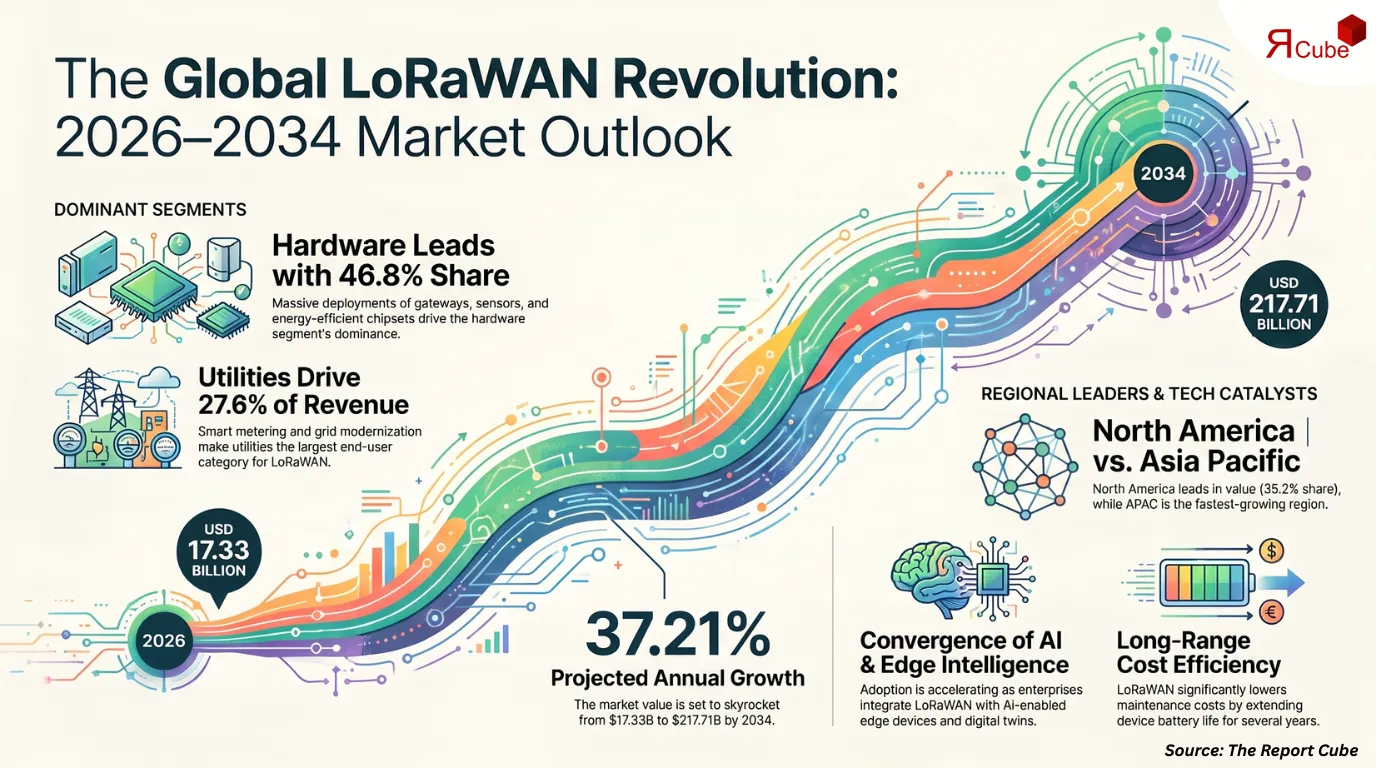
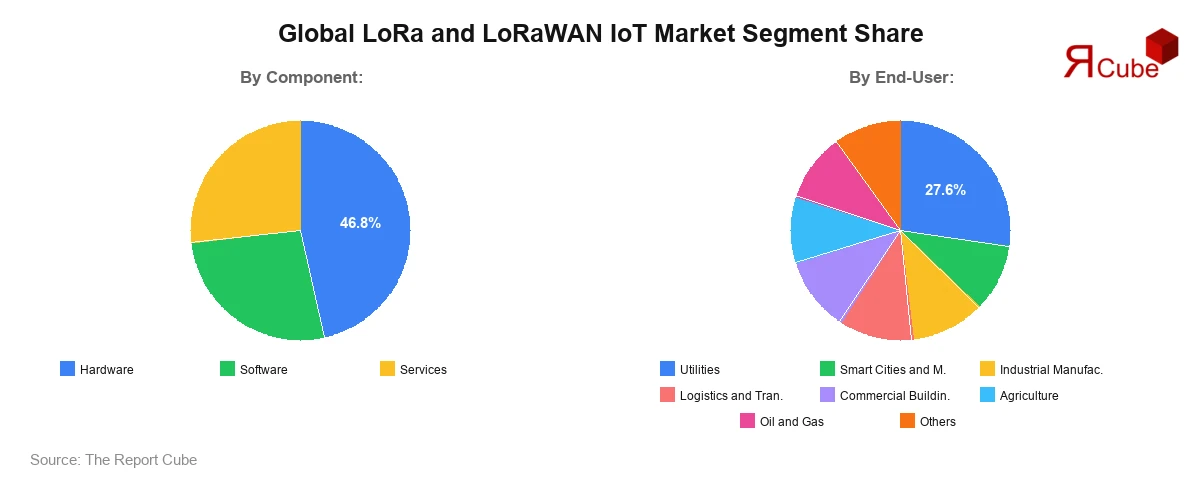
Hardware segment leads the market with approximately 46.8% share.
By End-User:
Utilities segment dominates the market with nearly 27.6% of total revenue.
Regional Outlook:
North America dominates the Global LoRa and LoRaWAN IoT Market with around 35.2% market share.
Global LoRa and LoRaWAN IoT Market Insights & Analysis
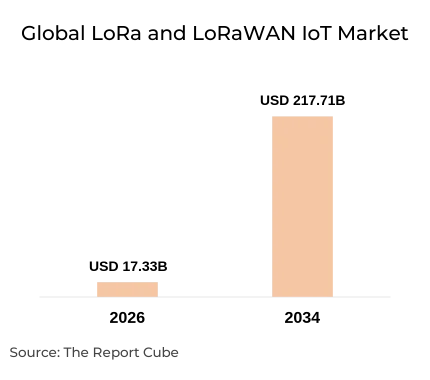
The Global LoRa and LoRaWAN IoT Market is anticipated to register a CAGR of around 37.21% during the forecast period 2026-2034. The market size is valued at USD 17.33 billion in 2026 and is projected to reach USD 217.71 billion by 2034. Strong momentum is being created by the rapid digitalization of critical infrastructure, where organizations require communication technologies capable of delivering secure, long-range connectivity with minimal energy consumption. Utilities, manufacturers, logistics providers, agricultural enterprises, and municipalities continue replacing legacy monitoring systems with connected sensor networks that generate real-time operational visibility. LoRaWAN has become a preferred low-power wide-area networking technology because it enables reliable communication across large geographic areas while extending device battery life for several years. This operational advantage significantly lowers maintenance costs and improves deployment economics, particularly for remote infrastructure where frequent battery replacement is impractical.
Commercial adoption has accelerated as enterprises increasingly integrate LoRaWAN networks with cloud computing, edge intelligence, digital twins, and predictive maintenance platforms. Semiconductor manufacturers continue introducing more energy-efficient chipsets, while network providers are strengthening interoperability and cybersecurity capabilities to support enterprise-scale deployments. During 2025 and 2026, numerous smart city initiatives expanded investments in intelligent lighting, environmental monitoring, connected parking, water conservation, and public utility modernization, creating sustained demand for scalable LPWAN infrastructure. The emergence of AI-enabled edge devices, satellite-supported LoRaWAN connectivity, and battery-free sensing technologies is also broadening deployment possibilities across transportation, mining, healthcare, and industrial manufacturing. These technology advancements continue strengthening the long-term growth outlook for the LoRa and LoRaWAN IoT Market.
Global LoRa and LoRaWAN IoT Market Impact Analysis
| Factor | Type | Specific Impact on Market | Magnitude | Business Implication |
|---|---|---|---|---|
| Explosive LPWAN Adoption | Market | Rapid LPWAN use in smart cities, industry, and utilities lifts LoRaWAN deployments worldwide. | High | Vendors must scale networks and solutions to capture high growth across priority verticals. |
| Smart City and Agriculture Demand | Consumer | Rising need for smart metering, agriculture, and environmental sensing drives device volumes. | High | Solution providers should build tailored vertical stacks and reference use cases for fast rollout. |
| Cost and Power Efficiency Advantage | Competitive | Low power and low total cost strengthen LoRaWAN versus cellular for many IoT projects. | High | Position offerings on lifetime cost savings and battery life to win price sensitive deployments. |
| Global Standardization and Ecosystem | Technological | Open standard status and large device base improve interoperability and partner innovation. | Medium | Firms should join alliances, certify products, and co innovate with ecosystem partners globally. |
| Security and Network Management Needs | Technological | Growing deployments raise concerns around secure connectivity and large scale device control. | Medium | Vendors can differentiate with robust security tools, device lifecycle and fleet management. |
| Geopolitical and Supply Chain Exposure | Environmental | Tariffs and regional tensions affect semiconductor supply and hardware availability timelines. | Medium | Requires diversified sourcing, regional manufacturing, and inventory buffers for resilience. |
| Competition from Other IoT Networks | Competitive | NB IoT, LTE M, and satellite options compete for similar low power connectivity budgets. | Medium | LoRa players must focus on coverage flexibility and hybrid architectures to defend share. |
Global LoRa and LoRaWAN IoT Market Dynamics
Key Driver: Increasing Investment in Smart Infrastructure and Industrial Digitalization
Governments and private organizations continue allocating substantial capital toward modernizing essential infrastructure through connected technologies. Smart electricity grids, intelligent water distribution systems, automated street lighting, environmental monitoring stations, and digital transportation networks increasingly depend on reliable long-range wireless communication. LoRaWAN provides an attractive solution because it combines extensive coverage, low power consumption, and cost-effective deployment, enabling organizations to monitor thousands of distributed assets without relying on expensive cellular connectivity. As infrastructure operators seek greater operational efficiency and sustainability, the adoption of LoRa-enabled sensing platforms continues to accelerate across both developed and emerging economies.
Industrial manufacturers are expanding connected factory initiatives to improve productivity, equipment reliability, and workplace safety. Thousands of wireless sensors are now deployed across production lines, warehouses, pipelines, storage facilities, and utility assets to capture operational data continuously. Maintenance teams can identify equipment anomalies before failures occur, reducing downtime and extending asset life. These measurable operational benefits have encouraged greater investment in private LoRaWAN networks, reinforcing sustained demand for hardware, software, and managed services throughout the forecast period.
Industry Trend: Convergence of Edge Intelligence, AI, and Private LoRaWAN Networks
Enterprise IoT strategies increasingly focus on processing operational data closer to connected devices rather than transmitting every data point to centralized cloud platforms. This architectural shift has accelerated the adoption of edge computing combined with artificial intelligence, allowing industrial facilities to perform anomaly detection, predictive maintenance, and automated decision-making with minimal communication latency. LoRaWAN serves as an efficient connectivity layer that delivers sensor data reliably while preserving battery performance, making it particularly valuable for large-scale industrial and municipal deployments.
Private LoRaWAN networks are also becoming a preferred communication infrastructure for manufacturing plants, airports, ports, universities, healthcare campuses, and logistics hubs. Organizations value the ability to retain complete operational control while strengthening cybersecurity and network availability. Hybrid deployments integrating terrestrial infrastructure with satellite connectivity are further extending network coverage into remote mining sites, agricultural operations, offshore facilities, and energy installations. These technological developments continue expanding the commercial value of LoRaWAN ecosystems across multiple industries.
Book your FREE 30-minute expert consultation today
Contact UsMajor Challenge: Complex Multi-Vendor Integration and Cybersecurity Requirements
Successful LoRaWAN deployment often requires seamless integration between gateways, sensors, cloud platforms, analytics software, enterprise applications, and cybersecurity frameworks. Many organizations operate equipment supplied by multiple technology vendors, making interoperability a critical implementation requirement. Maintaining consistent communication protocols, firmware compatibility, and secure device authentication across thousands of endpoints requires careful planning and specialized technical expertise. These integration challenges can increase deployment timelines, particularly for organizations migrating from legacy operational technology environments.
Cybersecurity continues to receive significant attention as connected infrastructure expands across energy, transportation, healthcare, manufacturing, and public services. Every connected endpoint represents a potential security risk if lifecycle management and encryption policies are not properly maintained. Organizations are therefore investing in secure device provisioning, end-to-end encryption, identity management, and continuous network monitoring. Although these investments improve long-term resilience, they also increase implementation costs and operational complexity, particularly for large enterprise deployments involving geographically distributed assets.
Opportunity: Expanding Adoption Across Agriculture, Environmental Monitoring, and Smart Utilities
Modern agricultural operations increasingly depend on connected sensing technologies to improve productivity while reducing water consumption, fertilizer use, and labor requirements. Soil moisture monitoring, weather observation, livestock tracking, irrigation control, and crop condition assessment have become important applications where LoRaWAN delivers strong technical and economic advantages. Long communication distances combined with extremely low power requirements make the technology particularly effective across extensive agricultural landscapes where conventional wireless infrastructure remains limited.
Environmental sustainability initiatives are creating additional opportunities for market participants. Governments, municipalities, and utility providers continue investing in connected air quality sensors, flood monitoring systems, wildfire detection networks, water leakage monitoring, and waste management solutions to improve public services and regulatory compliance. Integration with AI-powered analytics enables organizations to convert sensor data into actionable operational insights while improving resource utilization. As climate resilience and sustainable infrastructure remain strategic priorities worldwide, these applications are expected to generate significant long-term demand for LoRa and LoRaWAN technologies.
Global LoRa and LoRaWAN IoT Market Segment-wise Analysis
By Component:
- Hardware
- Chipsets
- Modules
- Sensors
- Antennas
- Gateways
- Meters
- End Nodes
- Trackers
- Others
- Software
- Device Management Platform
- Network Server
- Application Enablement Platform
- Analytics Software
- Security Software
- Others
- Services
- Consulting
- Installation and Integration
- Network Planning
- Managed Network Services
- Maintenance and Support
- Device Certification Support
- Others
The Hardware segment captured nearly 46.8% of the Global LoRa and LoRaWAN IoT Market in 2026, establishing itself as the leading component category. Large-scale deployment of gateways, sensors, modules, chipsets, and end nodes across utilities, manufacturing facilities, logistics networks, and smart city infrastructure continues to support hardware demand. Organizations are prioritizing energy-efficient devices capable of operating for several years on a single battery while delivering reliable long-range connectivity. This has encouraged semiconductor manufacturers to introduce highly integrated, compact, and low-power chipsets that improve network coverage, reduce deployment costs, and support millions of connected devices. Growing investments in smart metering, industrial automation, and environmental monitoring projects further reinforce hardware sales worldwide.
Hardware innovation remains a key competitive factor as enterprises seek scalable IoT infrastructure with enhanced reliability and simplified deployment. Manufacturers are introducing rugged gateways with higher processing capacity, multi-channel communication capabilities, and improved edge computing support to manage increasing device density across industrial environments. At the same time, advancements in antenna design and sensor technology are improving signal performance, accuracy, and energy efficiency in challenging operating conditions. As organizations continue expanding digital infrastructure and connected asset management programs, hardware is expected to maintain its dominant contribution to overall market revenue throughout the forecast period.
By End-User:
- Utilities
- Smart Cities and Municipalities
- Industrial Manufacturing
- Logistics and Transportation
- Commercial Buildings
- Agriculture
- Oil and Gas
- Retail and Warehousing
- Healthcare Facilities
- Others
The Utilities segment accounted for approximately 27.6% of global market revenue in 2026 and continues to represent the largest end-user category. Electricity, gas, and water utilities are rapidly replacing conventional infrastructure with connected smart meters and intelligent monitoring systems to improve operational efficiency and service reliability. LoRaWAN enables utilities to collect real-time consumption data, monitor distribution networks, identify equipment failures, and detect water leaks without requiring frequent battery replacement. These capabilities reduce maintenance costs while supporting regulatory objectives related to energy efficiency, resource conservation, and carbon emission reduction.
Utility providers are also investing in grid modernization initiatives that require secure, scalable communication across geographically distributed infrastructure. Connected transformers, substations, pressure monitoring systems, and renewable energy assets increasingly rely on LoRaWAN networks to deliver continuous operational visibility and predictive maintenance capabilities. Growing integration of distributed energy resources, battery storage systems, and smart grid technologies is further increasing demand for reliable low-power connectivity. Continued investment in digital utility infrastructure across developed and emerging markets is expected to strengthen the segment's revenue contribution during the forecast period.
Regional Projection of Global LoRa and LoRaWAN IoT Market
- North America
- Europe
- Asia Pacific
- Middle East and Africa
- South America
North America held approximately 35.2% of the Global LoRa and LoRaWAN IoT Market in 2026, supported by strong technology adoption across utilities, manufacturing, logistics, healthcare, and commercial infrastructure. Enterprises throughout the United States and Canada continue expanding private LoRaWAN networks to support predictive maintenance, industrial automation, connected campuses, and intelligent asset tracking. High investment in cloud computing, cybersecurity, artificial intelligence, and industrial IoT platforms has accelerated the deployment of scalable LPWAN solutions across multiple industries. The presence of leading semiconductor companies, network solution providers, and system integrators further strengthens regional market competitiveness.
Public infrastructure modernization programs continue creating favorable conditions for long-term market expansion across North America. Utility companies are accelerating smart metering rollouts, while municipalities are investing in connected street lighting, intelligent transportation systems, environmental monitoring, and water management solutions. Industrial organizations are also adopting edge computing and AI-enabled analytics to maximize the value of operational data generated through LoRaWAN networks. Continuous innovation, supportive regulatory initiatives, and sustained enterprise investment in digital transformation are expected to help North America maintain its leadership position in the global market through 2034.
Need insights for a specific region within this market?
Request Regional DataRegional Analysis of Global LoRa and LoRaWAN IoT Market
The global LoRa and LoRaWAN IoT market is expanding rapidly, with strong regional differences in ecosystem maturity, spectrum policy, and IoT use cases.
| Region | Demand Level | Key Areas | System Dominance | Core Demand Logic | Growth Nature |
|---|---|---|---|---|---|
| North America | Very High | US, Canada metro belts | Private & public LoRaWAN | Smart utilities, logistics, buildings | Upgrade‑led, platform driven |
| Europe | High | Germany, France, UK, Nordics | MNO LoRaWAN & shared infra | Smart metering, city infra, ESG | Policy‑driven, steady scale‑up |
| Asia Pacific | Extremely High | China, India, Japan, ASEAN | Nationwide LoRaWAN grids | Mass smart city and utilities | Fastest‑growing, volume led |
| Middle East & Africa | Medium | GCC hubs, South Africa | City‑scale and campus LoRaWAN | Smart city, oilfield, utilities | Project‑driven, emerging base |
| South America | Medium | Brazil, Mexico, Chile, Argentina | Operator and neutral LoRaWAN | Agritech, metering, urban pilots | Catching up, use‑case led |
Government Initiatives & Policies
- United States Smart Grid Investment Program (Grid Modernization): Federal funding continues supporting advanced metering infrastructure, intelligent grid communications, and utility modernization projects that create strong demand for LPWAN technologies, including LoRaWAN.
- European Union Digital Europe Programme (2025-2027): The program supports deployment of advanced digital infrastructure, smart communities, AI, cybersecurity, and IoT ecosystems, encouraging broader adoption of low-power connected devices across member states.
Global LoRa and LoRaWAN IoT Industry Recent Developments
- 2026: Browan Communications showcased AI-powered zone-level tracking during Mobile World Congress through a LoRa Alliance update. The solution demonstrated improved indoor positioning accuracy and reinforced enterprise demand for low-power location intelligence across industrial facilities, logistics operations, and commercial buildings.
- 2026: Dracula Technologies, ASYGN, and Semtech Corporation demonstrated a battery-free AI vision device connected through LoRaWAN during CES 2026. The solution combined energy harvesting, edge AI, and long-range connectivity to reduce battery maintenance while enabling intelligent monitoring for future IoT deployments.
- 2025: ZENNER announced that its LoRaWAN network surpassed 10 million connected sensors. The milestone highlighted increasing commercial adoption across smart metering, municipal infrastructure, environmental monitoring, and smart city projects while strengthening confidence in large-scale LPWAN deployments.
Why Choose This Report?
- Provides a comprehensive overview of the overall market analysis, encompassing key trends, consumer behavior analysis, and risk assessment to support strategic decision-making.
- Provides accurate, up-to-date insights into market size, segmentation, and emerging opportunities, helping to minimize risk while capitalizing on growth.
- Gives deep understanding of target audience preferences, investment habits, and communication channels for enhanced product development and marketing effectiveness.
- Delivers competitive analysis and benchmarking, uncovering the strengths and weaknesses of market competitors to guide strategic planning.
- Consolidates comprehensive market intelligence, reducing research effort while streamlining business planning.
- Facilitates customized market segmentation and risk mitigation strategies tailored to business objectives.
- Aids in identifying both market challenges and untapped opportunities within the industry to drive long-term business growth.
- Provides valuable information based on actual customer data, technology adoption trends, and market developments.
Table of Contents
- Introduction
- Objective of the Study
- Product and Category Definition
- Market Segmentation
- Study Variables
- Research Methodology
- Secondary Data Points
- Breakdown of Secondary Sources
- Primary Data Points
- Breakdown of Primary Interviews
- Secondary Data Points
- Executive Summary
- Market Dynamics
- Emerging Opportunities
- Adoption Trends
- Demand Drivers
- Disruption Analysis (Challenges)
- Industry Analysis & Strategic Insights
- Supply/Value Chain Analysis
- Pricing Analysis
- Go-To-Market (GTM) Strategy
- BCG Matrix
- Recent Trends and Developments
- Import and Export Analysis
- Regulatory and Policy Landscape
- Region-wise Policies
- Government Initiatives
- Global LoRa and LoRaWAN IoT Market Overview and Forecast Analysis (2021-2034)
- Market Size, By Value, By Growth Rate (CAGR/USD Billion)
- Market Share, By Component
- Services
- Maintenance and Support
- Consulting
- Device Certification Support
- Managed Network Services
- Installation and Integration
- Network Planning
- Others
- Software
- Security Software
- Analytics Software
- Application Enablement Platform
- Network Server
- Device Management Platform
- Others
- Services
- Market Share, By Network Type
- Hybrid Network
- Community Network
- Satellite-Enabled Network
- Private Network
- Public Network
- Market Share, By Deployment Model
- Agricultural Deployment
- Utility-Scale Deployment
- Outdoor Deployment
- Industrial Deployment
- Indoor Deployment
- Market Share, By Application
- Smart Agriculture
- Waste Management
- Asset Tracking
- Smart Lighting
- Industrial Monitoring
- Water Network Monitoring
- Logistics and Fleet Tracking
- Environmental Monitoring
- Smart Buildings
- Smart Metering
- Smart Cities
- Others
- Market Share, By End-User
- Retail and Warehousing
- Healthcare Facilities
- Industrial Manufacturing
- Agriculture
- Oil and Gas
- Commercial Buildings
- Logistics and Transportation
- Smart Cities and Municipalities
- Utilities
- Others
- Market Share, By Region
- North America
- Europe
- Asia Pacific
- Middle East and Africa
- South America
- Market Share, By Company
- Revenue Shares and Analysis
- Competitive Landscape
- North America LoRa and LoRaWAN IoT Market Overview and Forecast Analysis (2021-2034)
- Market Size, By Value, By Growth Rate (CAGR/USD Billion/Million)
- Market Share, By Component
- Market Share, By Network Type
- Market Share, By Deployment Model
- Market Share, By Application
- Market Share, By End-User
- Market Share, By Country
- United States
- Canada
- Mexico
- Rest of North America
- Europe LoRa and LoRaWAN IoT Market Overview and Forecast Analysis (2021-2034)
- Market Size, By Value, By Growth Rate (CAGR/USD Billion/Million)
- Market Share, By Component
- Market Share, By Network Type
- Market Share, By Deployment Model
- Market Share, By Application
- Market Share, By End-User
- Market Share, By Country
- Germany
- United Kingdom
- France
- Italy
- Spain
- Netherlands
- Russia
- Poland
- Belgium
- Sweden
- Rest of Europe
- Asia Pacific LoRa and LoRaWAN IoT Market Overview and Forecast Analysis (2021-2034)
- Market Size, By Value, By Growth Rate (CAGR/USD Billion/Million)
- Market Share, By Component
- Market Share, By Network Type
- Market Share, By Deployment Model
- Market Share, By Application
- Market Share, By End-User
- Market Share, By Country
- China
- India
- Japan
- South Korea
- Australia
- Indonesia
- Thailand
- Malaysia
- Vietnam
- Philippines
- Singapore
- New Zealand
- Rest of Asia Pacific
- Middle East and Africa LoRa and LoRaWAN IoT Market Overview and Forecast Analysis (2021-2034)
- Market Size, By Value, By Growth Rate (CAGR/USD Billion/Million)
- Market Share, By Component
- Market Share, By Network Type
- Market Share, By Deployment Model
- Market Share, By Application
- Market Share, By End-User
- Market Share, By Country
- Saudi Arabia
- United Arab Emirates
- South Africa
- Egypt
- Nigeria
- Morocco
- Turkey
- Rest of Middle East and Africa
- South America LoRa and LoRaWAN IoT Market Overview and Forecast Analysis (2021-2034)
- Market Size, By Value, By Growth Rate (CAGR/USD Billion/Million)
- Market Share, By Component
- Market Share, By Network Type
- Market Share, By Deployment Model
- Market Share, By Application
- Market Share, By End-User
- Market Share, By Country
- Brazil
- Argentina
- Chile
- Colombia
- Peru
- Rest of South America
- Competitive Analysis, 2026
- Market Share of Key Players
- Competitive Mapping for Each Segment and Companies Operating Regionally
- North America LoRa and LoRaWAN IoT Companies Share and Competitive Analysis, 2026
- Europe LoRa and LoRaWAN IoT Companies Share and Competitive Analysis, 2026
- Asia Pacific LoRa and LoRaWAN IoT Companies Share and Competitive Analysis, 2026
- Middle East and Africa LoRa and LoRaWAN IoT Companies Share and Competitive Analysis, 2026
- South America LoRa and LoRaWAN IoT Companies Share and Competitive Analysis, 2026
- Company Profile (Partial List)
- Advantech Co., Ltd.
- Company Overview
- Product Portfolio
- Strategic Alliances and Partnerships
- Recent Developments
- Seeed Technology Co., Ltd.
- Company Overview
- Product Portfolio
- Strategic Alliances and Partnerships
- Recent Developments
- Semtech Corporation
- Company Overview
- Product Portfolio
- Strategic Alliances and Partnerships
- Recent Developments
- OrbiWise SA
- Company Overview
- Product Portfolio
- Strategic Alliances and Partnerships
- Recent Developments
- Murata Manufacturing Co., Ltd.
- Company Overview
- Product Portfolio
- Strategic Alliances and Partnerships
- Recent Developments
- Cisco Systems, Inc.
- Company Overview
- Product Portfolio
- Strategic Alliances and Partnerships
- Recent Developments
- The Things Industries B.V.
- Company Overview
- Product Portfolio
- Strategic Alliances and Partnerships
- Recent Developments
- TEKTELIC Communications Inc.
- Company Overview
- Product Portfolio
- Strategic Alliances and Partnerships
- Recent Developments
- Kerlink SA
- Company Overview
- Product Portfolio
- Strategic Alliances and Partnerships
- Recent Developments
- Actility S.A.
- Company Overview
- Product Portfolio
- Strategic Alliances and Partnerships
- Recent Developments
- Everynet B.V.
- Company Overview
- Product Portfolio
- Strategic Alliances and Partnerships
- Recent Developments
- STMicroelectronics N.V.
- Company Overview
- Product Portfolio
- Strategic Alliances and Partnerships
- Recent Developments
- UnaBiz Holdings Pte. Ltd.
- Company Overview
- Product Portfolio
- Strategic Alliances and Partnerships
- Recent Developments
- MOKO Technology Ltd.
- Company Overview
- Product Portfolio
- Strategic Alliances and Partnerships
- Recent Developments
- Laird Connectivity
- Company Overview
- Product Portfolio
- Strategic Alliances and Partnerships
- Recent Developments
- Microchip Technology Inc.
- Company Overview
- Product Portfolio
- Strategic Alliances and Partnerships
- Recent Developments
- Milesight Technology Co., Ltd.
- Company Overview
- Product Portfolio
- Strategic Alliances and Partnerships
- Recent Developments
- MultiTech Systems, Inc.
- Company Overview
- Product Portfolio
- Strategic Alliances and Partnerships
- Recent Developments
- Dragino Technology Co., Ltd.
- Company Overview
- Product Portfolio
- Strategic Alliances and Partnerships
- Recent Developments
- Senet, Inc.
- Company Overview
- Product Portfolio
- Strategic Alliances and Partnerships
- Recent Developments
- Others (Partial List)
- Advantech Co., Ltd.
- Contact Us and Disclaimer
Top Key Players & Market Share Outlook
- Advantech Co., Ltd.
- Seeed Technology Co., Ltd.
- Semtech Corporation
- OrbiWise SA
- Murata Manufacturing Co., Ltd.
- Cisco Systems, Inc.
- The Things Industries B.V.
- TEKTELIC Communications Inc.
- Kerlink SA
- Actility S.A.
- Everynet B.V.
- STMicroelectronics N.V.
- UnaBiz Holdings Pte. Ltd.
- MOKO Technology Ltd.
- Laird Connectivity
- Microchip Technology Inc.
- Milesight Technology Co., Ltd.
- MultiTech Systems, Inc.
- Dragino Technology Co., Ltd.
- Senet, Inc.
- Others
Frequently Asked Questions






